Crime & Law
Trump Asks Supreme Court to Allow Him to Immediately Deploy National Guard in Chicago
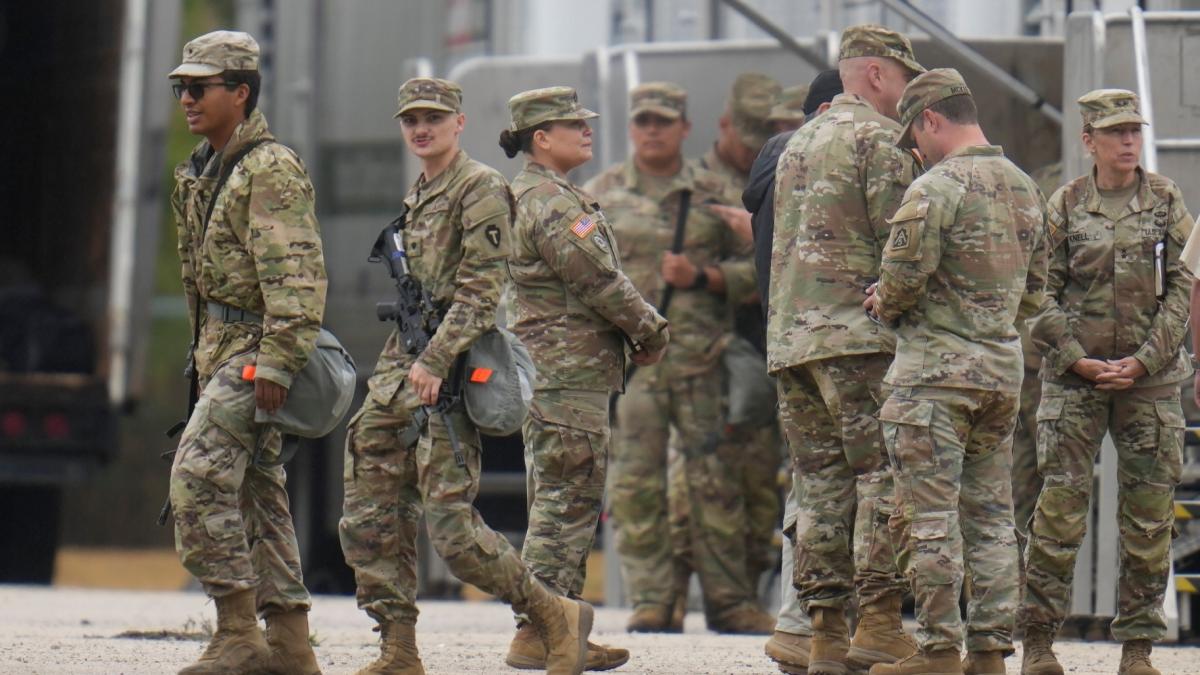 Military personnel in uniform, with the Texas National Guard patch on, are seen at the U.S. Army Reserve Center, Tuesday, Oct. 7, 2025, in Elwood, Ill., a suburb of Chicago. (AP Photo/Erin Hooley)
President Donald Trump asked the U.S. Supreme Court on Friday to allow him to immediately deploy 700 National Guard troops into Chicago.
The emergency appeal came eight days after a federal judge temporarily blocked “the federalization and deployment” of 300 members of the Illinois National Guard, 200 members of the Texas National Guard and 14 members of the California National Guard into Illinois.
However, the Trump administration told the Supreme Court that it wanted to deploy 300 members of the Illinois National Guard and 400 members of the Texas National Guard.
“All of those soldiers will serve under federal command and will be deployed solely in a protective capacity — not to engage in civilian law enforcement functions,” the emergency request said.
Lawyers for the state and the city have until 5 p.m. Monday to respond.
“Donald Trump will keep trying to invade Illinois with troops — and we will keep defending the sovereignty of our state,” Gov. JB Pritzker said on social media. “Militarizing our communities against their will is not only un-American but also leads us down a dangerous path for our democracy. What will come next?”
In Illinois, Deputy Assistant Attorney General Eric Hamilton declined to tell U.S. District Court Judge April Perry that National Guard troops would be limited to protecting federal property or federal agents carrying out their duties, saying the president’s judgement on how to deploy the troops was unreviewable.
The president has repeatedly vowed to use National Guard troops to fight crime in Chicago, which he has denigrated as a “hell hole” and a “war zone.”
There is ample evidence that there is rebellion, or the danger of rebellion, in Illinois, lawyers for the Department of Justice told the Supreme Court.
“In response to lawful immigration enforcement efforts, agitators have specifically targeted federal property and officials with violence, intimidation, and threats—and, if it were required, there is ample evidence of orchestrated and coordinated attacks, going well beyond merely spontaneous outbursts,” according to the application.
The conservative-dominated court has handed Trump repeated victories in emergency appeals since he took office in January, after lower courts have ruled against him and often over the objection of the three liberal justices. The court has allowed Trump to ban transgender people from the military, claw back billions of dollars of congressionally approved federal spending, move aggressively against immigrants and fire the presidentially appointed leaders of independent federal agencies.
The Trump administration previously appealed Perry’s order blocking the National Guard deployment to the 7th U.S. Circuit Court of Appeals, which allowed Perry’s ruling blocking the deployment of National Guard troops in Illinois to stand, while halting her order stopping Trump from federalizing those troops.
A three-judge appeals court panel made up of Judge Amy St. Eve, Judge Ilana Kara Diamond Rovner and Judge David Hamilton on Thursday rejected the Trump administration’s request to overturn Perry’s order.
Read the appeals’ court’s full decision.
“Political opposition is not rebellion,” the panel wrote. “A protest does not become a rebellion merely because the protestors advocate for myriad legal or policy changes, are well organized, call for significant changes to the structure of the U.S. government, use civil disobedience as a form of protest, or exercise their Second Amendment right to carry firearms as the law currently allows. Nor does a protest become a rebellion merely because of sporadic and isolated incidents of unlawful activity or even violence committed by rogue participants in the protest. Such conduct exceeds the scope of the First Amendment, of course, and law enforcement has apprehended the perpetrators accordingly. But because rebellions at least use deliberate, organized violence to resist governmental authority, the problematic incidents in this record clearly fall within the considerable daylight between protected speech and rebellion.”
Nor has Trump been “unable with the regular forces to execute the laws of the United States,” the standard set for deploying the National Guard over the objections of local officials, since immigration enforcement arrests occur and courts are functioning normally, according to the panel’s ruling.
The decision means that the hundreds of National Guard troops will remain at a military facility near Joliet, where they arrived Oct. 7, but are blocked by Perry’s order from doing anything other than training on land controlled by the federal government.
“The spirited, sustained, and occasionally violent actions of demonstrators in protest of the federal government’s immigration policies and actions, without more, does not give rise to a danger of rebellion against the government’s authority,” the panel wrote.
Even as a lengthy legal battle grinds on, immigration agents have continued to carry out the Trump administration’s combative immigration enforcement operation dubbed “Operation Midway Blitz.”
‘Unreliable’ Assertions by the Trump Administration
Although lawyers for the state of Illinois and city of Chicago had asked Perry to block Trump from deploying the military into Illinois, she found that there had not been sufficient evidence presented that the president planned to take that step.
The Posse Comitatus Act, which dates to 1878, is a criminal law that bars the use of the military for domestic policing.
Trump has said he would consider enacting the Insurrection Act, which allows presidents to deploy the U.S. military within the country in response to what is determined to be an insurrection against the government, if judges block his deployment of National Guard troops to Illinois and Portland, Oregon.
“So far it hasn’t been necessary, but we have an Insurrection Act for a reason. If I had to enact it, I’d do that,” Trump said earlier this month. “If people were being killed and courts were holding us up, or governors, or mayors were holding us up, sure I’d do that.”
In her initial ruling, Perry said she found federal officials’ assertions that federal agents had been subjected to serious and coordinated violence by protestors “unreliable.”
Perry wrote that she took note of “a troubling trend of Defendants’ declarants equating protests with riots and a lack of appreciation for the wide spectrum that exists between citizens who are observing, questioning, and criticizing their government, and those who are obstructing, assaulting, or doing violence.”
“This indicates to the Court both bias and lack of objectivity,” Perry wrote.
Perry also concluded that she could not “find reasonable support for a conclusion that there exists in Illinois a danger of rebellion satisfying the demands” of the federal law allowing the president to federalize the National Guard.
“The unrest Defendants complain of has consisted entirely of opposition (indeed, sometimes violent) to a particular federal agency and the laws it is charged with enforcing. That is not opposition to the authority of the federal government as a whole,” Perry wrote. “Defendants have offered no explanation supporting the notion that widespread opposition to immigration enforcement constitutes the makings of a broader opposition to the authority of the federal government.”
Perry, who was appointed by former President Joe Biden, was first tapped to serve as the U.S. attorney for the Northern District of Illinois. Her confirmation to that post was blocked by former U.S. Sen. JD Vance, who is now vice president.
‘Countermanding the President’s Military Judgment’: Feds
During the historic Oct. 9 hearing, Deputy Assistant Attorney General Eric Hamilton repeatedly asserted that Perry must give the president’s determination that the deployment of the National Guard is necessary “great deference.”
“The president’s judgement is unreviewable,” Hamilton said.
In its appeal, the Trump administration said Perry had misapplied the law.
“In countermanding the president’s military judgment, the district court largely ignored the facts on the ground, relied on an improper … factual investigation, and rested on an adverse ‘credibility’ finding that had no basis in the record,” according to lawyers for the Trump administration.
Perry scheduled the next hearing in the case for 9 a.m. Oct. 22, when she said she will consider extending the temporary restraining order she issued for an additional 14 days before the initial order expires at 11:59 p.m. Oct. 23.
Nearly 2,500 federalized National Guard troops from several states led by Republicans have been in Washington, D.C., since August.
While the president has credited those troops with lowering crime in the nation’s capital, crime data shows no significant drop in violent crime, records show. National Guard members have picked up trash and helped package meals for unhoused residents, according to the Associated Press.
A lawsuit brought by D.C.’s attorney general is challenging the deployment, with a hearing scheduled for Oct. 24.
Of the more than 4,000 National Guard troops and 700 U.S. Marines sent to Los Angeles, approximately 100 California National Guard members remain under federal authority, officials said, including the 14 soldiers sent to Illinois to provide “training and subject matter expertise.”
Los Angeles and California officials challenged that deployment in federal court. A judge found not only was it illegal, but the activities of the military violated the Posse Comitatus Act. That order has been halted by an appeals court, but the litigation remains ongoing.
Trump has also ordered National Guard troops to Portland, Oregon, despite Gov. Tina Kotek’s objections.
U.S. District Court Judge Karin Immergut, a Trump appointee, said the president’s claims of daily unrest in Portland were “untethered to facts” and risked violating the U.S. Constitution by imposing military rule. Immergut has temporarily blocked the deployment of National Guard troops into Portland.
A three-judge panel of the 9th U.S. Circuit Court of Appeals could decide at any time whether to overturn Immergut’s ruling, which she extended for another 14 days on Wednesday.
The Associated Press contributed to this report.
Contact Heather Cherone: @HeatherCherone | (773) 569-1863 | [email protected]