Politics
Federal Judge Temporarily Blocks National Guard Deployment in Chicago Area
Video: Joining “Chicago Tonight” are Harold Krent, law professor at the Chicago-Kent College of Law; and Brandon Smith, partner at Holtzman Vogel, a national law firm that focuses on government, business and advocacy. (Produced by Blake Thor)
A federal judge on Thursday temporarily blocked President Donald Trump from deploying 200 members of the Texas National Guard alongside 300 members of the Illinois National Guard and 14 members of the California National Guard to the Chicago area.
“I see no credible evidence there is a danger of rebellion in the state of Illinois,” U.S. District Court Judge April Perry said from the bench late Thursday.
Perry scheduled the next hearing in the case for 9 a.m. Oct. 22, when she said she will consider extending it for an additional 14 days before the initial order expires at 11:59 p.m. Oct. 23.
Perry also blocked the Trump administration from sending National Guard troops from any other state into Illinois, handing Gov. JB Pritzker and Mayor Brandon Johnson, who vehemently opposed the deployment, what appeared to be a resounding victory.
“There is no evidence that the president is unable, with the regular forces, to execute the laws of the United States,” Perry said.
Pritzker said there was no place for National Guard troops in Chicago.
“Donald Trump is not a king — and his administration is not above the law,” Pritzker said in a statement. “Today, the court confirmed what we all know: there is no credible evidence of a rebellion in the state of Illinois.”
Johnson said the “ruling is a win for the people of Chicago and the rule of law.”
“Trump’s deployment is illegal, unconstitutional, dangerous, and unnecessary,” Johnson said. “There is no rebellion in Chicago. There are just good people standing up for what is right.”
The Trump administration appealed Perry’s ruling early Friday morning, sending the dispute to the 7th Circuit Court of Appeals.
If the Trump administration deploys the National Guard, it is “likely to lead to civil unrest,” Perry said.
National Guard troops from Texas and federal officials would be unable to “appreciate” the complexity of the “strained” relations between Chicagoans and members of law enforcement, making the possibility of permanent damage a significant threat, Perry said.
In her oral ruling, Perry rejected the central argument advanced by lawyers for the Trump administration: that the president’s determination that there was a danger of rebellion in Illinois.
Federal law permits the federalization of guard troops in three instances, “not whenever (the president) determines when one of them is met,” Perry said.
In addition, Perry said she found federal officials’ assertions that federal agents had been subjected to serious and coordinated violence by protestors “simply unreliable.” Much of the hearing centered on events at the Broadview ICE facility, where protesters have been tear-gassed and shot with pepper pellets by federal agents after trying to block the agency’s operations.
Perry spent the bulk of the nearly three-hour hearing pressing Deputy Assistant Attorney General Eric Hamilton on the Trump administration’s assertion that incidents of violence around protests at an Immigration and Customs Enforcement facility in west suburban Broadview and in response to federal agents’ efforts to detain those they believe to be in the country illegally in Chicago presents a “danger of rebellion.”
Trump deployed the National Guard to Illinois and must be allowed to send them into Chicago to confront an “urgent and serious ongoing threat to officer safety” as well as the need to protect federal facilities, Hamilton said.
“It doesn’t have to be a literal rebellion,” Hamilton said, telling Perry repeatedly that her ability to review the president’s action was severely limited. “The president’s judgement is unreviewable.”
Assistant Attorney General Christopher Wells, arguing for the Illinois Attorney General’s office, said the president’s order “threatens the careful balance of our constitutional system,” and that there “is no rebellion in Illinois.”
The president’s actions are not motivated by a desire to enforce federal immigration law or reduce crime, Wells said. Instead, the president is motivated by his long-standing animus toward Chicago and a desire to punish his political rivals with a “a pattern of conduct that is terrifying.”
“The president’s power is not unlimited,” Wells said, his voice thick with emotion. “This court can check that power.”
Since federal officials are still enforcing federal laws, there is no need for the National Guard to be deployed, Wells said, pointing to the fully functioning courthouse that hosted Thursday’s hearing.
Perry pushed Hamilton to detail how many National Guard troops could be deployed to Chicago and what they would be asked to do.
While 500 National Guard troops are just outside the city, Hamiltion declined to tell Perry how many more could be sent to Illinois or where exactly they would be deployed.
“The filing says the troops will be deployed primarily in Cook County,” Perry said. “I don’t see that as having any guardrails.”
Nor would Hamilton tell Perry whether the troops would be charged with crowd and traffic control, whether they would be allowed to patrol the streets with weapons or whether they would be allowed to pursue individuals or vehicles.
“We can’t predict what might be necessary,” Hamilton said.
The Posse Comitatus Act, which dates to 1878, is a criminal law that bars the use of the military for domestic policing.
Hamilton once again asserted that Perry must give the president’s determination that the deployment of the National Guard is necessary “great deference.”
Perry also pressed Hamilton on the stark differences between assertions made by lawyers for the president, who told her National Guard troops will protect federal property and federal agents while allowing them to carry out their duties, while the president has repeatedly vowed National Guard troops will fight crime.
When Hamilton declined to tell her that National Guard troops would not be limited to protecting federal property or federal agents carrying out their duties, Perry seemed taken aback.
“We would be in a very different position,” if you were arguing the National Guard was just here to defend federal property and agents enforcing immigration law, Perry said.
“I am very much struggling to figure out where this would ever stop,” Perry said.
Perry pointed out discrepancies between the federal government’s description of the protests at Broadview with how the Broadview Police Department and Illinois State Police characterized them.
“What if (the president) is relying on invalid evidence?” Perry asked.
Perry also asked Hamilton whether the president had the authority to call up the National Guard if, as state and local leaders assert, it is the federal agents who are causing the violence with the tactics they are using to enforce federal immigration law.
Hamilton said it would not matter.
Efforts by federal prosecutors to indict a number of people charged with criminal violations during those protests in recent weeks have been rejected by grand juries, including one during Thursday’s lengthy hearing.
Lawyers for the Trump administration cited the arrest of a Chicago couple that were armed during a protest outside the Broadview ICE facility was evidence that the National Guard was needed.
But Perry pointed out that the couple were legally carrying guns, as permitted under the Second Amendment to the Constitution. A grand jury declined to indict them on Tuesday, and the charges against them were dismissed.
Department of Justice lawyers did not include those facts in their filings, a decision that Perry said hurt their credibility and undermined the value of their arguments.
Perhaps the sharpest exchange of the hearing came when Perry said the government’s definition of rebellion would mean “literally all nonviolent protest” could be considered evidence of an insurrection.
“The court doesn’t have to decide what a rebellion is,” Hamilton responded.
“I think I do,” Perry said.
Perry sounded skeptical that “petty acts of vandalism,” including “slashed tires” and “keyed cars” would be significant enough to serve as evidence that there was a danger of rebellion.
“Some of this frankly sounds like a Carrie Underwood song,” Perry said, prompting Hamilton, his voice rising in anger, detailing what he called the serious assaults suffered by federal agents and against federal property.
Perry asked for more information about the agent who lawyers alleged “had his beard ripped off” and the discovery of an alleged “improvised explosive device” outside the Broadview ICE facility.
Hamilton said he had no more information to add to the government’s filing, but again reminded her that she must defer to the president’s judgement.
Perry questioned Hamilton closely about whether the fact that federal drug laws have been violated repeatedly for decades in Chicago.
“Riddle me this,” Perry said. “Has the president had the authority for decades to deploy the National Guard here?”
Perry also noted that Attorney General Pam Bondi has said the Illinois law and Chicago ordinance designed to protect undocumented immigrants from deportation violate federal law, and asked whether that determination could give the president the authority to deploy the National Guard.
A federal judge rejected those arguments from the Trump administration earlier this year.
500 National Guard Troops Outside Chicago
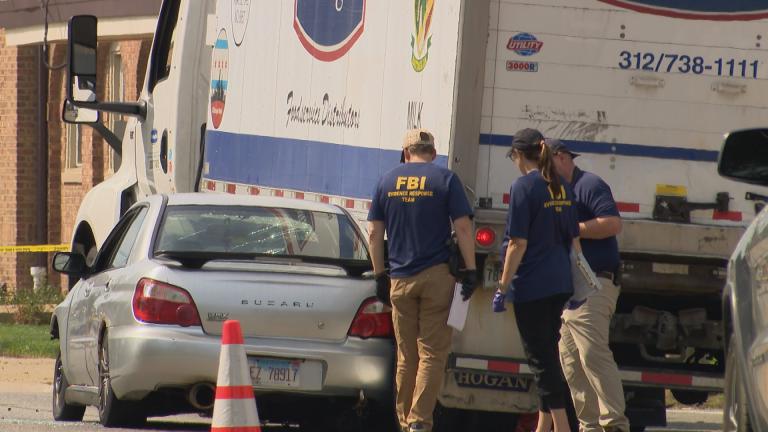
A day after members of the Texas National Guard landed at a military facility near Joliet, 45 soldiers arrived late Wednesday at the ICE processing facility in west suburban Broadview, a spokesperson for the village said in a statement.
“Police officers observed the vans parked in the rear of 2000 25th Ave. and all of the guards were sleeping,” spokesperson David Ormsby said.
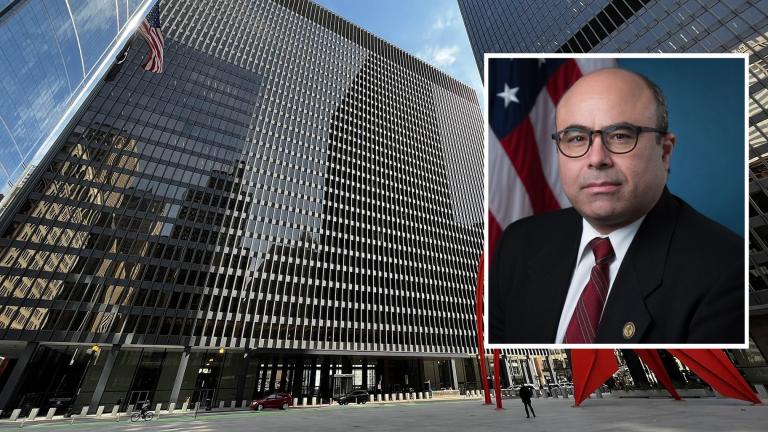
In their late-night filing, lawyers for the Trump administration said officials planned to deploy National Guard troops to the U.S. Dirksen Federal Courthouse on Friday at the request of federal officials.
Juan Espinoza Martinez, who federal prosecutors claim is a “ranking member” of the Latin Kings gang, is scheduled to appear at the Dirksen courthouse for a detention hearing. Martinez has been charged with soliciting the murder of Border Patrol Chief Greg Bovino.
In addition, Marimar Martinez, shot by federal agents, with ramming a vehicle driven by an U.S. Customs and Border Protection agent in Brighton Park on Saturday morning is scheduled to appear for a preliminary hearing.
However, Chief Judge Virigina Kendall said in a statement she had not asked for additional security at the courthouse, which has been surrounded by black iron gates for more than a month.
“At no point did I, or the Building Security Committee, authorize or request the National Guard’s assistance to secure the Dirksen Courthouse,” Kendall said in a statement.
After Perry ordered lawyers for the Trump administration to provide additional evidence that they received a request for National Guard troops, federal officials reversed course.
Trump administration officials argued that National Guard troops must be deployed to Chicago because there is “a danger of a rebellion against federal authority” that impedes “the ability of federal officials to enforce federal law,” lawyers for the Trump administration told the judge.
“Plaintiffs ask the court to second-guess the president’s judgment of the current situation in Illinois and exercise supervisory authority over his deployment of federalized Guardsmen, with the potential of putting federal officers (and others) in harm’s way,” according to lawyers for the Trump administration. “But responsibility, and accountability, for those decisions should rest with the political branches of the federal government, not this court.”
But lawyers for the state and the city accused federal officials of overstating the threat and noted that the head of operations for ICE at Broadview praised efforts led by the Illinois State Police to keep protests from spiraling out of control by creating designated zones where protests are allowed and preventing demonstrators from blocking federal operations.
“The memo specifies no triggering event to support such a finding and instead speaks in hypothetical and future terms,” lawyers for the state and city wrote. “There simply has been no incident, or series of incidents, where the president has been unable to execute federal law, much less any broader circumstance warranting federalized troops.”
No more than 20 protestors have been present outside the facility at any given time from Oct. 5 through Thursday, according to the lawyers.
“Twenty people simply do not pose a ‘danger of rebellion’ or nor do they ‘impede’ a federal agency that includes 80,000 law enforcement officers from doing their job,” according to state and city lawyers.
Community organizations have been working to identify the location of federal agents in Chicago neighborhoods to warn undocumented immigrants of their presence. Groups have distributed whistles and created text and phone networks to sound the alarm.
Federal agents have been repeatedly heckled and confronted by Chicagoans objecting to the Trump administration’s aggressive immigration enforcement operation dubbed “Operation Midway Blitz.”
The lawsuit accuses federal officials of using “unprecedented, brute force tactics for civil immigration enforcement.
“The community’s horror at these tactics and their significant consequences have resulted in entirely foreseeable protests,” according to state and city lawyers.
Illinois and Chicago officials reacted with fury to the news that members of the California National Guard, which have been under federal control since June, had been sent to Illinois. The 14 members of the California National Guard in Illinois “are not anticipated to perform missions beyond providing training and subject matter expertise,” according to Trump administration lawyers.
The Trump administration attempted to send California National Guard troops to Oregon but was blocked by a federal judge.
“This lawless targeting by the president and his administration of people and places he does not favor will not stop without court intervention,” lawyers representing Illinois and Chicago told the judge. “The court can and should stop this authoritarian march. We remain a nation of laws.”
During an initial hearing on Monday, Perry warned federal officials about deploying the National Guard before she had a chance to rule on the state and city’s request for a temporary restraining order.
“If I were the government, I might strongly consider taking a pause on this until Thursday,” Perry said.
Federal officials did not heed that warning, state and city lawyers told Perry.
Instead, “defendants hit the accelerator,” they told Perry.
“(The) Trump administration has continued its purposeful defiance of the lawful bounds of its power to create a federal military occupation of Illinois,” state and city lawyers told Perry. “Indeed, in the past few days, the president has repeated his disdain for any guardrails on those powers.”
Trump called early Wednesday morning for Johnson and Pritzker to be jailed, asserting without evidence the two Democrats failed to protect a federal immigration officer. That claim was repeated by lawyers for the government in response to the city’s request for a temporary restraining order.
Trump said Monday he would consider enacting the Insurrection Act, which allows presidents to deploy the U.S. military within the country in response to what is determined to be an insurrection against the government, if judges block his deployment of National Guard troops to Illinois and Portland, Oregon.
“So far it hasn’t been necessary, but we have an Insurrection Act for a reason. If I had to enact it, I’d do that,” Trump said. “If people were being killed and courts were holding us up, or governors, or mayors were holding us up, sure I’d do that.”
Contact Heather Cherone: @HeatherCherone | (773) 569-1863 | [email protected]