Politics
Chicago Community Groups Say Expected Troop Deployment Will Heighten Fears, Create Chaos
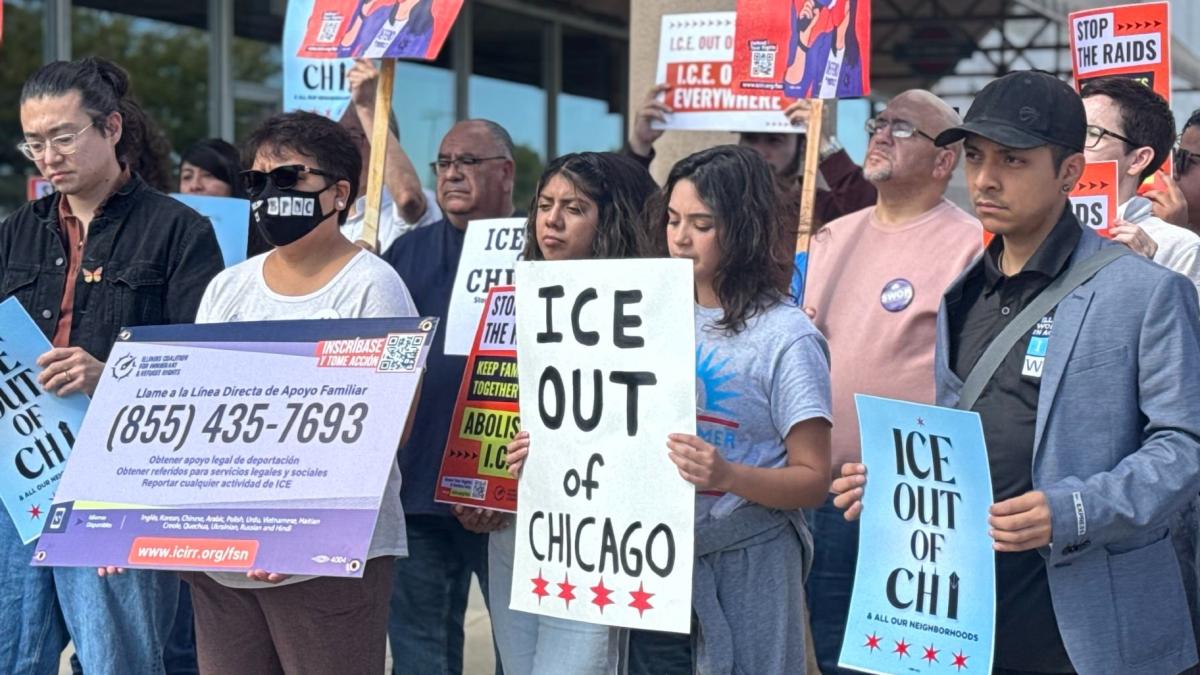 The Illinois Coalition for Immigrant and Refugee Rights holds a news conference on Sept. 25, 2025, in response to ICE’s activity on the Southwest Side. (Courtesy of the Illinois Coalition for Immigrant and Refugee Rights)
As federal immigration agents continue operations in the Chicago area and with plans to deploy National Guard troops in motion, community organizations across the city say they are working overtime to protect the rights of immigrants.
President Donald Trump plans to deploy 400 members of the Texas National Guard and 300 members of the Illinois National Guard to the area any day. Illinois Gov. JB Pritzker and Chicago Mayor Brandon Johnson have asked a federal judge to block that move, but U.S. District Court Judge April Perry declined to immediately issue a restraining order and will hold a full hearing Thursday.
Meanwhile, lawyers for the Trump administration said in court that troops could hit area streets as soon as Tuesday. Community groups who work with Chicago’s immigrant populations said Monday that deployment is an unnecessary escalation that will likely bring more chaos amid continuing raids and tense protests.
Illinois Coalition for Immigrant and Refugee Rights Communications Director Brandon Lee said a deployment of the National Guard to Chicago would be an escalation of an already “harmful, hateful operation” against communities by federal immigration agents.
Lee pointed to federal immigration officials conducting a middle-of-the-night raid in South Shore, in addition to killing Silverio Villegas González in Franklin Park.
“What they’re doing is not bringing safety into our communities — it’s bringing more chaos,” Lee said. “It’s bringing more violence into our communities.”
The coalition’s goal will be to continue to make sure that community members know their rights, that communities look out for each other and that elected officials take proactive measures to protect communities in Illinois, according to Lee.
The organization runs a family support network hotline that people can call to report ICE activity and receive legal support and social service resources if someone in their family is taken by immigration officials. The hotline has typically seen 200 to 400 calls on a daily basis since heightened operations began in the beginning of September, said Lee.
This past Friday saw more than 800 calls to the hotline, the most calls the organization has seen this year, Lee said.
“More and more people are seeing the harm that ICE and DHS are inflicting on all people in Chicago and in Illinois,” Lee said. “People see that this is not something that is just affecting a few people in one part of the city — this operation stretches far and wide with their disruption and their violence.”
Disruption is also something Little Village Community Council President Baltazar Enriquez expects more of with the National Guard coming to Chicago, saying troops on the city’s streets would add “another layer of trauma” that his heavily Latino community is already experiencing amid what Enriquez describes as ICE “profiling” and the “kidnapping” of community members.
“These are not criminals,” Enriquez said. “These are people waiting for the bus, going to work. These are people selling tamales, people taking their kids to school.”
Amid the fear during heightened immigration enforcement efforts, Enriquez said he is also concerned about an increase in mental health issues, such as anxiety attacks and depression.
“A lot of the businesses are losing business, and once they don’t have business, they start laying off people,” Enriquez said. “People are also afraid to go to work, they’re afraid to come out. With the National Guard, it’s gonna be more frightening.”
Instead of the National Guard, Enriquez said he wants more resources to support jobs, to fight crime and improve the quality of education for youth.
Patrol teams with the Little Village Community Council start patrolling the neighborhood around 6 a.m. and blow whistles if they see ICE agents to inform the community, according to Enriquez. The organization also plans on starting what Enriquez calls a “magic bus” initiative, where people will help walk children to and from school, in addition to the implementation of “block captains” who watch the neighborhood block-by-block.
“We’ve been organizing, and we’re gonna organize more,” Enriquez said. “We’re gonna protest peacefully, we’re going to continue educating our people.”
Instead of sending in the National Guard, ACLU of Illinois spokesperson Ed Yohnka said there’s an easy way to reduce tensions in Chicago: ICE can stop engaging in what he calls “violent and reckless” behavior.
“The violence, the concern that’s been created, it’s been created by ICE, not by the public,” Yohnka said.
Yohnka emphasized that constitutional rights still apply to dealing with federal agents: the right to remain silent, to ask for a lawyer, to decline to consent to a search of yourself, your car or your home.
The National Guard is not to engage in policing activities, a federal judge ruled in September over the deployment of troops into Los Angeles. The National Guard also cannot engage in immigration enforcement, Yohnka said.
“There is no reason for this to happen in much the same way that in LA the National Guard came in, many of them just stood around and didn’t do anything,” Yohnka said. “In D.C., they’ve ended up engaged in a host of other activities that have nothing to do with what the guards’ traditional role is.”
Part of the National Guard’s D.C. deployment included the sweeps of homeless camps — a concern for Doug Schenkelberg, executive director of the Chicago Coalition to End Homelessness.
“[The National Guard was] coming in with little notice, taking people’s property, destroying people’s property, forcing them to move,” Schenkelberg said. “That’s a worst-case scenario that we’re obviously on alert for.”
The number of homeless Chicagoans is at an all-time-high, even after a 60% drop from last year, according to the city’s annual survey. Undocumented people are disproportionately represented in the homeless population, Schenkelberg said.
The coalition has been preparing for these troops by distributing “know your rights” information to those unsheltered and service providers, providing bus cards and helping people find storage for their items.
“Communication is really, really critical amongst the various people and organizations that work with those who are unhoused … so that people can get there to provide support and protection to people when at all possible,” Schenkelberg said.
Immigrants from Latin American countries are not the only groups on edge.
In a statement, Asian Americans Advancing Justice Chicago also condemned the Trump administration’s stated plans for deployment of National Guard troops to Chicago.
The organization noted Uptown, Chinatown and West Ridge are home to thousands of immigrant and mixed-status families who face heightened risks due to ramp-up federal immigration enforcement.
“Our neighborhoods are not battlegrounds,” Grace Pai, executive director of Asian Americans Advancing Justice Chicago, said in a statement. “Deploying troops isn’t about protection — it’s about intimidation.”
Contact Eunice Alpasan: [email protected]
Contact Blair Paddock: @blairpaddock.bsky.social | [email protected]