Crime & Law
Chicago Police Officers Who Shot, Killed Dexter Reed Won’t Be Charged
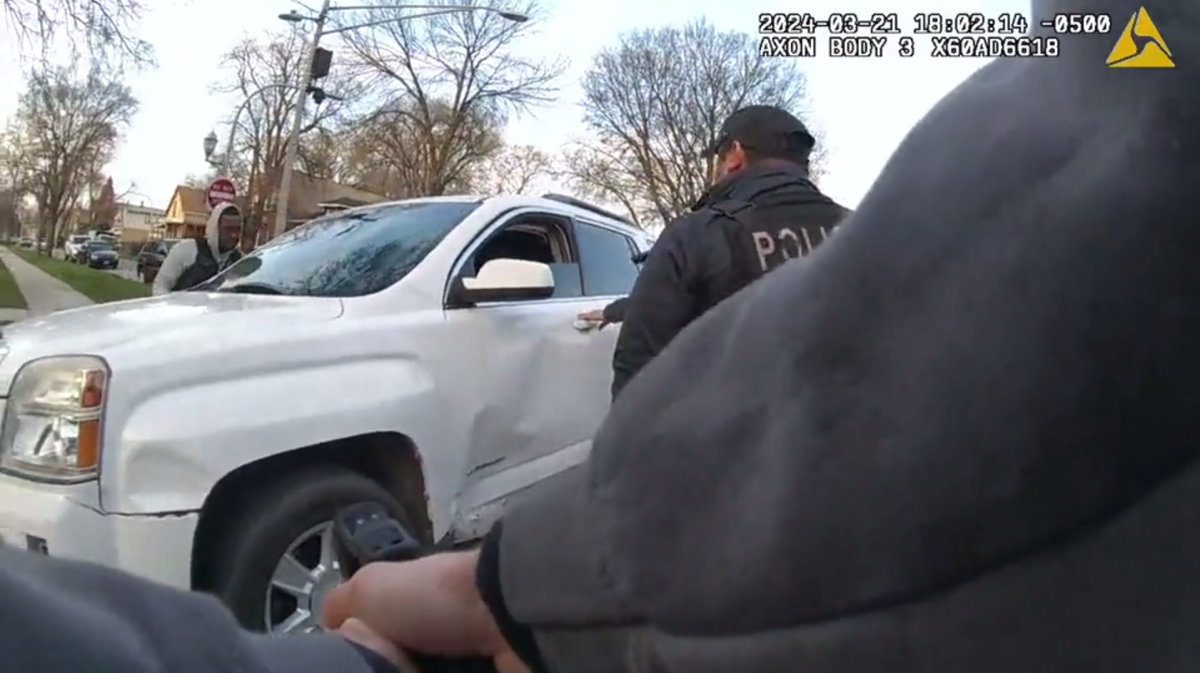 Chicago police officers surround an SUV driven by Dexter Reed moments before shots are fired on March 21, 2024. (Civilian Office of Police Accountability)
Cook County State’s Attorney Eileen O’Neill Burke announced Wednesday that her office will not charge any of the five officers who shot and killed Dexter Reed during a March 2024 traffic stop after he shot and wounded an officer.
“The decision is not reached lightly nor does it diminish the tragedy that occurred,” O’Neill Burke said at a news conference at the Leighton Criminal Courts Building, calling the evidence “clear and overwhelming.” “But to the question of whether the officers committed a crime under the Illinois Criminal Code, the answer is straightforward: They did not.”
Andrew M. Stroth, the attorney for Reed’s family, said that while he respected the decision not to charge the officers, he disagreed with it. Reed’s family, who is suing the city, is deeply upset by O’Neill Burke’s decision, Stroth said.
Reed, 26, was stopped just after 6 p.m. March 21, 2024, by a tactical team of officers in plainclothes driving an unmarked SUV near the border between Humboldt Park and Garfield Park on Chicago’s West Side.
Initially, Officers Alexandra Giampapa and Gregory Saint Louis approached Reed and ordered him to lower his SUV’s windows, which were tinted, unlock the doors and show them his hands. Reed did not comply with those orders, Assistant State’s Attorney Lynn McCarthy said.
That prompted the other three officers to exit their vehicle and approach Reed, McCarthy said.
Less than 30 seconds after the traffic stop began, Reed fired at Saint Louis, who was standing on the passenger side of the vehicle, striking him in the wrist and seriously wounding him, O’Neill Burke said.
Four officers fired 96 shots at Reed, hitting him 13 times, and fatally injuring him.
After an eight second pause, Reed fired another 10 shots out of both the driver’s and passenger side front windows, McCarthy said. Eleven shell casings were found in the front seat of Reed’s car, as well as the gun, which was found in a position that indicated it had been fired until empty, she said.
Reed was not licensed to carry that weapon, O’Neill Burke said.
After the first shots were fired, Reed’s SUV moved forward and crashed into a nearby parked car, McCarthy said. Reed got out of his SUV and walked to the back of the vehicle and “crouched down,” McCarthy said.
Just 41 seconds elapsed between when Reed fired the first shot and the 107th, and final shot, McCarthy said.
One of the officers fired at least 50 times at Reed, including three times while he was motionless on the ground, according to a letter sent by Andrea Kersten, the former chief administrator of COPA, to Chicago Police Supt. Larry Snelling. That officer reloaded his weapon twice, while three other officers reloaded their weapon once, according to the letter.
The officers’ behavior after Reed was shot was consistent with their belief that he posed a continuing threat to them and others and was reasonable, McCarthy said.
The probe into the shooting by the Civilian Office of Police Accountability, better known as COPA, is ongoing, an agency spokesperson told WTTW News.
Giampapa resigned from CPD in November and is now an officer with the Tipp City, Ohio, police force. Saint Louis’ name does not appear in the city’s database of employees.
The other three officers who stopped Reed — Victor Pacheco, Aubrey Webb and Thomas Spanos — are assigned to administrative duties, but have not been stripped of their police powers, sources told WTTW News.
Pacheco and Webb earn $108,000 annually, while Spanos earns $98,000, city records show.
Officers told COPA investigators at the scene of the fatal shooting they stopped Reed because they believed he was not wearing his seat belt, a violation, according to reports signed by the officers involved and released by COPA through a Freedom of Information Act request.
After Reed’s death, police brass agreed to expand a federal court order requiring CPD to change the way it trains, supervises and disciplines officers to include traffic stops. That agreement has yet to be finalized.
The officers who stopped Reed violated the constitutional rights of at least two other drivers on Chicago’s West Side less than three weeks before, WTTW News reported in May.
Snelling concurred with COPA’s conclusions and found those violations merited suspensions ranging from three days to 25 days for each officer that participated in the stop. COPA had recommended suspensions of no more than 30 days for each officer who participated in each of the two stops, records show.
While lawyers for the city recommended that the Chicago City Council pay $1.25 million to Reed’s family to resolve the lawsuit they filed, alleging Chicago police officers violated Reed’s civil rights, the Finance Committee rejected that recommendation. The City Council has yet to finalize that rejection.