Politics
Bill Boosting Police, Firefighter Pensions Made Chicago’s Dire Financial Condition Worse: Ratings Agency
A bill that will boost the retirement benefits for some Chicago police officers and firefighters has weakened the city’s already dire financial condition, a Wall Street ratings agency warned Tuesday.
An analysis of the bill by the city’s Office of Budget and Management warned the bill “would increase the city’s pension liabilities by more than $11 billion” in the two funds that pay pensions to retired police officers and firefighters.
The warning from S&P, one of a handful of major ratings agencies, comes six months after it downgraded Chicago’s credit one notch to BBB with a stable outlook. The city’s 2025 spending plan left intact “a sizable structural budgetary imbalance,” S&P warned.
“With the passage of this legislation, the prognosis for Chicago’s long-term fiscal health has weakened,” S&P analysts led by Scott Nees wrote. “Chicago will now face a steepening outyear pension cost curve even as it currently faces a fiscal 2026 budget gap that we already expected would probably be the largest in the city’s history.”
Chicago’s finances have long been out of whack, pinched by soaring pension costs, spiraling personnel costs and a massive amount of debt. The city’s fiscal stability is also threatened by the crises facing the Chicago Transit Authority and Chicago Public Schools. Both agencies used federal financial assistance during the COVID-19 pandemic to expand operations and now must stand alone.
Chicago faces a likely deficit of $1.2 billion in 2026, according to the city’s most recent budget forecast.
The bill is designed to make sure that Chicago police officers and firefighters earn pension benefits at the same level as downstate first responders. It also ensures that pensions for police officers and firefighters hired after 2010 offer benefits that are in line with Social Security payments earned by private sector employees, as required by federal law.
However, S&P’s analysis found the bill did more than required and includes “much more generous benefit expansions” for Chicago first responders.
Gov. JB Pritzker signed the bill Friday afternoon, with his office’s spokesperson telling reporters it would prevent the city’s pension debt from growing even faster in the future and avoid lawsuits.
Mayor Brandon Johnson said his team warned the governor that the bill would worsen the city’s financial condition and urged him to couple its passage with a measure that expanded the city’s ability to cover those costs. Most revenue-generating proposals, like imposing a sales tax on services, not just goods, would require a change in state law.
However, the mayor did not ask the governor to veto the bill, which passed the General Assembly unanimously.
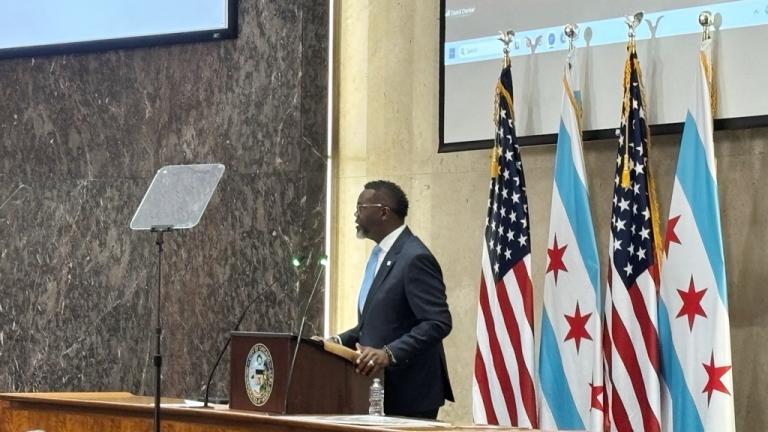
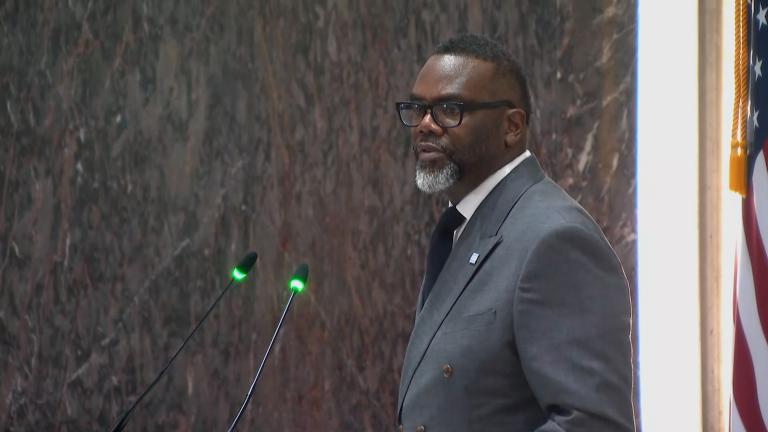
Johnson told reporters Tuesday at a City Hall news conference that the city was essentially caught between a rock and a hard place.
“We have to ensure that, you know, our pensioners are supported,” Johnson said. “I think everyone agrees with that.”
But Johnson said he was concerned that Chicago could see another reduction in its credit rating, which would make it much more expensive for the city to borrow money, officials said. The ratings issued by the four major ratings agencies help determine how much the city must pay in interest to incur debt, much like an individual’s credit score.
“Am I concerned? Of course I am,” Johnson said. “Do I believe that all hope is lost? No.”
Johnson acknowledged the city finds itself in the midst of a “difficult season.”
“We have reached a point now where there’s no return,” Johnson said.
At the end of 2024, Chicago’s police and fire pension funds had funding levels of approximately 24.5%, according to the city’s annual financial report. That represented a slight improvement as compared with previous years.
The bill signed by Pritzker Friday will wipe out that progress and decrease the funding levels of both pension funds to less than 18%, according to the city’s analysis.
By comparison, other large public pension funds have average funding levels of about 70%.
In all, Chicago owes $35.9 billion to its four employee pension funds representing police officers, firefighters, municipal employees and laborers, according to the 2024 Annual Comprehensive Financial Report.
Chicago’s pension debt has grown by nearly 13% since 2019, adding approximately $4.1 billion to the city’s unfunded liabilities, records show.
During the past three years, the city has paid $802 million more into its four pension funds than required by state law, records show.
Before the bill was signed by Pritzker, the city faced a nearly $2.76 billion pension bill in 2026, according to city records, in order to comply with a state law that requires two of Chicago’s funds be funded at a 90% level by 2055 and the other two by 2058, ensuring they can pay benefits to employees as they retire.
It is unclear how much the new bill will add to the city’s pension bill next year. That estimate is expected to be released by Johnson by the end of the month.
Contact Heather Cherone: @HeatherCherone | (773) 569-1863 | [email protected]