Politics
Mayor Brandon Johnson Says New Taxes for Big Companies ‘On the Table’ to Help Fill Projected $1.2B Deficit
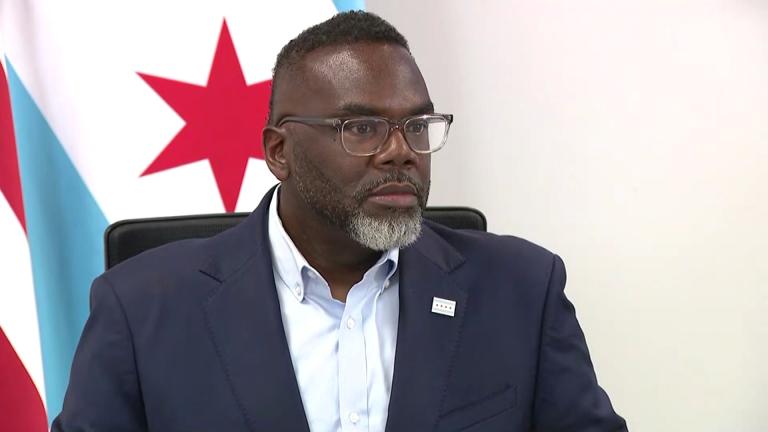
Mayor Brandon Johnson said Tuesday that Chicago officials must consider hiking taxes on large corporations as his administration prepares to confront a likely budget deficit of $1.2 billion during what officials have called one of most difficult budget years in Chicago history.
“It’s on the table,” Johnson said Tuesday at a City Hall news conference where reporters pressed him to detail how he would find enough of what he calls “progressive” revenue to fill the city’s projected budget gap. “Everything has to be on the table. Everything has to be on the table.”
The mayor’s remarks came just a few days after he said he would not propose increasing property taxes to help balance the city’s 2026 budget. City officials are scheduled to detail Chicago’s financial condition by the end of August.
Property taxes are the city’s largest source of revenue and the most effective way for city officials to raise revenue and ensure expenses do not outstrip costs. Most other revenue-generating proposals, like imposing a sales tax on services, not just goods, would require a change in state law.
Johnson was elected in 2023 on a campaign platform that vowed to levy $800 million in new taxes on the wealthiest Chicagoans to fund new investments designed to boost working-class Chicagoans, particularly on the West and South sides.
A measure that would have given the City Council the power to generate approximately $100 million annually by hiking taxes on the amount of real estate sales of more than $1 million was rejected by voters in March 2024. Despite promises to do so, Johnson has not renewed that effort.
During the campaign, Johnson vowed to impose a $4 per employee tax on large companies, which could raise approximately $25 million annually. The mayor did not include that proposal in either his 2024 or 2025 proposed budgets.
That head tax, in place for four decades, was eliminated in 2011 by former Mayor Rahm Emanuel, who said lifting it helped spur millions of dollars of economic activity in the city and prompted dozens of companies to relocate to Chicago.
The City Council has the power to impose that tax on Chicago businesses without a change in state law.
“I think it’s important that we look at, in a very meaningful way, how those individuals with means, particularly our billionaires and ultra rich, who have benefited from a growing economy, can put more skin in the game,” Johnson said, pledging to consider a “variety of options.”
Chicago must do more to ensure that it lives up to its reputation as one of the best big cities in the world, Johnson said.
“Our corporate partners will have to do more,” Johnson said, noting that too many Chicagoans live in poverty.
A new proposal from the Institute for the Public Good would levy a payroll expense tax on Chicago businesses modeled on Seattle’s JumpStart tax, which forced businesses with annual payrolls of at least $7 million and employees earning at least $150,000 to pay an additional levy between 0.7% and 2.4%, according to Seattle Cascade, the city’s PBS affiliate.
The revenue generated by the JumpStart tax has been significantly more than expected, helping Seattle officials balance the city’s budget.
The Institute for the Public Good’s proposal would levy a 5% tax on Chicago businesses with annual payrolls of at least $8 million and employees earning at least $200,000, according to the proposal.
That would generate more than $1.5 billion in new revenue for the city, a portion of which could be earmarked to help small businesses, according to the Institute for the Public Good.
“Corporations can afford to contribute more — especially those with CEOs making 1,000 times what their workers make,” said Julie Dworkin, the institute’s co-director. “We know what works. We just need the will to do it.”
Johnson dismissed concerns that hiking taxes would prompt wealthy Chicagoans to leave the city to avoid paying additional taxes. Instead, those Chicagoans are most concerned about crime and violence, the mayor said.
“Clearly, living in the greatest freaking city in the world is not a burden, but it can be a strain if you don’t get a handle on violence,” Johnson said.
Through the end of June, the number of homicides in Chicago dropped more than 30% in 2025, as compared with the same period in 2024, according to Chicago police data. The number of shootings is also down more than 30%, according to police data.
Reinstating the corporate head tax has been a goal of Chicago’s progressive politicians since Emanuel left office in an attempt to make Chicago’s wealthiest residents shoulder more of the burden.
But any proposal to tax big corporations in Chicago for every worker they employ would be blasted immediately by Chicago’s business community as a job killer and fuel efforts to defeat Johnson and his allies on the City Council in the 2027 election.
It is also unclear whether Johnson’s top financial advisers would recommend new corporate taxes.
When City Council members peppered Budget Director Annette Guzman with questions about reinstating the corporate head tax during a June 2024 committee hearing, she said officials would need to move cautiously to avoid a “chilling effect” on businesses.
The push is also complicated by the shift to remote work, one of the lasting legacies of the COVID-19 pandemic, Guzman said.
“We have to understand how that impacts how we think about that type of tax,” Guzman said.
Contact Heather Cherone: @HeatherCherone | (773) 569-1863 | [email protected]