Politics
Mayor Brandon Johnson Says He Won’t Propose Property Tax Hike to Help Fill Projected $1.2B Deficit
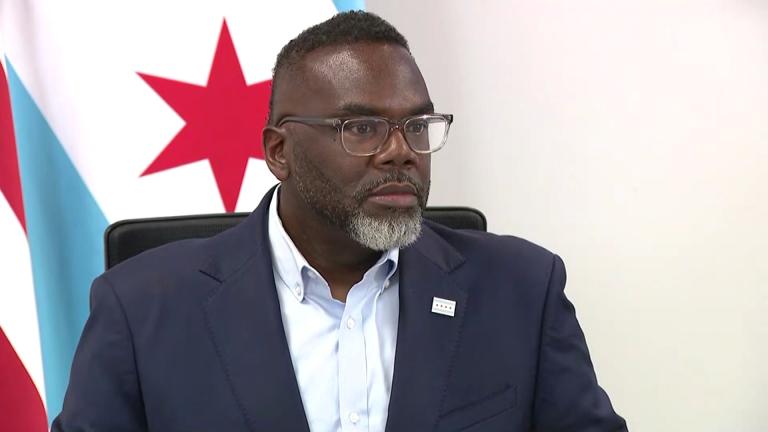
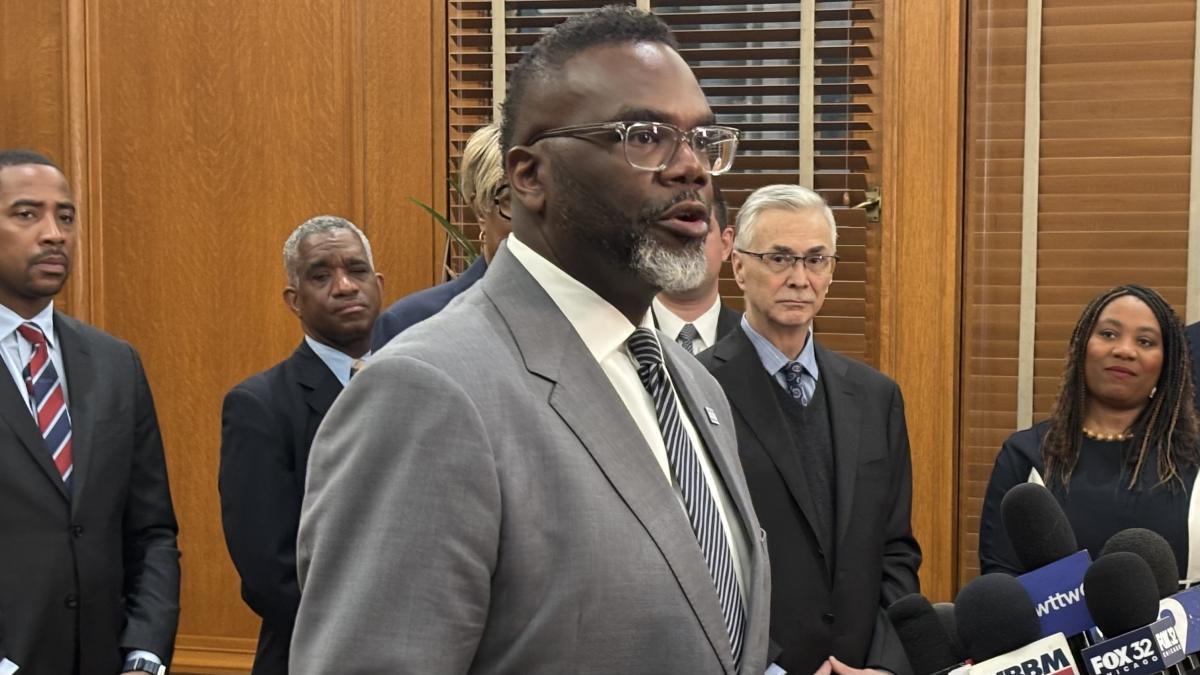 Mayor Brandon Johnson addresses the news media on Monday, April 21, 2025. (Heather Cherone / WTTW News)
Mayor Brandon Johnson said Thursday he would not propose a property tax hike to help balance the city’s 2026 budget, even as officials prepare to face a likely budget deficit of $1.2 billion during what officials have called one of most difficult budget years in Chicago history.
“I will not be proposing a property tax increase in my budget,” Johnson said after an unrelated event Thursday. “I’m going to continue to work hard to find progressive revenue so that we can continue to make critical investments in transforming our city.”
Johnson credited his first two spending plans with making investments that led to a sustained drop in crime and violence in Chicago. Through the end of June, the number of homicides in Chicago dropped 30% in 2025, as compared with the same period in 2024, according to Chicago police data. The number of shootings is also down 30%, according to police data.
“I’m counting on City Council to join me in my effort,” Johnson said.
Any proposed property tax hike would face an uncertain fate once it reaches the Chicago City Council, whose members face reelection in February 2027.
Johnson’s unscheduled remarks on the city’s financial crisis came two days after Chief Financial Officer Jill Jaworski told Bloomberg News that a property tax increase was “likely (to) ... be part of the package” presented to the City Council this fall.
When Johnson was asked by reporters about Jaworski’s statement on Wednesday, he did not rule out a property tax hike and blamed the city’s financial crisis on “malfeasance.”
“It is too early to determine what our ultimate package will look like,” Johnson said Wednesday.
A day later, Johnson said his remarks did not reflect a difference of opinion between him and his top financial adviser or an about-face.
Johnson declined to detail what specific proposals he would make to balance the budget with “progressive revenue.”
However, “the ultimate goal is to challenge those with means in this city, and quite frankly in this state, to pay their fair share,” Johnson said.
A year ago, Johnson proposed a $300 million property tax hike, the largest increase since 2016, saying he had no choice but to break one of his central campaign promises in order to avoid draconian cuts to city services and thousands of layoffs.
The City Council unanimously rejected that proposal, sending Johnson’s 2025 spending plan back to the drawing board.
Ultimately, the $17.1 billion 2025 budget that narrowly passed the City Council hinged on $165.5 million in additional taxes and fees as well as several one-time fixes after Johnson refused to support any cuts to city services or layoffs.
That prompted S&P, one of a handful of major ratings agencies, to downgrade Chicago’s credit one notch, finding that “the city’s practical options for raising new revenue appear less certain, as does the willingness of city leadership to cut spending, creating a level of uncertainty around its financial trajectory that is more appropriately reflected in the lower rating.”
Property taxes are the city’s largest source of revenue and the most effective way for city officials to raise revenue and ensure expenses do not outstrip costs. Most other revenue-generating proposals, like imposing a sales tax on services, not just goods, would require a change in state law.
Convincing the Illinois General Assembly and Gov. JB Pritzker to change state law in order to impose new taxes would be a difficult and time-consuming effort.
Since the city faces a deadline of Dec. 31 to approve a spending plan for 2026, any change in state law would have to be approved during this fall’s veto session, when a supermajority is required to pass new legislation.
Chicago’s finances have long been out of whack, pinched by soaring pension costs, spiraling personnel costs and a massive amount of debt. The city’s fiscal stability is also threatened by the crises facing the Chicago Transit Authority and Chicago Public Schools. Both agencies survived the COVID-19 pandemic with federal financial assistance and must now stand alone.
If the economy worsens significantly, the projected $1.2 billion gap for 2026 could swell to $1.6 billion, according to the budget forecast.
Assuming a robust economy, that shortfall could shrink to $634 million in 2026, according to the forecast that no one at City Hall believes is likely.
That dire financial outlook is complicated by President Donald Trump’s attempts to revoke all federal funding from Chicago because officials have refused to stop protecting undocumented immigrants from deportation.
That effort could cost the city more than $3 billion, if successful.
In an effort to avoid repeating the mistakes that plagued the 2025 budget negotiations, Johnson formed a working group in April, and charged members with crafting solutions to the city’s fiscal crisis.
The working group’s recommendations are due to the mayor by Aug. 31, typically when the process of crafting the city’s budget for the next year begins in earnest after the publication of the department’s budget forecast.
The working group, which is led by Loop Capital’s Jim Reynolds, includes representatives of Chicago’s business community, nonprofit organizations, civic organizations, labor groups and the City Council. None of its members have spoken publicly about the group’s work, nor has the mayor’s office responded to questions about its activities.
The first test of Johnson’s ability to push his fiscal proposals through the City Council is already on tap, even though the City Council has six months to craft and pass a 2026 spending plan.
After state lawmakers ended the state’s 1% grocery tax at Pritzker’s request, it gave municipalities the option of levying — and collecting — the tax on its own.
To avoid blowing an additional $80 million hole in the city’s 2026 budget, Johnson asked the City Council to vote to keep the tax in place before an Oct. 1 deadline.
More than 150 cities and villages have done just that, ensuring that shoppers’ grocery bills won’t change on Jan. 1, 2026, keeping tax dollars flowing to local governments.
Contact Heather Cherone: @HeatherCherone | (773) 569-1863 | [email protected]