Crime & Law
Prosecution Set to Rest its Case in Michael Madigan’s Landmark Corruption Trial
Video: The WTTW News Spotlight Politics team on the Madigan trial and more of the day’s top stories. (Produced by Paul Caine)
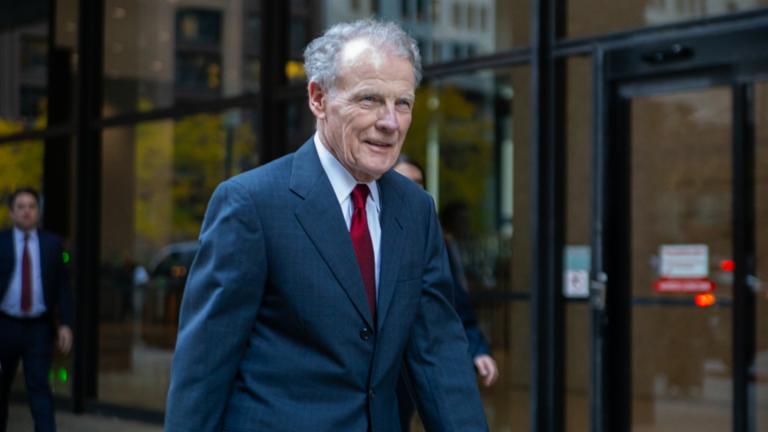
Federal prosecutors are set to officially rest their case in the landmark corruption trial of former Illinois House Speaker Michael Madigan after more than eight weeks of testimony, secret recordings and evidence.
The government concluded its witness testimony and evidence, but did not officially rest their case Tuesday afternoon before the jury was dismissed for the day, nearly two months since opening statements were held in the sweeping case at the Dirksen Federal Building in downtown Chicago.
Madigan, who is charged alongside his longtime right-hand man Michael McClain, is alleged to have orchestrated multiple corruption schemes, wielding his political power to reward loyal allies and enrich himself.
He and McClain are each charged with racketeering, bribery and wire fraud. They have each pleaded not guilty.
The government’s case came to an end following contentious testimony from ex-Illinois House Rep. Eddie Acevedo, who is at the center of one of the five schemes Madigan and McClain are allegedly behind.
Between 2017 and 2018, records show Acevedo collected $142,500 in indirect payments from ComEd and AT&T Illinois, which prosecutors allege stemmed from no-work contracts arranged by McClain at Madigan’s request as Acevedo was a key Madigan ally in the General Assembly’s growing Latino Caucus.
In exchange, Madigan allegedly supported legislation that allowed AT&T to terminate its costly obligation to provide landline phone services to all Illinois residents who requested them.
Acevedo — who testified under an immunity deal after he was compelled to do so by U.S. District Judge John Blakey — on Tuesday said he has been diagnosed with dementia and has a brain tumor that has caused significant memory issues. He told jurors he no longer handles his own personal affairs and sometimes forgets the names of his own grandchildren.
He also said he couldn’t recall any details about meetings he had with Madigan, McClain or AT&T officials back in 2016 or 2017 and had to repeatedly refer back to transcripts from his 2022 grand jury testimony, where he went into detail about those interactions.
During his testimony, Acevedo initially denied that he had done no work for AT&T and said that, while being paid by the phone company in 2017, he would provide updates to AT&T lobbyist Steve Selcke and Michael Lieteau, an external lobbyist who’d previously spent decades working for AT&T.
“I never asked anyone for a no-show job,” he said under cross examination questioning from McClain’s attorney Patrick Cotter. “I would have done anything they asked me to that was legal.”
Acevedo on Monday insisted AT&T had issued him assignments. When Bhachu asked about an FBI interview in 2019 in which Acevedo apparently told agents that he was “never given work assignments from ComEd,” Acevedo said he didn’t remember.
The jury has already heard from former AT&T Illinois contract lobbyist Tom Cullen, who testified about agreeing to be the intermediary for the company’s $2,500-per-month payments to Acevedo for nine months beginning in mid-2017. Cullen testified that AT&T increased the size of Cullen’s monthly retainer, and he cut Acevedo a check each month.
Though Acevedo was assigned to write a report on the political dynamics within the Latino caucuses of both the General Assembly and Chicago City Council, Cullen said it was understood by all parties that the assignment wasn’t real.
Acevedo on Tuesday told jurors he would also report to Lieteau and share information about Latino members of the General Assembly, whom he knew from his time as a House representative.
But Lieteau testified that he was no longer an AT&T employee by 2017 — they were only a client of his lobbying firm by that point — and that he had no supervisory authority over any work Acevedo had or hadn’t been assigned.
“Any work he was performing for AT&T, I was not aware (of),” Lieteau said.
According to Lieteau, Acevedo was known to drink excessively and had a poor reputation by the time his tenure in the House came to a close. He told jurors that he would not have wanted to hire Acevedo as an external lobbyist.
As his testimony began Monday afternoon, Acevedo claimed that while he never submitted any report, he had indeed worked on it with his two sons. When Assistant U.S. Attorney Amarjeet Bhachu reminded Acevedo that he told the FBI in 2019 that he’d created no work product for AT&T, the former lawmaker said he didn’t remember telling agents that.
He also noted that Acevedo in 2019 failed to inform the FBI he was suffering from any memory issues and made no mention that he had undergone any sort of neurological assessment until he faced sentencing in his own criminal case.
Acevedo was charged in 2021 with tax evasion and ultimately pleaded guilty to that charge, though the former lawmaker maintained on Tuesday he “was not trying to hide anything” related to that AT&T income.
According to Bhachu, Acevedo’s neurological assessment was provided as mitigation in order to try and get less prison time at sentencing in 2022.
For their final witness, the government called FBI Special Agent Kyle Scherrer, who testified about Acevedo’s 2019 meeting with investigators. According to Scherrer, Acevedo during that meeting stated that he never completed any work product for AT&T Illinois and that two weeks before he was contacted by the FBI, he got a call from Madigan attorney Heather Wier Vaught, who asked him if he had an attorney.
Reviewing the transcript from Acevedo’s change of plea hearing in his tax evasion case, Scherrer also stated that there was no mention of Acevedo’s dementia during that proceeding.
During his own testimony, Acevedo stated he could not recall who Vaught was.
Acevedo’s testimony got off to a rocky start Monday after he said he was unable to read a transcript in front of him because he said he’d forgotten to bring his glasses. That prompted Judge Blakey to threaten to hold Acevedo in contempt if he made the same mistake again Tuesday.
As questioning got underway Tuesday morning, Bhachu first asked Acevedo whether he’d remembered his glasses this time.
“Right here,” he said, holding them up in court.
“Congratulations,” Bhachu replied.
Capitol News Illinois contributed to this report.