Science & Nature
Chicago Could See Spectacular Northern Lights Thursday as Rare ‘Severe’ Solar Storm Heads Toward Earth
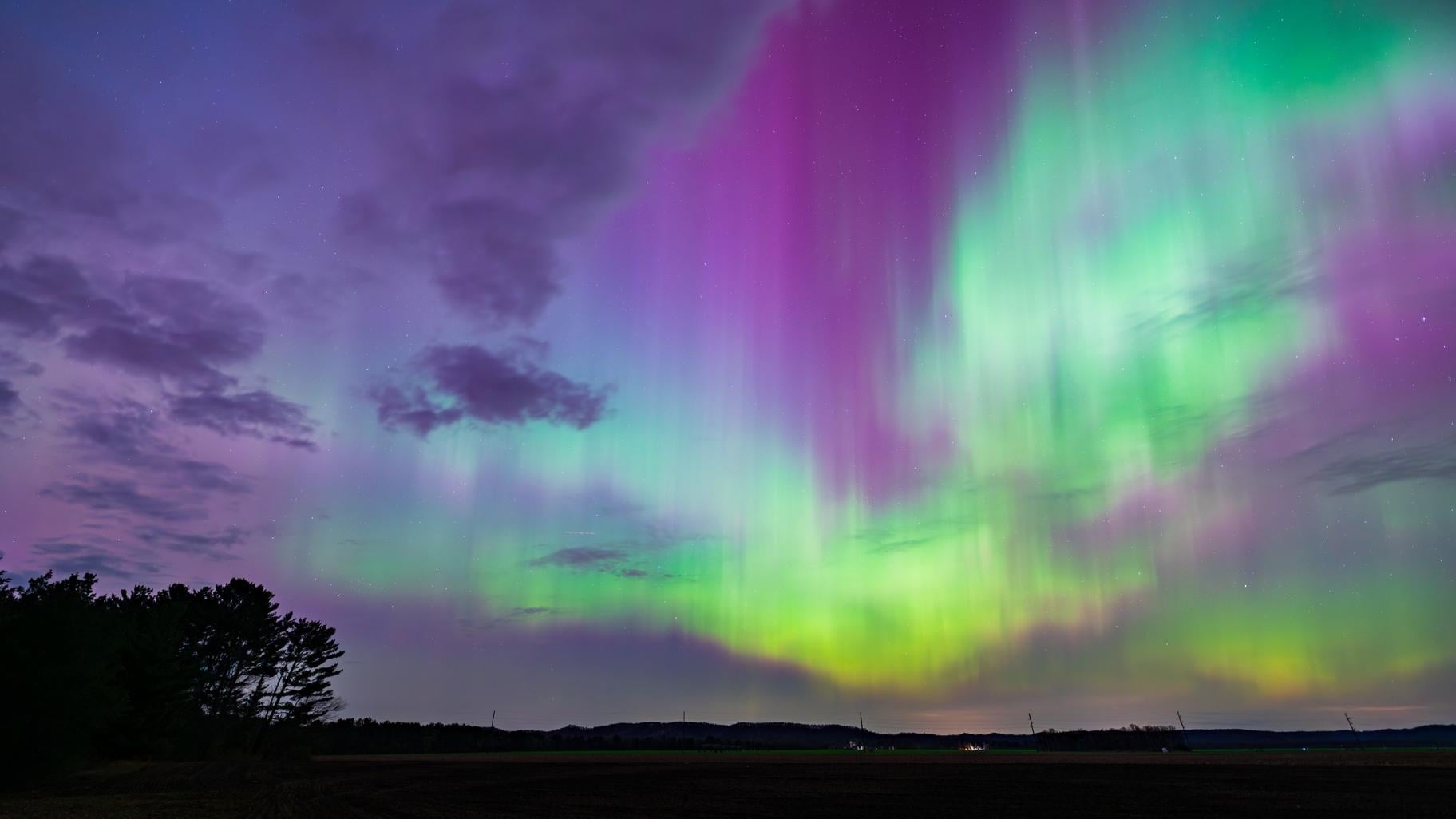 Aurora borealis, seen in the U.S. in 2023. (Jonah Lange / iStock)
A severe geomagnetic storm is heading toward Earth, likely to hit Thursday, and what that means for Chicagoans is conditions are ripe for another spectacular display of the aurora borealis (northern lights) in our neck of the woods.
The Space Weather Prediction Center, operated by the National Oceanic and Atmospheric Administration, is tracking a fast-moving coronal mass ejection (CME), often described as a “solar burp” or gas bubble, that erupted from the sun Tuesday night.
In this case, fast-moving means the burp is traveling at a speed of 1,200 kilometers per second.
On a geomagnetic storm watch scale of G1 to G5 — with G5 being the most severe — this latest has been ranked a G4, a watch level rarely issued by the prediction center.
In addition to producing auroras, these severe storms can also disrupt GPS and communications, though the entities that manage these networks have plenty of practice and know-how when it comes to mitigating any effects, according to Michelle Nichols, director of public observing at the Adler Planetarium.
Aurora chasers across the country are comparing the viewing potential this Thursday and Friday to May’s event — a G5 — when the aurora was visible in parts of the country that are seldom treated to the light show. If the prediction center’s forecast holds, the aurora might be seen as far south as Alabama.
The meteorologists at Illinois Storm Chasers have said it’s possible people might even be able to see the aurora with the naked eye in Illinois, as opposed to the best viewing being through a camera lens.
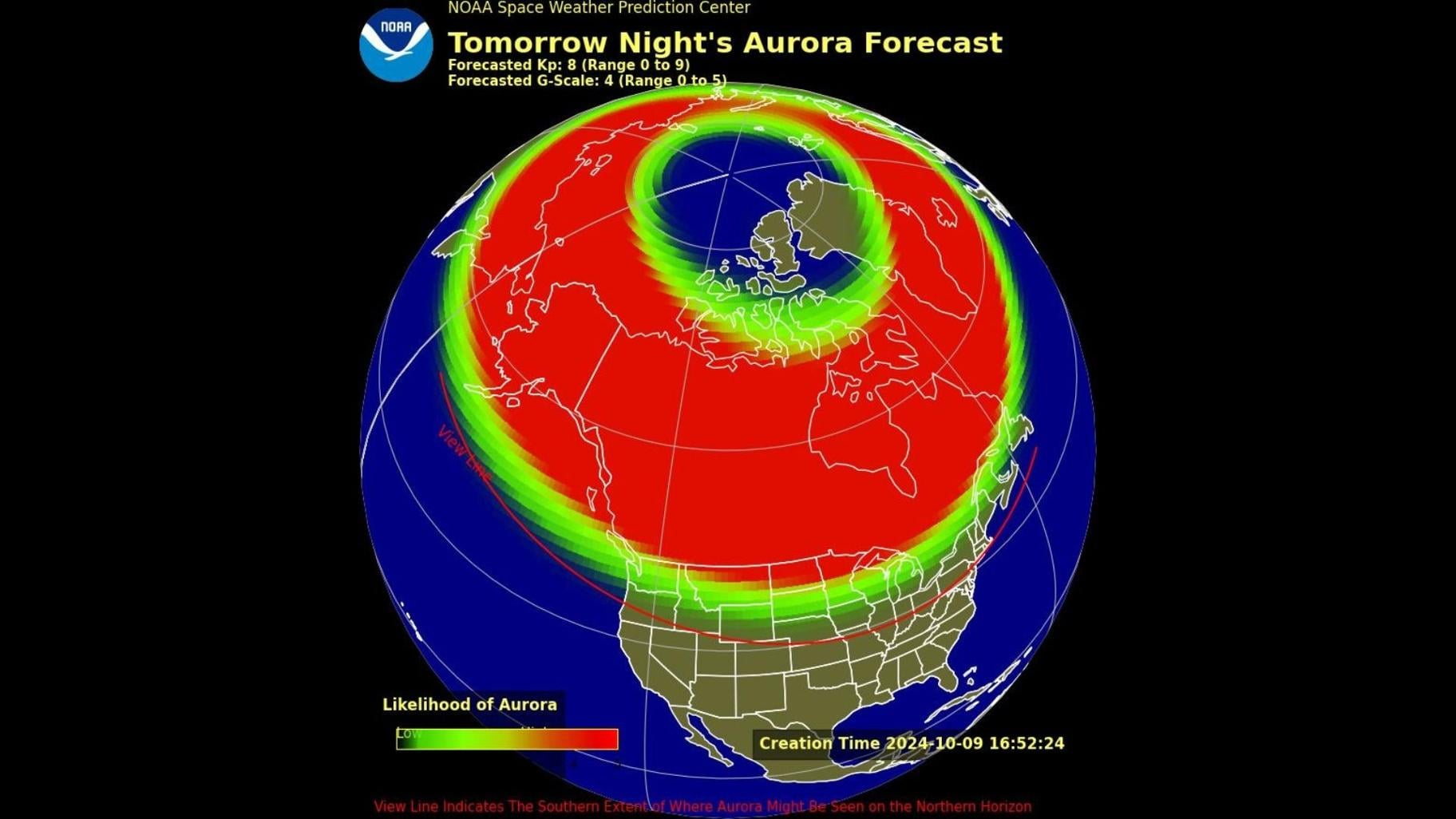 The aurora forecast for Oct. 10, 2024. More red means greater intensity. (National Oceanic and Atmospheric Administration)
Why so many solar eruptions lately?
Solar activity occurs cyclically, and it’s about to reach a peak in 2025 before decreasing in intensity.
This approaching peak, and the related uptick in solar burps, has been expected by scientists. What’s new this cycle is the extent to which the public is following along, Nichols said.
“The public has access to all this information,” she said. “You can sign up for text alerts from the Space Weather Center.”
As word has spread on social media — in particular as images have spread on social media — more and more people have added “see an aurora” to their bucket list.
“It just really intrigues people,” Nichols said.
What exactly is the aurora?
The northern lights are created when energized particles from the sun slam into Earth’s upper atmosphere, where the planet’s magnetic field redirects them toward the poles.
These solar particles collide with our atmosphere’s nitrogen and oxygen atoms and “excite” or heat them up via an energy transfer, which, when the energy is released, is what causes an aurora’s colors. The greens are linked to oxygen, while the blues, pinks and purple are nitrogen, according to experts.
Any viewing tips?
First, cross your fingers for clear skies. For once, the weather in Chicago looks like it will cooperate.
Second, get away from lights. Auroras have to be extremely bright to cut through light pollution — the aurora in May was nearly a unicorn in that respect.
“It’s always best to get under the darkest sky you can find,” Nichols said.
Third, be prepared that the timing won’t work out.
The Space Weather Prediction Center said prime aurora viewing usually occurs within an hour or two of midnight, or a window from 10 p.m. to 2 a.m. But if the space storm hits during the middle of day, Chicago time, the aurora’s effects might not last through nightfall.
Unlike, say, the timing of a solar eclipse, which scientists have down to the minute, pinpointing auroras is a far less exact business. Consider the accuracy of meteorology — earth weather — 30 to 40 years ago, Nichols said, and that’s where aurora forecasting is today.
“There’s always some wiggle room,” she said.
Finally, be sure to have your smartphone or camera handy. Cameras, it turns out, are far more sensitive than the human eye to the full range of colors in the dark, emphasis on “in the dark,” said Nichols.
Back in August, she and her husband saw an aurora from the back yard of their home in the western suburbs. “We more saw the structure and the movement, but when I pointed my phone at it,” the colors came to life, Nichols said. “We have these ready-made tools in our pockets.”
Check the Space Weather Prediction Center website for geomagnetic storm and aurora forecast updates.
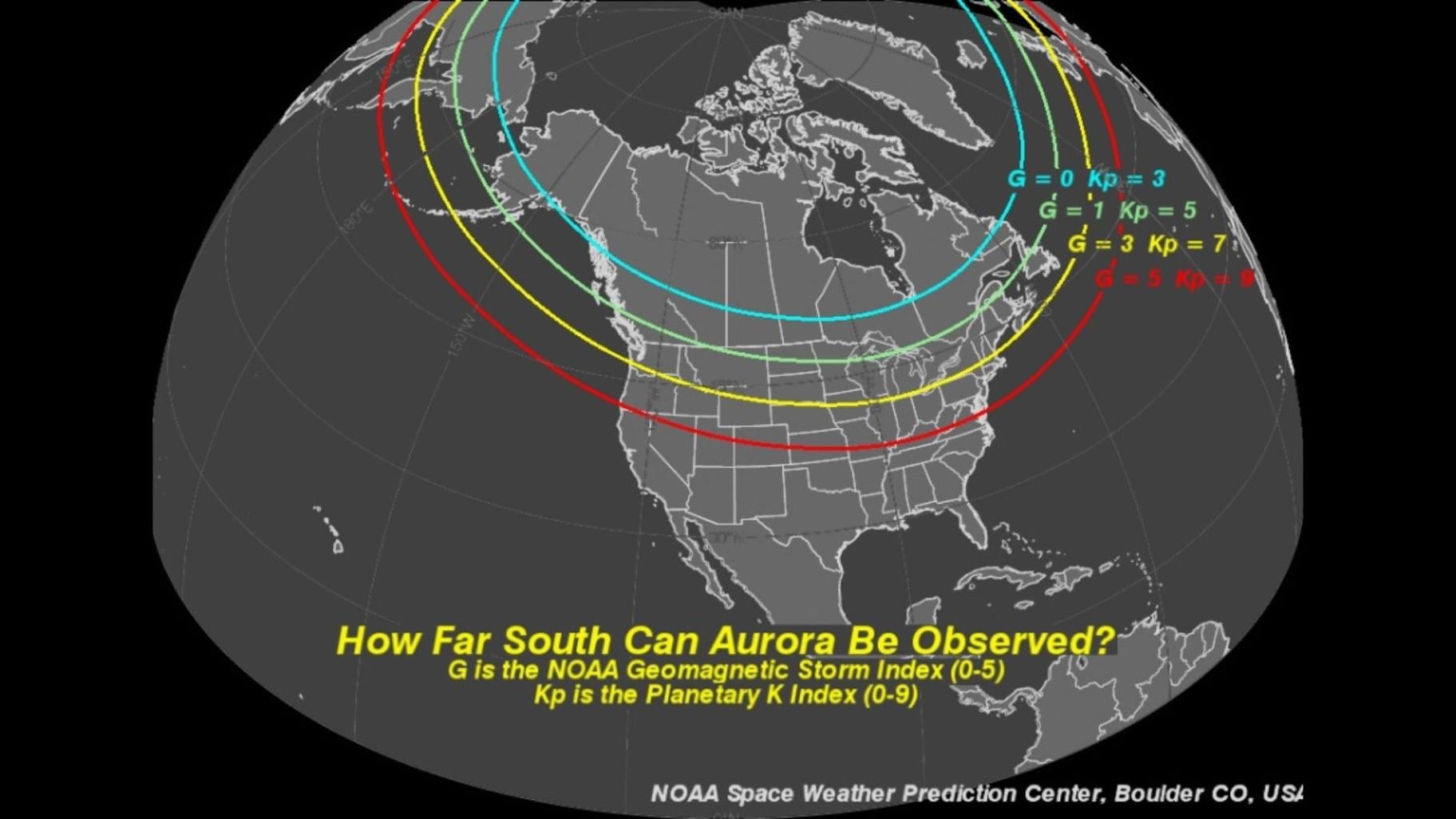 How to read the jargon in a space weather forecast: Mind your G’s and K’s. (National Oceanic and Atmospheric Administration)
Contact Patty Wetli: @pattywetli | (773) 509-5623 | [email protected]