Science & Nature
To the Moon and Back: Here’s What to Know About Today’s Artemis II Launch
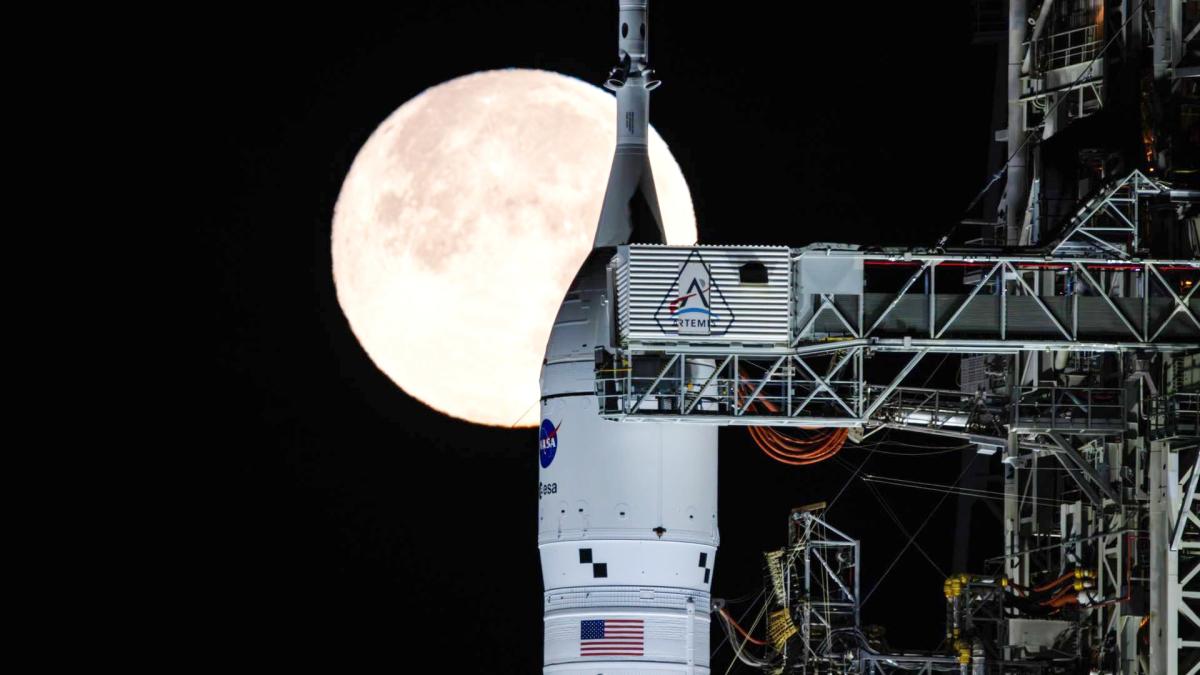 Artemis II on the launch pad. (NASA / Sam Lott)
If the weather holds, NASA will send four astronauts into space today on a 10-day mission to the moon and back, something the agency hasn’t done in more than 50 years.
The two-hour launch window for Artemis II opens at 5:24 p.m. Chicago time. Here’s what you need to know about this lunar fly-by.
How to Watch
NASA has you covered with live blog updates, live views from the Kennedy Space Center and an official broadcast.
Chicago’s Adler Planetarium is hosting a public viewing event, with real-time narration and insights provided by Michelle Nichols, the planetarium’s senior director of public programs.
The Adler’s program starts at 4 p.m. and will be held in the planetarium’s cafe. Seating is limited and will be available on a first-come, first-served basis, no reservations. The event is free with admission to the planetarium, and April 1 happens to be free admission for Illinois residents.
About the Astronauts
The crew includes three astronauts from NASA and one from Canada.
— Commander Reid Wiseman has already logged more than 150 days in space on the International Space Station.
— Pilot Victor Glover will be the first Black astronaut on a lunar mission. He’s also a space station veteran.
— Mission specialist Christina Hammock Koch will be the first female astronaut to travel to the moon. She also made history as a participant in the first all-female spacewalks aboard the space station.
— Mission specialist Jeremy Hansen, of the Canadian Space Agency, is a former fighter pilot and will be the first Canadian on a lunar mission.
What’s the Point?
The Artemis II crew won’t be landing on the moon, but it will be testing the systems future astronauts will use to touch down on the lunar surface, including the Orion space capsule. NASA’s ultimate goal is to build a base on the moon capable of supporting missions to Mars.
Fast Facts
Apart from its groundbreaking crew, Artemis II will set a number of records, if all goes according to plan.
The astronauts will travel farther into space than any other humans, as they use a slingshot technique to fly around the moon’s dark side and propel their craft back to Earth. The ill-fated Apollo 13 mission used this same technique but didn’t travel quite as far.
The Orion capsule will re-enter Earth’s atmosphere at 25,000 miles per hour. There has been concern about Orion’s heat shields being able to withstand re-entry but officials have said they’re confident in the technology.
The capsule is equipped with an actual toilet — or, in NASA-speak, a “hygiene bay” — which is another first for a NASA lunar mission.
If launch is a no-go on Wednesday, the window remains open through April 6. The next window after that isn’t until April 30.
Contact Patty Wetli: [email protected]