Crime & Law
Broadview ICE Facility Lacks Beds, Showers, Adequate Food as Federal Judge Indicates Temporary Restraining Order Likely
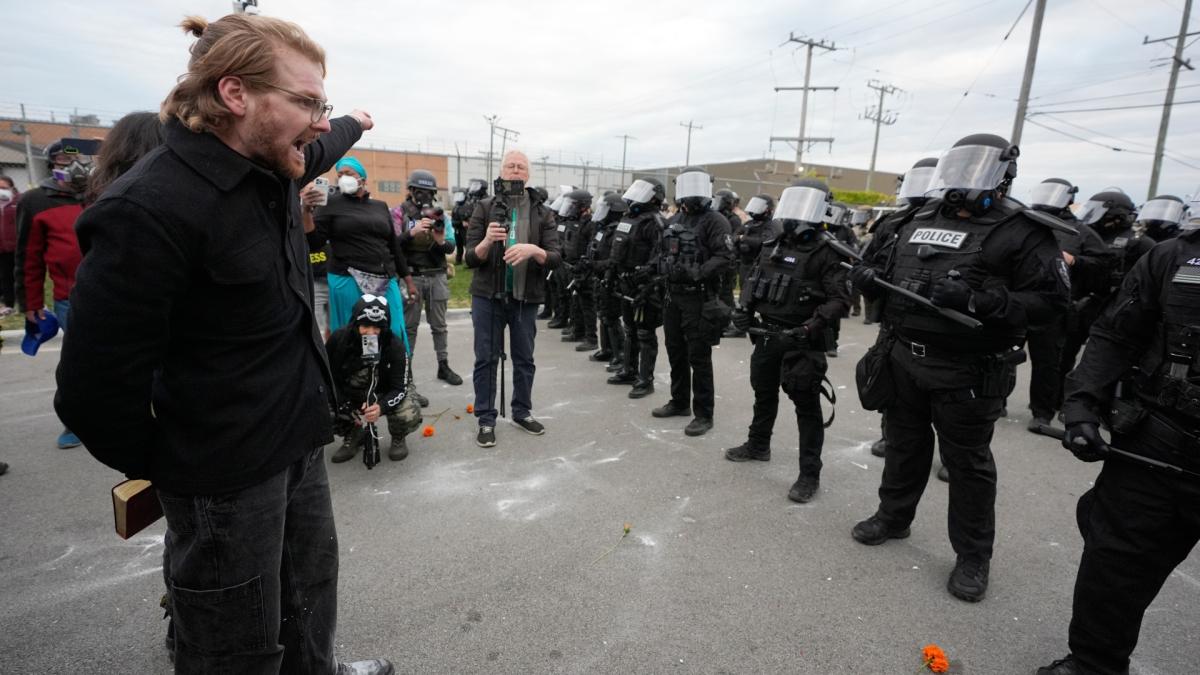 Protesters standoff with law enforcement outside an ICE processing facility in the Chicago suburb of Broadview, Ill., Saturday, Nov. 1, 2025. (AP Photo / Alex Brandon)
When Pablo Moreno Gonzalez was taken into custody by Immigrations and Customs Enforcement agents on Chicago’s Northwest Side last week, he said he was whisked off to a suburban processing facility where he was met with scores of other detainees.
The 56-year-old construction worker, who was born in Mexico and has spent the last 35 years in the U.S., said he was placed into a jam-packed cell with what he estimated was around 150 others. It lacked beds. He was forced to sleep in a chair and had to hop over others sleeping on the floor in front of him to get around.
“It was too much,” he said through a translator as he broke down in tears inside a packed courtroom in downtown Chicago Tuesday morning. “It was too much. It was just too much. I just can’t deal with it.”
Moreno Gonzalez told the court he was waiting for his boss last Wednesday morning near Pulaski Road and Foster Avenue, when he was detained by immigration agents.
He testified that he remained in Broadview from Wednesday through Friday, during which time he said he was never given a hot meal or able to shower. He said detainees were given three bottles of water per day while requests for any additional food or water were met with refusals or even anger from ICE agents.
That testimony comes as part of a lawsuit brought by the MacArthur Justice Center and the ACLU of Illinois request for a temporary restraining order to address what advocates claim are “inhumane and unlawful conditions” at the Broadview facility.
Federal officials have denied those accusations.
U.S. District Judge Robert Gettleman set the hearing to weigh evidence in the lawsuit alleging ICE officials are denying detainees access to their attorneys and subjecting them to mistreatment and overcrowding.
Gettleman did not rule on the TRO request Tuesday — he is expected to do so Wednesday — but he did say he felt the plaintiffs “made a case” that justifies the entry of some type of temporary restraining order.
He said the testimony presented was “pretty strong” in showing the Broadview facility is no longer simply operating as a temporary holding center.
“It has really become a prison … it is no longer just a processing center,” Gettleman said.
He called the sleeping conditions “unnecessarily cruel” and said the government’s claims that detainees are allotted water on demand and that there are benches for people to sleep have been contradicted repeatedly by Tuesday’s testimony.
“It’s just unacceptable,” Gettleman said.
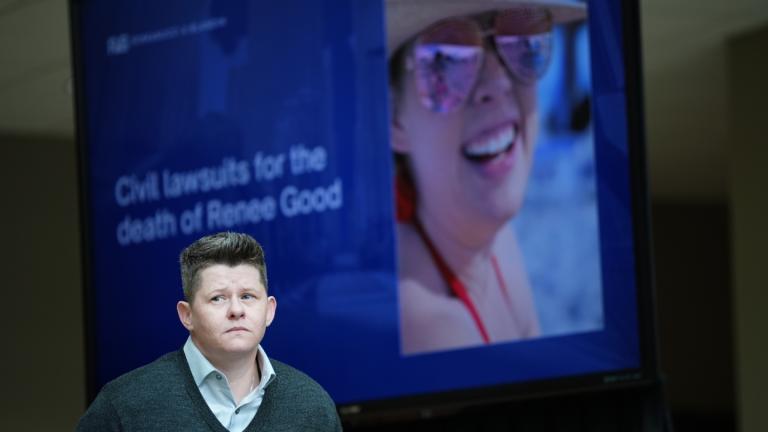
Alexa Van Brunt, director of the MacArthur Justice Center’s Illinois office and lead counsel on the suit, told the court Tuesday morning that Broadview detainees face a “set of dire conditions” posed by ICE officials, who are denying them their “basic human needs.”
Reading through claims from dozens of declarations filed with the court, Gettleman laid out the laundry list of allegations made by those who have been detained in Broadview — overcrowding, a lack of beds, no hygiene or medical supplies, no working showers, a lack of toilets and insufficient food and water access.
Beyond that, the lawsuit’s major claims revolve around detainees being denied access to their attorneys as they are allegedly coerced into signing documents they do not understand including voluntary departure forms that could result in their deportation.
Attorneys also claim that ICE’s online detainee locator does not work properly and often does not provide updates on a person’s location for days, meaning their families do not know where they are.
Assistant U.S. Attorney Jana Brady claimed that if the restraining order were to be approved as written, it would effectively halt the government’s ability to execute immigration laws in the state of Illinois.
She denied anyone’s constitutional rights have been violated and instead claimed any issues at the Broadview facility are the result of an ongoing “learning curve” in which staff are figuring out how to deal with a massive influx of detainees in recent months.
Brady acknowledged in-person attorney visits have been “somewhat restricted” in part because they slow down the processing and force detainees to be held at the site longer. Illinois law prevents ICE from using state facilities as detention centers, which she said has also limited the agency’s ability to move detainees out of Broadview.
Moreno Gonzalez’s co-plaintiff Felipe Agustin Zamacona — an Amazon deliveryman from Mexico who lives in Portage Park — provided a similar account. He was detained on Oct. 30 and spent around one day in Broadview.
He also testified about a packed holding cell and a lack of showers. He also said he believes he got sick off of the single Subway sandwich he was given to eat while there.
Zamacona, who does speak English, testified that agents gave him two choices: deportation or a court date before a judge. He testified he opted for the court date, but when agents gave him forms to sign that they said would help him set that date up, he realized it was instead a self-deportation document.
“They would have taken me to the airport and to Mexico,” he said when asked what would’ve happened if he had signed.
Claudia Carolina Pereira Geuvara, a mother of three who has since been deported, testified remotely from Honduras that she spent five days in Broadview in early October, during which time staff never cleaned her holding cell.
When detainees there asked for a broom so they could clean up themselves, she said officers refused. Pereira also said detainees were never given soap, toothpaste or toothbrushes.
“They wouldn’t give us anything that had to do with cleaning,” she said. “Absolutely nothing.”
Geuvara also testified people were forced to sleep on benches or chairs because there were no beds available. She said she typically slept in a chair but eventually laid down on the floor at one point because “my body was already hurt bad.”
When Geuvara became ill and lost feeling in the lower half of her body, she testified that her request to see a doctor was denied and she was given medicine by an agent who said it would treat vomiting.
According to Geuvara, ICE agents presented her with deportation papers and claimed that she had to sign, otherwise she would remain held in Broadview until she did.
Geuvara eventually did sign after an agent told her she would be able to return to the U.S. in five years. She didn’t learn until after she returned to Honduras that she, in fact, couldn’t come back for a decade.
Ruben Torres Maldonado — who was granted bond and released from custody last week while his teenage daughter continues battling Stage 4 cancer — also detailed his experience inside Broadview.
He spent five nights inside the processing center after he was detained on Oct. 18, many of which were spent sleeping on the floor without blankets or a pillow.
Like others, he testified the rooms at the site were filled with dozens of people, sometimes more than 100, he estimated.
At night, he said people could hardly walk because so many people were lying on the floors.
Maldonado said he knew of people at the site who had been there for 12 days, but when they’d ask officials for an explanation, they’d receive nothing.
Government attorneys claim ICE officials in Broadview do not “systematically deny access to counsel” and instead only block access for what they called “legitimate reasons,” that include “incomplete documentation demonstrating an attorney-client relationship, ongoing processing … security risks such as violent protests, or the detainee’s refusal.”
They also blamed “disruptive protesters,” who have been a regular sight near the facility, claiming their presence has periodically forced ICE to strictly limit access to the facility in order to “protect the safety of detainees and officers.”
“As a result of these types of operational challenges, ICE has also prioritized the efficient and speedy processing of aliens arrested in Chicago to minimize risk to the safety of its officers and individuals in ICE custody,” Assistant U.S. Attorney Jana Brady wrote in a filing Monday.
The lawsuit, brought on behalf of Broadview detainees Pablo Moreno Gonzalez and Felipe Agustin Zamacona, claims ICE officials have essentially placed detainees into a “black box,” cutting them off from the outside world by preventing them access to legal counsel inside a facility that is not meant to hold people for more than a few hours.
Hours after that lawsuit was filed last week, both Moreno Gonzalez and Zamacona were transferred from Broadview to a detention facility out of state — a move their attorneys argued would make it even more difficult to contact them.
During an emergency hearing Friday afternoon, U.S. District Judge Robert Gettleman ordered that the men be returned to Illinois — even if that means going back to Broadview — ahead of Tuesday’s hearing.
Both are expected to attend that hearing, either in person or remotely.
Attorneys for the men said a “human rights emergency” is unfurling in Broadview that requires immediate action.
According to the lawsuit, as of June 4, the median time a detainee was held at Broadview was nearly 48 hours — already four times longer than the supposed 12-hour limit for detainees.
But by mid-June, ICE data showed the median detention time at Broadview had risen to three days, the lawsuit states, adding that the facility does not “have the capacity or capability to hold the number of detainees" currently being held.
“They are being confined at Broadview inside overcrowded holding cells containing dozens of people at a time,” the lawsuit states. “The federal officers who patrol Broadview under Defendants’ authority are abusive and cruel. Putative class members are routinely degraded, mistreated, and humiliated by these officers.”
The lawsuit also claims ICE agents have coerced detainees to sign paperwork they do not understand that in some cases can lead to them relinquishing their rights while allowing immigration officials to deport them before they ever see an immigration judge.
DHS Assistant Secretary Tricia McLaughlin on Friday called the lawsuit allegations “garbage” and claimed any statements about “subprime conditions” at the Broadview ICE facility are false. She also stated ICE has “worked diligently” to obtain additional detention space in order to avoid overcrowding in Broadview.