Health
Traveling Crosses Honor People Who Died in Federal Immigration Custody, ICE Encounters
On a recent weekend, 103 white crosses stood in rows outside Our Lady of the Heights in Chicago Heights — each one carrying a name, an age and a country of origin.
Together, the crosses form a traveling memorial honoring people organizers say died in federal immigration custody or during encounters with U.S. Immigration and Customs Enforcement agents since 2020.
The crosses come from The Immigrant Crosses, an effort by Chicago-area priests, religious sisters, union workers and community members to put names and stories to people often reduced to numbers in the immigration debate.
“From Cameroon, Ethiopia, Senegal, China, Nicaragua, all over the world,” the Rev. Brendan Curran, co-founder of Priests for Justice for Immigrants, said as he pointed to the crosses.
The youngest person represented is 19-year-old Royer Perez-Jimenez of Mexico, who organizers say died in March. The oldest is 74-year-old Choung Woong Ahn of South Korea, who died on St. Patrick’s Day while detained at Camp East Montana in Texas, a detention facility with a capacity of about 600 people.
“We are also talking about 103 people in that collection from 41 different countries in less than six years,” Curran said. “We did that intentionally because we wanted to lift up a problem, a crisis in our society.”
The crosses are modeled after those found along the U.S.-Mexico border. The crosses travel from parish to parish, school to school and community to community throughout Chicago and the suburbs.
Priests for Justice for Immigrants and Sisters and Brothers of Immigrants came together to make this project a reality.
“The whole purpose of all of this is to get people talking, and in talking and telling their stories, people become people,” said the Rev. Gary Graf, a pastor at Our Lady of the Heights. “They’re not numbers and issues.”
More than 100 union workers volunteered to build and paint the crosses. Jeremy Esparza, a business agent and attorney with Laborers Local 1, said the union’s history is closely tied to immigrant workers.
“Our union was founded on immigrants, right? Founded because the people that did the work we did were attacked left and right, many of them immigrants,” Esparza said. “… If we’re not doing something, what are we doing?”
Esparza has also volunteered his time to help transport the crosses from one location to another. He said the stories represented hit close to home.
“We represent people that are vulnerable a lot,” Esparza said. “My grandfather was very vulnerable at times being a bracero. So, a lot of these people are in the farmworker industry. They’re hardworking people. They don’t deserve the attacks that they’re getting.”
Moving the memorial is intentional. Rather than asking people to travel to one location, organizers want the stories to reach different communities.
“We have to be bridge builders,” Curran said.
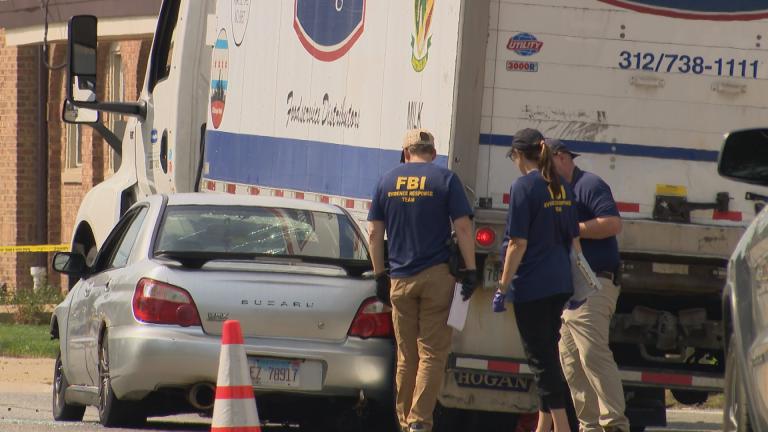
Among the 103 crosses is one bearing the name of 38-year-old Silverio Villegas Gonzalez, who was shot and killed in Franklin Park by an ICE agent during a traffic stop in 2025.
“Tragically, those kids who are 7 and 3, and other kids, are now without their father,” Curran said.
Organizers hope visitors take away a simple message: that the people represented by the crosses were more than statistics. They were parents, children, grandparents, siblings, friends and members of communities.
“Never forgotten, nunca olvidados, a reminder to us — we can never forget,” Curran said.
The crosses will continue traveling throughout the Chicago area, bringing names and stories to new communities. Click here for the schedule.
For those behind the project, the hope is that people start a conversation about how immigrants are treated in the communities they call home.