Business
As Organizations Help Chicagoans Navigate High Cost of Living, New Survey Finds 43% of Residents Just Getting By
 (Locus Stock LLC / iStock)
A homelessness organization working with residents facing eviction. A food bank seeing families forced to choose between paying for food, healthcare or housing. An employment agency assisting clients working multiple jobs or facing significant employment barriers.
As social service organizations like these aim to meet Chicagoans’ needs, a new poll released Wednesday sheds light on what residents are facing.
The ChicagoSpeaks Poll commissioned by NORC at the University of Chicago and first reported by WTTW News offers insight into Chicagoans’ financial pressures, concerns of job loss and the inability to pay bills, along with the role of federal safety net programs like SNAP and Medicaid.
“Most Chicagoans are managing, but they have almost no financial margin,” said Vince Welch, associate director at NORC at University of Chicago. “There’s not a lot of room for error, and there’s not a lot of room for the other things that might contribute to the greater sense of well-being or thriving, (like) savings and other non-essentials.”
The survey found:
- 43% of participants said they are just getting by, 13% said they’re finding it hard to get by, and 39% said they are living comfortably. Only 5% considered themselves to be thriving financially.
- Of those interviewed, 29% said they cannot pay some bills or can only make partial payments on some.
- Federal safety-net programs reach a sizable share of the city, with about 3 in 10 Chicagoans receiving health coverage through Medicaid in the past year, and about a quarter receiving SNAP benefits.
- Among employed residents, 19% thought it is very or fairly likely they will lose their job or be laid off in the next 12 months. The concern has held steady in recent months, but is down nine percentage points from September 2025.
This poll of 1,108 adults was conducted Sept. 13-23, using a sample drawn from NORC’s probability-based ChicagoSpeaks Panel, which is designed to be representative of the Chicago population. The margin of sampling error is plus or minus 4.1 percentage points.
“We want these data to get into the hands of folks who are in a position to make the lives of Chicagoans better,” Welch said. “We want these data to be a true representative piece of information that allows them to craft policy or to deliver services in a way that is going to be the most helpful.”
Homelessness Prevention and Services
All Chicago Making Homelessness History is a planning and policy body that works to end homelessness in the city. One of its services includes emergency financial assistance, also known as homelessness prevention funding.
The average request for emergency funding, typically used to help families cover back rent to avoid eviction, is about $1,500, according to All Chicago President and CEO Peter Toepfer.
The ChicagoSpeaks survey found 29% of Chicagoans say they cannot pay some bills or can only make partial payments on some.
“People’s incomes simply are not keeping pace with the cost of living, and rent, in particular, which has climbed so much in the last several years,” Toepfer said. “Housing is typically people’s largest single expense, and so as the prices in the housing market go up, that puts greater pressures on every other aspect of people’s livelihood.”
Toepfer said there is far more demand for services — from one-time financial assistance to long-term rental subsidies — than the organization is able to meet.
The nonprofit recently launched a new approach for its emergency financial assistance program that aims to focus on neighborhoods with the highest rates of evictions. Those neighborhoods are located on the South and West sides.
“We know that people will skip meals to help pay for rent, will forgo utility payments to pay for rent, won’t pick up prescription medications so that they can cover their rent,” Toepfer said. “Whether because of affordability or a personal crisis, it becomes extremely stressful, and then if someone were to fall into homelessness, people often talk about the trauma of experiencing homelessness and the shame of becoming homeless even when it’s not something that is their doing. They still feel like, ‘I couldn’t figure this out,’ when in fact, it’s not their choice.”
The organization advocates for increased funding for homelessness services and more investments in affordable housing and fewer barriers to build affordable housing. Toepfer said there needs to be a fundamental shift in how people talk about housing, which is that housing is a universal human right and a basic human need.
Food Assistance
Every year, the Greater Chicago Food Depository distributes more than 100 million pounds of food to more than 850 emergency food distribution partners, including food pantries, soup kitchens and homeless shelters.
The nonprofit has seen an increase in demand for services in light of the passage of HR1, the 2025 budget reconciliation law known as President Donald Trump’s “One Big Beautiful Bill Act.” That act led to sweeping changes to SNAP by imposing stricter work requirements, along with cutting eligibility from refugees and those granted asylum.
Along with increased demand for food, the food bank is also seeing an increase in demand for public benefits enrollment services, with people having questions about their benefits in an increasingly complex benefits landscape, according to Nolan Downey, senior director of policy at the Greater Chicago Food Depository.
The ChicagoSpeaks survey found majorities believed the federal government was spending too little on federal safety-net programs like Medicaid and food and nutrition assistance programs like SNAP or EBT.
Views on government spending on these programs varied by political affiliation, the study found. Democrats and independents in Chicago were more likely to believe spending on Medicaid and SNAP is insufficient, while Chicago Republicans were more likely to feel the government spends too much on these programs.
“The polarizing opinion about our benefit system has to do with the inflammatory rhetoric that’s often used to falsely characterize people that are on these programs, when really, we just need to center on the fact that we have enough resources to meet people’s basic needs,” Downey said. “It’s a moral failure in this country that there are people that are going hungry.”
More than 1 in 3 households in Chicago, or about 417,000 households, lack consistent access to enough food, with families with children being at even greater risk, according to a study released last month by the Greater Chicago Food Depository.
The organization advocates for a “robust and meaningful” social safety net, which it believes is needed to ultimately end hunger, Downey said.
Helping Job Seekers Overcome Barriers
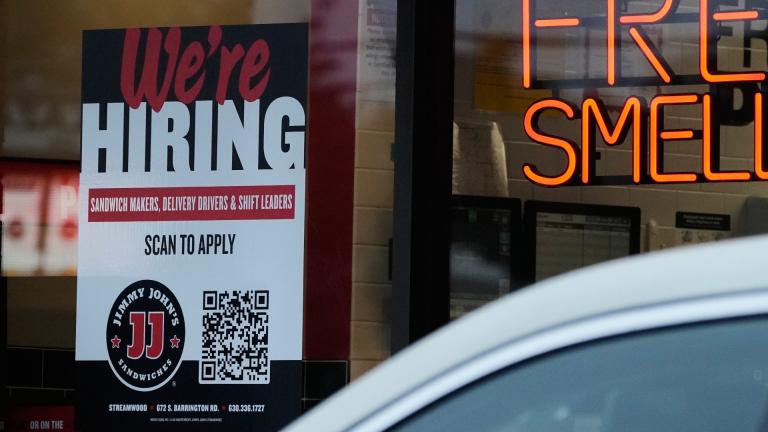
Kurt Miller is a senior regional director at Employment & Employer Services who manages American Job Centers in south suburban Harvey and at the King Center. Designated through the federal Workforce Innovation and Opportunities Act, the centers are a free resource where people can get career counseling, job training and other employment-related services.
Miller said he serves clients across all ages at various stages of their careers, from young people who want to gain more work experience to older adults who may have recently gotten laid off and are looking to get more comfortable with technology.
“A lot of times, the first step is you have to have a computer, you have to have Wi-Fi, you have to sit down somewhere and you have to be able to interview, and not everyone has those accommodations in their home, and a lot of people have not interviewed virtually before,” Miller said.
Those who his organization serves often face other barriers and pressures, such eviction concerns, rent increases, access to transportation and childcare, and people working multiple jobs in order to afford expenses, according to Miller.
“I think a piece of empathy goes a long way when you’re working with people and just trying to meet people where they’re at,” Miller said. “The big thing to remember is people are the experts of their own lives.”
American Job Centers in the Chicago area are within the umbrella of the Chicago Cook Workforce Partnership, a nonprofit that stewards federal workforce development funding. Beyond helping job seekers, the work of Employment & Employer Services also involves engaging with local employers who are looking to hire and train for their teams.
Job sectors that tend to consistently hire include healthcare, construction, hospitality and logistics, according to Miller. Seasonal hiring jobs can also help to lead to full-time opportunities. Miller advised employers to be flexible in their hiring, to lay out a career path and let people know when there are other opportunities within the organization.
The ChicagoSpeaks survey found that among employed residents, 19% think it is very or fairly likely they will lose their job or be laid off in the next 12 months.
Miller advised those with jobs to continue to update their resume and skills and to continue to look for other job opportunities if working somewhere that conducts many layoffs.
“Don’t wait until you don’t have a job to look for a job,” Miller said.
Contact Eunice Alpasan: [email protected]