Business
Dow Has Best Post-Midterm Elections Day in 44 Years as Democrats Take Control of Congress
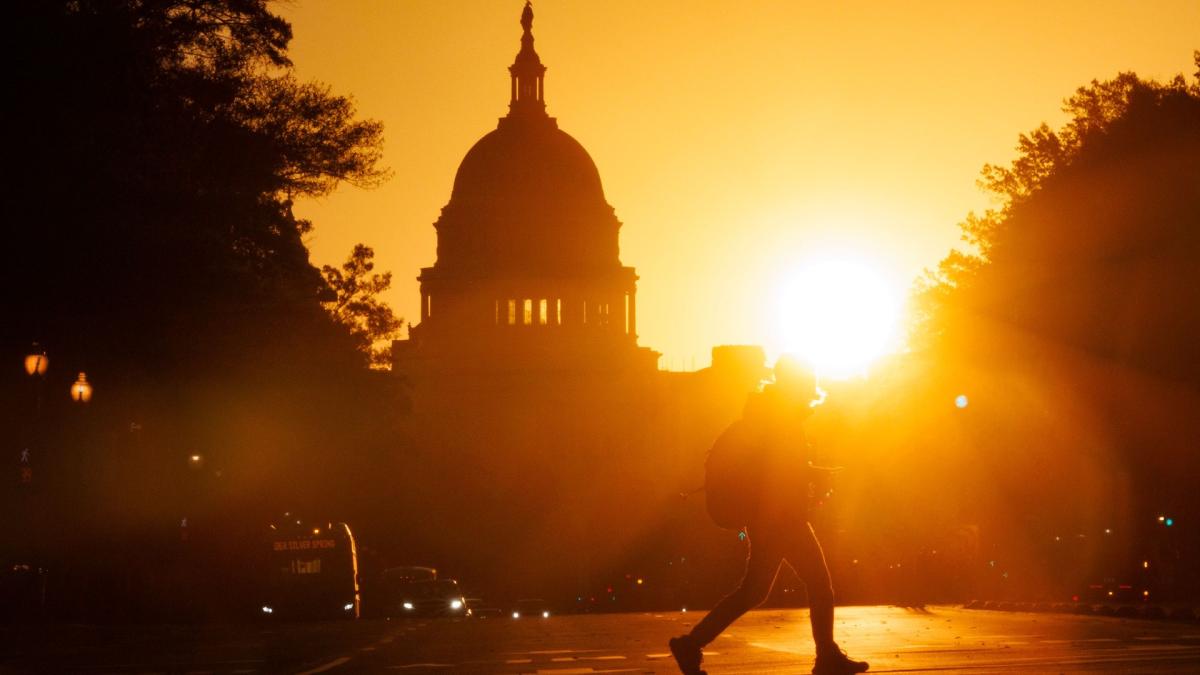 The U.S. Capitol, seen during sunrise on Nov. 4, 2026 in Washington, DC. (Tom Brenner/Getty Images via CNN Newsource)
(CNN) — U.S. stocks soared Wednesday as Wall Street digested the resounding Democrat sweep in the midterm elections and mulled what a divided government will mean for the war with Iran, President Donald Trump’s policy agenda and the AI trade.
The Dow surged 1,569 points, or 3%, and had its best day since April 2025. The Dow also posted its biggest post-midterm elections single-day gain since 1982, according to data from CFRA Research.
The S&P 500 rose 1.58% and had its second-biggest post-midterm elections single-day gain since 1982, following its gain after the 2018 midterms. The Nasdaq Composite rose 1.44%, its biggest post-midterm elections one-day gain since 2018.
Stock futures initially fell Tuesday night before erasing losses and gaining overnight as investors embraced the certainty offered by the decisive election results and Trump’s acknowledgement that he’ll accept them.
The benchmark US stock indexes extended gains Wednesday while oil prices dropped sharply and bond yields fell as traders weighed the future of the war with Iran with a newly Democrat-controlled Congress.
“The reason we lost is the war,” Vice President JD Vance said in a post on X. “The president himself said so last night.” Oil prices accelerated declines after the vice president’s comments. Brent crude fell almost 8.7% and settled at $94.62 per barrel, its lowest settle level since August 31.
While traders priced in potential de-escalation, other analysts urged caution. “Traders are betting that the administration is going to quit this war because the (midterms) shellacking was bigger than anyone expected,” said Bob McNally, president and founder of Rapidan Energy Group. “We’re not buying it. We think escalation is more likely.”
Investors also warmed to the prospect of policy gridlock under a divided government, which can curb excess spending and create a more predictable outlook for markets. The VIX, which measures expectations for volatility, sank almost 20%.
“The combination of a large Democratic majority in Congress and President Trump’s statement that he is willing to work with the opposition should act as a break on extreme policy outcomes and bring down risk premia,” George Saravelos, global head of FX research at Deutsche Bank, said in a note.
Expectations that the election outcome could keep a lid on excessive government borrowing and spending bolstered US government bonds, sending yields lower. The dollar weakened against a basket of major currencies.
“Divided government has generally made it harder for fiscal stimulus to be passed,” Deutsche Bank analysts wrote in a note. “So, that’s eased concerns on the fiscal trajectory a bit.”
“A Democratic-controlled Congress would significantly constrain Trump’s legislative agenda, particularly on taxes, fiscal stimulus and spending,” Charu Chanana, chief investment strategist at trading platform Saxo, said in a note on Wednesday. “But Democrats would not have a free hand to rewrite policy either, because Trump retains veto power.”
Questions Linger for AI Stocks
Meanwhile, investors are also trying to discern what key election results could mean for the outlook for data centers, which are the bedrock of the AI trade that has buoyed US markets.
Wall Street analysts had expected a strong performance for Democrats, but the extent of the sweep caught some traders off guard. On Kalshi, odds for Gina Hinojosa to win the Texas governor’s race were pinned at less than 20% for most of the year.
The proliferation of AI data centers across different states became a critical issue in many campaigns, and Democrat wins in states like Texas raise questions about whether there will be more moratoriums or restrictions that could slow the data center buildout.
While most stocks were higher Wednesday, shares of semiconductor chipmakers and other companies involved in the data center buildout fell. Nvidia (NVDA) fell 3%, while an exchange-traded fund tracking AI infrastructure stocks dropped 9%.
Shares of CoreWeave (CRWV) and Nebius (NBIS), two neoclouds that rent out compute power for the AI boom, sank roughly 10% and 6.7%, respectively.
Shares of Elon Musk’s Tesla (TSLA) and SpaceX (SPCX) fell about 3.3% and 3.9%, respectively. Musk has made Texas the home for his companies, and Democrats’ victories in the gubernatorial and Senate races are casting uncertainty over his future relationship with the state.
“While a blue wave could spark volatility in certain sectors, such as tech and AI, given growing public opposition to the buildout of data centers, we believe markets can grind higher regardless of the outcome as investors applaud falling uncertainty,” Justin Buell, chief investment officer at Continuity Group, wrote in a note.
Elsewhere, shares of CVS Health (CVS) dropped 12.5% after the healthcare giant announced it would split into two companies.
The-CNN-Wire™ & © 2026 Cable News Network, Inc., a Warner Bros. Discovery Company. All rights reserved.