Business
Storm Recovery Continues in Gary, as Thousands Still Without Power
When heavy rains and high winds hit Gary, Indiana, nearly two weeks ago, Joshua Austin was locked out of the building where he works.
Austin, the executive director at City Life Center, had to take shelter in his car. According to Austin, the building uses smart locks that fail when the power is out.
“After the storm was over, I drove around the city of Gary and saw the immediate devastation — the flooding, the trees down everywhere, power lines down, poles just snapped in half,” Austin said. “It was different from any storm we’ve had.”
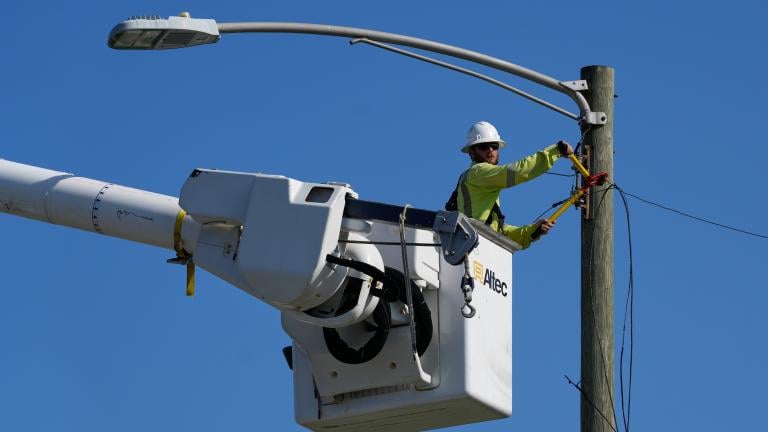
Tuesday will mark two weeks since a derecho swept through Illinois and northwest Indiana, with winds damaging homes, uprooting trees and knocking out power for hundreds of thousands.
While the slow pace of restoring power to a majority Black city in Indiana is drawing increasing scrutiny, community members, elected officials and local organizations are finding ways to lean on each other for support.
NIPSCO, the electric utility for northern Indiana, estimated that 347,500 customers lost power after the derecho and subsequent storms. As of 4 p.m. Monday, 9,319 customers were still without power.
More than 80% of those customers without power were in Gary and Portage. NIPSCO estimated power would be restored to both of these cities by 11:59 p.m. Tuesday.
In a statement, the utility company said, “NIPSCO employees who live in these communities have been working around the clock since before the first storm touched down. We’ve mobilized emergency support from across the country to help, and together we will not rest until power is restored to every home and small business in our service territory.”
Like Austin, Calvin Davis had never seen a storm like the one on Aug. 11. As a government and politics reporter for Capital B Gary, Davis started asking questions.
“I spent a lot of time last week talking to environmental researchers and meteorologists,” Davis said. “And I’ve even become a little fascinated myself.”
Through this reporting, Davis learned that strong, sustained winds — what some meteorologists called a “land hurricane” — coupled with wet soil from previous rains, created conditions ripe for uprooting trees.
Because of Gary’s dense tree canopy mixed with nearby power lines, many felled trees also brought down electricity infrastructure with them.
Recovery efforts are continuing while residents wait for power to be restored. According to Austin, City Life Center has served as a hub for resources. The city of Gary uses the center to help distribute three meals a day to residents, while the building also serves as a pick-up and drop-off spot for donated goods.
“People are feeling that hope, and that support — they still are not happy they’re without power — but people are seeing that the government, and the local officials are working for them,” Austin said.
Davis, a lifelong Gary resident, is well acquainted with the connectivity of the community. That quality, he said, is essential for showing resilience.
“A crisis like this really does test the community, because you don’t have people displaced, you have people isolated,” Davis said. “So in order to reach those people, you need to have strong connections. And that’s what we’ve been seeing.”