Crime & Law
How Community Intervention Groups Are Working to Stem Gun Violence in Chicago
Summer in Chicago statistically means a spike in gun violence.
While overall crime has been on a downward trend, the city is nevertheless on pace to pass last year’s shooting and homicide numbers, according to Chicago Police Department data — with June seeing 36 homicides and 132 shootings so far, both up from 2025.
Police continue to respond, but some groups think there’s a better way to handle gun violence: community prevention.
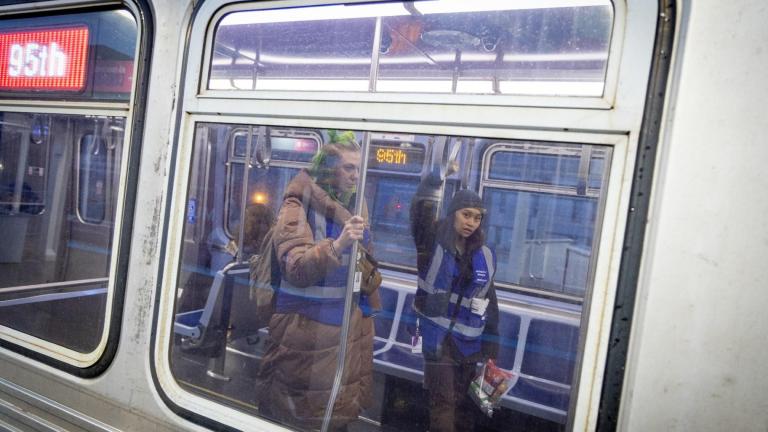
Community violence interventionists, or CVIs, walk high-risk neighborhoods hoping to interrupt cycles of violence through direct outreach and trust-building. WTTW News spent the day with one team to see what it’s all about.
On a recent sunny day in Garfield Park, a team of peacekeepers strolled the neighborhood — making contact with people, chatting about what’s going on and building trust along the way.
This is exactly what Vaughn Bryant, executive director of Metropolitan Peace Initiatives, wants to see.
“Community violence intervention is basically sort of a non-punitive approach to gun violence,” Bryant said. “We’re more preventative and intervention. You know, police are more accountability and trying to bring justice.”
Bryant knows community relations with the police are fraught and have been for a long time.
“A number of factors have led to a mistrust of police,” Bryant said. “There are policies and procedures that you know cities have that the law enforcement, like police, are enforcing that can be racist.”
Bryant sees a way for police to work with CVIs to make communities safer.
“It is really based on the idea that people that live in the local community are closest to the problem and more of the solution,” Bryant said.
Samuel Castro, director of strategic initiatives and partnerships at the Institute for Nonviolence Chicago, agrees.
“Lived experience is something that you can’t learn out of a book,” Castro said. “This is something that we went through.”
Castro and Bryant aren’t alone in this mission of community activism. Metropolitan Peace Initiatives gathered 15 area organizations to form Communities Partnering 4 Peace.
Castro feels a relationship with the community is crucial, but he knows they also need to connect with Chicago police.
“What we have created with law enforcement is a professional understanding,” Castro said. “We have to build a trust, so from CPD not to think that CVI organization staff are the same drivers of violence, the same people that used to sell drugs.”
Bryant agrees and said CVIs must strike a delicate balance.
“We have sort of a one-way communication line,” Bryant said. “So we get information from the police, but we don’t give information to the police because that would ruin the credibility and the trust that we have with folks.”
It’s work that’s been ongoing for years but has further to go.
“We want to get to a place where people just commit fewer crimes because they see opportunity to thrive,” Bryant said.
“There’s no magical powder in the air,” Castro said. “There’s real humans doing the work that have been impacted by violence, trauma, all through their life, and we’re running back to the fire to help people.”
So for now, Bryant and Castro stay the course.
“In 10 years from now, I’m hoping we could put ourselves out of business,” Castro said. “To make the communities safer.”
WTTW News coverage of policing and police reform is supported by The Joyce Foundation.