Crime & Law
Chicago’s Deputy Mayor for Community Safety on Teen Takeovers, Restorative Justice and the Value of Belonging
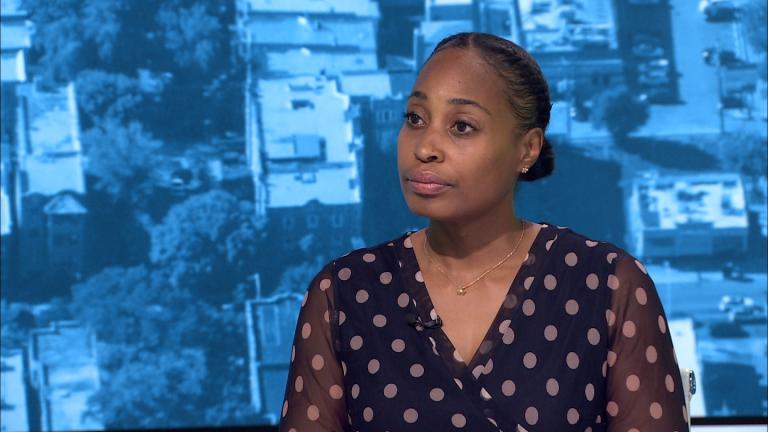
From the beginning of his appointment in April, Chicago Deputy Mayor for Community Safety Emmanuel Andre has faced a number of challenges — from how to handle teen takeovers and rising domestic violence cases to aggressive federal immigration enforcement and rising political tensions.
Andre is tasked with overseeing the city’s public safety agenda at a time when overall crime is on the decline but critics of Mayor Brandon Johnson are questioning his administration’s approach.
Andre sat down with “Chicago Tonight” to discuss progress so far and his vision for the city’s future. Here’s what he had to say about Chicago’s most pressing public safety issues and his personal journey in this role:
On homicides in Chicago:
Even though Chicago ended 2025 with its lowest homicide total in 60 years, homicides are still up 7.5% so far this year, according to data from the Chicago Police Department. The increase is in contrast to the two largest cities in the United States. According to the NYPD, homicides in New York City are down 21% so far this year, while Los Angeles saw a 10 % decrease.
“When you look at some of the rest of the data, especially around violent crimes and how that continuously declines, data around carjackings, around robberies, all of that is very, very consistent,” Andre said. “We’re not happy with where things are, but we are encouraged that the overall strategy is working, and this is something that takes several years to continue on, but we’re uber-focused on making things better.”
“We’re 77 communities, but we’re very disparate in a lot of ways, so we have seen a spike in certain neighborhoods and we’re trying to focus in on those neighborhoods that we’ve seen that spike in,” Andre said, noting that Chicago started with a higher homicide rate compared to New York and LA. “We continue to work on being able to help turn that tide.”
On his approach to community safety:
Andre founded a restorative justice hip-hop organization called Circles and Ciphers before he joined city government. The group uses music as a means to engage young people in a positive manner. He was also a Cook County public defender who worked to expand restorative justice community courts.
“Safety is about belonging, and not just the absence of violence, but about belonging,” Andre said. “It’s more so a philosophy of how we want things to be, and how we want to be in relationship with each other. … Because of my work, because of my background, I’ve been able to work with victims and survivors in addition to people who’ve been accused, and that helps frame the way I approach things to be able to say, ‘Look, at the end of the day, we wanna be a better community through whatever crisis happens,’ and what’s needed to be able to tap into that and move that forward.”
On teen takeovers:
“So this is not necessarily a new phenomenon, right? Young people have been gathering for years, for decades, I would argue. Now, we do have some new points in that phenomenon. We didn’t have social media, and we’re not coming off of a historic event like COVID. … How do we continue to increase the spaces for young people to go to be able to be in community with each other? A couple of months back, the mayor’s office hosted a big gathering at Navy Pier that saw over 1,500 young people. How do we continue to offer that? Even this weekend, there’s gonna be around 31 (activities) that we’re supporting in some way that we’re hopeful is going to be able to engage well over 40,000 people throughout the city. We’re excited about being able to be proactive, especially for the gatherings that we’re particularly concerned about — those that may, for whatever reason, turn violent. We’re working with city government partners all across the spectrum to be able to make an impact on this issue.”
On ShotSpotter:
Chicago in 2024 ended its contract with ShotSpotter, the technology used by law enforcement to identify and pinpoint the location of gunfire in real time. Johnson believes, based on a variety of studies, that the gunshot detection system is not effective in decreasing shootings or keeping Chicagoans safer. A majority of the Chicago City Council, however, remains convinced that such a system is necessary.
“I do think that the mayor still remains aligned with making sure that we have great technology that works, that’s going to help further inform public safety, but as it pertains to specifically ShotSpotter, I think there’s been tons of research around that in terms of the issues associated with that. So the mayor is very clear on his position.”
“I think what’s being asked right now is: ‘How do we properly evaluate those technologies?’ Chicago should not be the guinea pig for all technologies, the testing ground. So can we put together an infrastructure that’d be able to properly evaluate technologies to make sure that Chicagoans are getting the absolute best? I think that’s one thing that’s absolutely needed. We’re definitely not saying no to technology. We want to make sure it’s effective, efficient and is able to move public safety forward.”
WTTW News coverage of policing and police reform is supported by The Joyce Foundation.