Education
In This Fall’s Chicago School Board Elections, Many Voters May Only Have One Candidate to Choose From
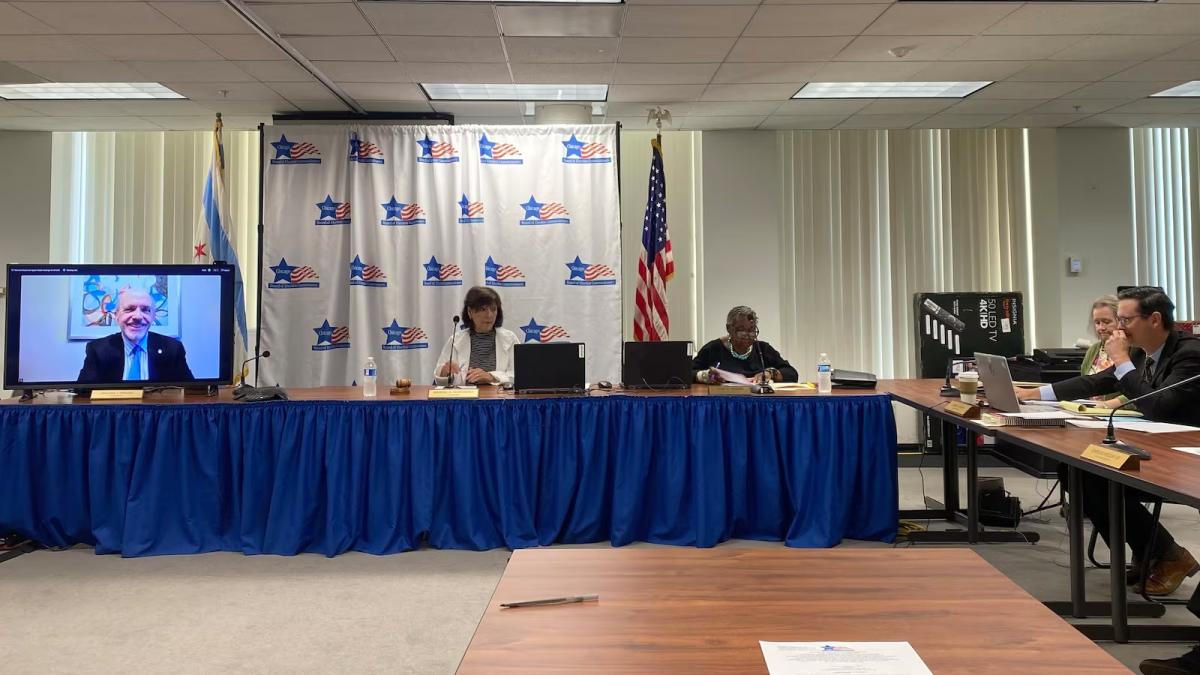 The electoral board of the Chicago Board of Elections Commissioners review cases challenging the petitions of people who filed to run in the 2024 school board elections. This year, challenges have been filed against more than half of the candidates running in the election this November. (Becky Vevea / Chalkbeat)
by Reema Amin, Chalkbeat Chicago and Maureen Kelleger, Board Rule
This story was originally published by Chalkbeat. Sign up for Chalkbeat Chicago’s free daily newsletter to keep up with the latest news on Chicago Public Schools. Subscribe here for Board Rule.
For three decades, Chicago voters have not had a direct say in who represents them on the city’s Board of Education.
And many may not have much of a choice again this fall, despite an otherwise historic election in which all 21 school board seats are on the ballot in November’s general election.
That’s because 17 races could end up with just one candidate if challenges to their petition signatures are successful. That’s on top of the two seats up for election that have just one candidate.
This year, 28 candidates — more than half the current field of 51 candidates — are at risk of getting knocked off the ballot. The Urban Center, a pro-school choice, politically centrist organization, is behind at least 14 of those challenges.
Most of the candidates facing challenges — including four of the five people running for board president — could be wiped from the ballot due to a claim that the way they collected signatures violated election law. Most of The Urban Center’s challenges include this claim.
Known as a dual circulator argument, the challengers say that some people who helped candidates collect signatures were not allowed to do so because they had already circulated petitions for other candidates during the March primary election. Chicago’s school board races are nonpartisan and were not part of the primary.
If the electoral board agrees, they could make a single ruling that would result in thousands of voters across 14 districts having just one school board candidate on their ballot.
For candidates, fighting petition challenges can be time-consuming and expensive, which can cut into campaigning or cause them to withdraw from the race and leave voters with fewer choices. Election attorneys and challengers, however, say the process ensures candidates are following the law and are people who voters want on the ballot.
In 2024, 47 candidates filed to run, and 31 remained on the ballot.
In Chicago, petition challenges are often backed by powerful special interests as a tactic to narrow the race.
The Chicago Teachers Union was behind many of the challenges in 2024, when 10 of 21 board seats were up for election. This year, other special interests are employing the tactic.
Robert Sylvester, vice president of The Urban Center and chair of their political action group, told Chalkbeat and Board Rule his group is working with other political organizations and longtime elections attorney Mike Kasper on their challenges — more than half of which target candidates who are current mayoral appointees on the school board, have previously been backed by the union, or lean politically progressive.
“The democratic process is important to me and Urban Center,” Sylvester said in an interview. “We challenge to make sure people play by the rules.”
Asked if The Urban Center targeted candidates who don’t ideologically align with it, Sylvester said, “We challenged anybody we thought didn’t have the requisite signatures or that they didn’t follow the rules around the circulators.”
The basis for challenging candidate petitions
Candidates for school board running to represent the district they live in were required to collect between 500 to 1,500 signatures on a form known as a nominating petition. Those running for board president, which is a citywide office, were required to collect 2,500 signatures.
But there are very specific rules for what counts as a valid signature: Signers must be registered to vote at an address in the same district as the candidate, they cannot sign multiple petitions for the same race, and, though it may be obvious, the signature can’t be forged.
Victor Henderson, a newcomer candidate running for board president, is facing one of the more serious challenges: Two objectors have accused him or someone on his team of fraudulently altering his signers’ addresses in order to make the signatures valid.
A handful of objections are over more technical matters. For example, one objector claimed that current appointed board member Norma Rios-Sierra, who is running in district 3a, should be knocked off the ballot because she didn’t include a hyphen in her last name on her nomination paperwork. Candidate Marlo Bennet faces two challenges arguing they did not identify the subdistrict they’re running for and should therefore be disqualified.
Nearly two dozen challenges include the “dual circulator” argument and cite a part of election law that says “no person shall circulate or certify petitions for candidates of more than one political party, or for an independent candidate or candidates in addition to one political party, to be voted upon at the next primary or general election, or for such candidates and parties with respect to the same political subdivision at the next consolidated election.”
Another section of election law says that where applicable, the law also applies to nonpartisan candidates.
The point of the law is to prevent “political gamesmanship” or a “sore-loser” situation, such as someone switching to run as an independent in the same election season, said Ross Secler, an elections attorney and partner at Odelsen, Murphy, Frazier and McGrath, who cited previous Illinois Supreme Court rulings over the issue.
Secler, who is representing objectors in two challenges but is not making the dual circulator argument in either of them, said he doesn’t see how dual circulators violated the spirit of the law in this situation. The March primaries were unrelated to local school board races.
Normally, a challenge is resolved once a hearing officer reviews the case, issues a recommendation, and the electoral board takes a final vote on whether the candidate gathered enough valid signatures to be on the ballot.
Connie Anderson is running in district 10b and is one of the candidates facing the dual circulator argument. Anderson’s husband, Clifton, has also challenged the petitions of Anderson’s opponent, Rosita Chatonda.
Anderson is getting legal help from the CTU to defend her petitions — an offer CTU leaders made to all candidates shortly after challenges were made public.
“We are blessed that an organization came in and said, ‘We will help you even if we haven’t endorsed you because we believe in your vision,’” Anderson said. “We align in that way.”
During the 2024 school board races, the union was behind challenges against 19 candidates. A CTU spokesperson said the union did not back any challenges this cycle and could not immediately confirm which candidates the union has offered legal help to.
Julie Metea, a spokesperson for the Electoral Board, said that attorneys involved in cases with the “dual circulator” argument asked the Electoral Board to rule on the issue once instead of having several different hearing officers decide on individual cases.
Metea said that the board is tentatively planning to hold one hearing to decide on this issue, but that isn’t final.
Candidates who escaped challenges breathe sigh of relief
Several candidates facing these objections didn’t return calls or declined to comment on the record about their cases.
Some current and former candidates said they escaped challenges because they did a lot of research or didn’t rely on paid circulators, who candidates pay per signature.
Jennifer Custer, a current elected board member who is running for board president, escaped a challenge, meaning she’s guaranteed to be on the ballot.
“We made sure to just check everything before we even started petitions and make sure that we were following the law,” Custer said in an interview.
When Anthony Hargrove ran for school board in 2024, he largely relied on a paid circulator who was tasked with securing 500 signatures. Then, Hargrove faced a petition challenge and was knocked off the ballot after many of his signatures were deemed invalid. Last time, it cost the father of four expensive attorney fees and time to fight the challenge.
Chicago elections, he said, can feel “like a frat that’s really, really impossible to get into.”
Hargrove is running again this year for district 5a on the West Side, and he changed his strategy for getting on the ballot. He got advice from retired politicians. He read the law. He said he didn’t pay anyone to collect signatures, and instead, he, his wife and others spent evenings and weekends knocking on doors and attending community events to collect hundreds of more names than he needed. Then he went to the county building to make sure his signatures were valid.
Last week, after repeatedly refreshing the Board of Elections website, he saw that no one had challenged his petitions.
“It was like, ‘Oh my god, I made it. Oh my god, I’m a candidate,’” Hargrove said.
Isaiah Pinzino and Norah D’Cruze contributed to this report.
Reema Amin is a reporter covering Chicago Public Schools. Contact Reema at [email protected].
Maureen Kelleher is the founding editor for Board Rule. Contact Maureen at [email protected].
Chalkbeat is a nonprofit news site covering educational change in public schools.