Investigations
Chicago’s Sidewalks Aren’t Accessible for People With Mobility Challenges, Lawsuit Argues. The City Wants the Case Dismissed
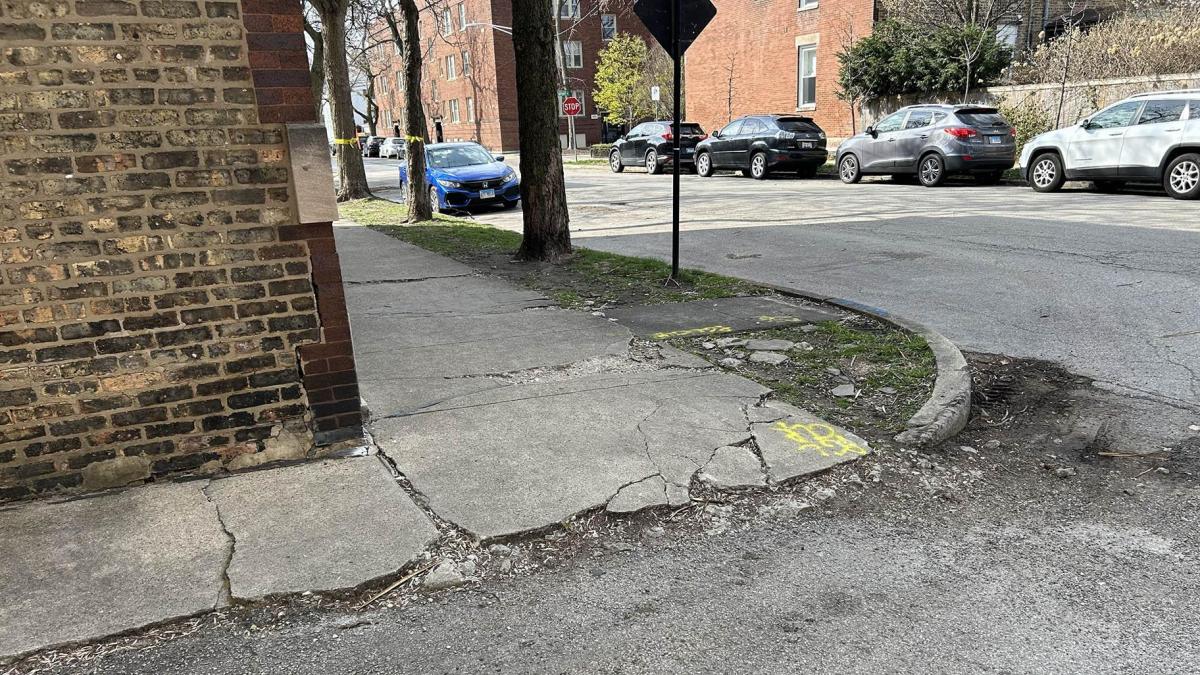 A sidewalk in Roscoe Village is pictured in an April 2024 file photo. (Jared Rutecki / WTTW News)
Getting around Chicago can be extremely difficult for people with a disability — and not just because it’s a complicated, noisy urban environment.
In 2023, a federal judge ruled in a class action lawsuit that Chicago’s failure to make its signalized crosswalks accessible to blind and low-vision pedestrians violated the Americans With Disabilities Act and Rehabilitation Act. Despite decades of cries for help — and New York City losing a similar lawsuit — the city fought the case for years, ultimately failing. Now it’s under a court-appointed monitor ensuring Chicago complies with a plan to fix the problem.
Last fall, the firm that successfully took on Chicago’s inaccessible crosswalks brought another lawsuit against the city — this time, arguing that it has long failed to properly build and maintain sidewalks, curb ramps and other key pedestrian infrastructure that people with mobility disabilities must navigate, as well as to provide accessible alternate routes when construction blocks rights of way.
It’s not the first time Chicago has faced claims like this. In 2005, the city was hit with a federal class action over its failure to build curb ramps. Chicago settled the case in 2007 by pledging to spend $50 million — the largest-ever settlement in an ADA suit at the time.
But just building the curb ramps and other accessible infrastructure isn’t enough if they’re not maintained, plaintiffs and attorneys involved in the suit say.
“We took a look at the city’s uncoordinated systems and they’re just simply not working,” said Rachel Weisberg, directing attorney in Disability Rights Advocates’ Chicago office. “We found that there were over 20,000 open (311) requests for sidewalk improvements, and even more concerning than that, the data showed that there were over 6,000 open for more than three years. That’s a very long time to wait to be able to navigate outside of your block or outside of your community.”
In an audit of 311 requests released in February, Chicago’s inspector general found that “the information about service requests on 311’s public facing platforms contributes to public confusion and distrust” because they “do not provide users with clear information on the overall process, request statuses, and work order timeframes … 311’s potential to improve city services and ability to provide deeper analysis is hampered by its limited staffing.”
A 2024 WTTW News investigation detailed how the city uses a patchwork of programs to maintain its sidewalks, leading to confusion about how and where they get repaired.
Dangerous Sidewalks, Constant Vigilance
Navigating broken curb ramps, cracked and crumbling sidewalks or pathways overgrown with weeds is nothing new to plaintiff Cherlnell Lane, a Washington Park resident who uses a motorized wheelchair to get around. She said she often encounters sidewalks with separations so large that she can’t roll over them, forcing her to ride in the street.
“Then I have drivers cursing at me, I have drivers trying to play chicken with me, screaming at me, saying that I shouldn’t be on the street, but I can’t go down the sidewalk,” Lane said.
For Lane, keeping an eye out for damaged infrastructure means constant vigilance when she’s on the go — but vigilance is no guarantee. She told WTTW News a damaged crosswalk once caused her to fall, with her chair landing on top of her.
“Stuff like that gives you PTSD, it scars you,” Lane said. “It feels like you’re at war … (and you) have to watch for grenades.”
Plaintiff Kevin Sullivan was born with a condition that makes his muscle tissue more fibrous than the average person, necessitating ankle-foot orthotics for short distances and a power wheelchair for longer trips. He lives in suburban Palatine and previously commuted into the city for work; he still regularly comes into Chicago to visit friends, see concerts or sports games and attend festivals.
“Going around a more unfamiliar area, I’ve got to keep an eye on the sidewalk to make sure that I don’t hit a bump too hard or accidentally damage my power wheelchair … it adds to the whole mental toll of the experience,” Sullivan said. “A lot of people take the sidewalk for granted because they are able-bodied and they can drive, but for people like me and Cherlnell and anyone else who uses a mobility device, the sidewalk is our road.”
But in a motion to dismiss the case, the city argues Sullivan and Lane don’t even have standing to bring this suit.
“Plaintiffs have not plausibly alleged facts to establish personal knowledge of and intent to use every pedestrian facility in the City, totaling more than 7,400 miles of sidewalks, curb ramps, and crosswalks,” city attorneys wrote, adding that the charges of failing to provide alternate routes when sidewalks are blocked should also be kicked out “because they identify no site that currently fails to comply with any identified regulation.”
The city also claims that the plaintiffs’ suit misapplies or fails to identify applicable accessibility law and Department of Justice regulations. A spokesperson for the city’s Law Department declined to comment, citing the ongoing nature of the litigation.
Both sides are awaiting a ruling from the judge assigned to the case on the city’s motion to dismiss. Weisberg said that assuming the ruling goes in their favor, the plaintiffs will next file to be certified as a class. And Weisberg added it’s important to bear in mind that while accessible sidewalks are crucially important for the plaintiffs in this case, safe pedestrian infrastructure is good for all Chicagoans: “older adults, parents with strollers, anyone navigating the public right of way. And so while it is an absolute lifeline for people with mobility disabilities, it’s certainly a benefit for everyone.”
As for Chicago’s efforts to make its crosswalks accessible, a June 5 press release touted that the city now has 160 accessible crosswalks with 78 having been completed in the past year and more than 100 installations slated for the coming year.
“Every Chicagoan deserves to move through our city safely and with confidence,” Mayor Brandon Johnson in a statement. “This significant expansion of Accessible Pedestrian Signals is about making our streets more inclusive and ensuring residents who are blind or have low vision can travel more independently in every neighborhood.”
The release touted that last year the Chicago Department of Transportation “significantly accelerated implementation, exceeding its annual installation targets and reaching more neighborhoods throughout the city” — but made no mention of the class action lawsuit the city lost. The court-appointed monitor’s report on the city’s progress installing accessible pedestrian signals is expected July 1.
Contact Nick Blumberg: [email protected] | (773) 509-5434 | @ndblumberg