Education
Development of CPS Safety Plan Can Serve as Model for Other School Districts: Study
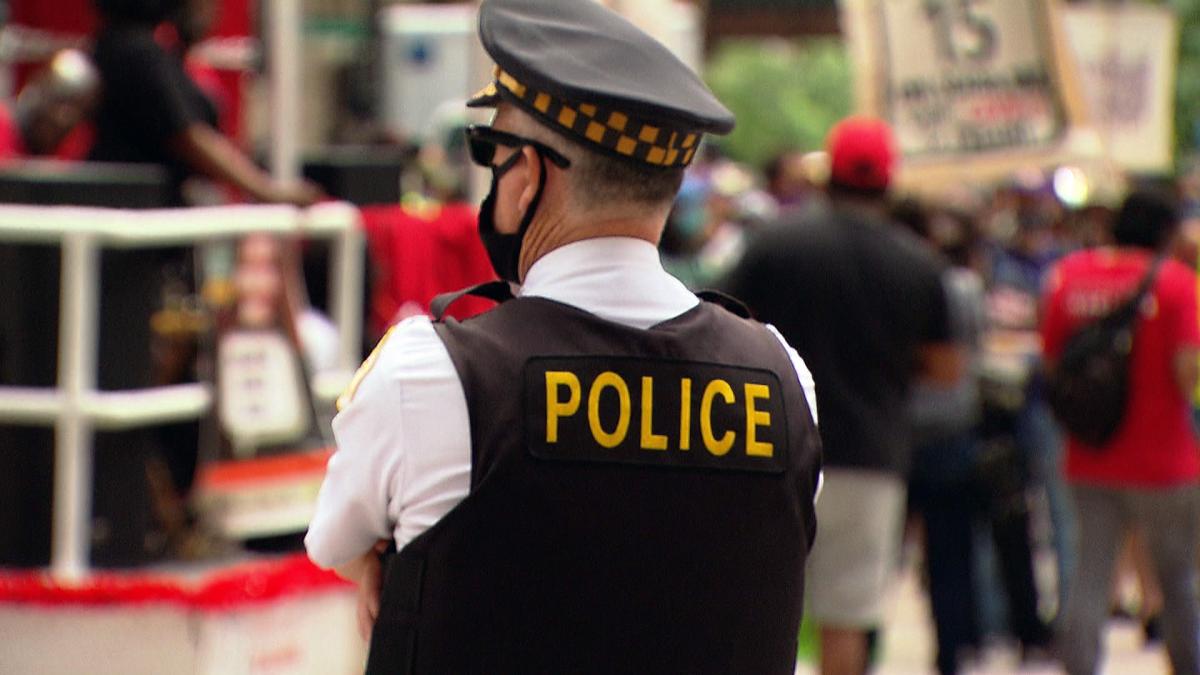 Demonstrators march in Chicago on Wednesday, June 24, 2020, to show their support for removing police officers from schools. (WTTW News)
Nearly two years after Chicago Public Schools removed police officers from campuses and implemented a new holistic approach to school safety, officials believe that shift could serve as a replicable model for school districts across the country.
Those findings come from a new study from the University of Chicago’s Consortium on School Research and the Center for Childhood Resilience at Lurie Children’s Hospital, which examined the CPS process for removing school resource officers in 2024 and replacing them with a new Whole School Safety plan.
“CPS officials and (community-based organization) leaders viewed the development of the WSS Framework as a novel and potentially replicable model of community-engaged, equity-focused policymaking — a marked departure from the district’s history of limited student, family, and community involvement,” the study states.
Chicago’s Board of Education voted in July 2024 to officially remove all resource officers from the city’s schools following a student-led push in 2020 from teens who believed the presence of police in schools had a disproportionately negative impact on Black students and strengthened the school-to-prison pipeline.
That same year, CPS launched a steering committee comprised of district officials, students, parents and community-based organizations, which led to the development of the Whole School Safety plan.
“School safety is one of the most contentious issues in urban education — and this partnership showed that genuine community-driven co-design can create the conditions for innovative and transformative work, even on the hardest problems,” David W. Johnson, a research assistant professor at the Center for Childhood Resilience who authored the study, said in a statement.
Already, a 2024 Consortium study found that removing police from schools did not lead to increased disciplinary issues, nor did it make students and staff feel less safe.
But it was the development process of the Whole School Safety plan that was the focus of the new study.
Those involved said they felt the district’s commitment to inclusivity, community engagement and equity came in stark contrast to previous CPS-led policymaking efforts, which were more siloed and less collaborative.
“District officials described the development of the WSS Framework as ‘trailblazing,’ ‘unprecedented,’ and illustrative of the district’s emerging commitment to ‘centering the voices of those most impacted by (district) decisions,’” the study states. “District officials and CBO leaders did not necessarily intend to develop a model of inclusive, community-engaged policymaking, but certainly felt that they had discovered one.”
CBO leaders described the collaboration as healing and restorative, the study states, while others involved saw their work as a step toward repairing “long-standing divisions and inequities between the district and communities most affected by past policies.”
“From the start, we knew safety wasn’t something you could just install in a building; it’s something you build with people,” CPS Chief of Safety and Security Ronan Shableski said in a statement. “This research proves that when students, families, staff and community partners all have a seat at the table, safety becomes a shared responsibility. That collective ownership is the heart of why Whole School Safety works.”