Politics
Pritzker Pitches $56 Billion Budget With New Fees on Social Media, Zoning Law Changes to Address Housing Shortage
Facing a projected $2.2 billion gap and massive uncertainty over federal funding flowing into Illinois, Gov. JB Pritzker on Wednesday proposed a $56 billion state budget plan for fiscal year 2027 beginning July 1.
That number reflects a 1.6% increase in spending from fiscal year 2026, which senior budget officials in the governor’s office say is due almost entirely to increased expenses tied to medical costs, pensions and evidence-based funding for school districts.
Budget leaders also stressed the dangers proposed by inconsistent federal funding, citing near-weekly threats for a wide array of programs that could cost the state up to $1.7 billion in the coming fiscal year.
While that federal cash doesn’t necessarily flow directly into the state’s general revenue fund, officials say cuts from Washington have ripple effects on the state’s economy – for example, a hit to employers if their workers lose child care. Federal cuts could also force the state to pick up the full cost of certain childcare programs, or make drastic changes to them.
In addition to the danger of lost funding, the budget also includes new costs tied to the One Big Beautiful Bill in the form of $50 million for new staff and eligibility monitoring for changes to SNAP and Medicaid requirements.
During Pritzker’s 2025 address, he warned of the looming threats posed by the recently inaugurated President Donald Trump.
“I was hoping that his threats to gut programs that support working families was the kind of unrealistic hyperbole that fuels a presidential campaign but then is abandoned when cooler heads prevail,” Pritzker said Wednesday. “Unfortunately, there are no cooler heads at 1600 Pennsylvania Avenue these days.”
Pritzker told lawmakers that the second Trump administration has come at an $8.4 billion cost to Illinois, which has sparked more than 50 court cases over the legality of funding freezes and clawbacks.
“These are not handouts,” Pritzker said. “These are dollars that real Illinoisans paid in federal taxes and that have been constitutionally approved by our elected Democratic and Republican representatives in Washington.”
The governor also took a swing at the president’s scattershot communication style, slamming his “executive orders, letters, and edicts that read like proclamations from the Lollipop Guild.”
But Republican leaders dinged Pritzker for spending too much time focusing on Trump.
“The governor spent a lot of time blaming President Trump and the federal administration for Illinois’ budget woes, which I will just tell you is not true,” Senate Minority Leader John Curran said after the speech. “What I wanted to hear more is how the governor is going to chart a more robust economic growth for the state of Illinois.”
To help close the budget gap, Pritzker’s proposed budget proposes several new revenue streams, including an estimated $200 million from a social media platform fee that would be earmarked for education. That fee would need to be passed through a bill in the General Assembly. For the largest social media firms with 1 million Illinois users or more, the proposal calls for charging $165,000 per month and an additional $.50 per month for each user over the 1 million user mark. Additional revenue would also come from changes to corporate tax structure, and from taxing table and electronic games in casinos at the same rate.
State Sen. Don DeWitte (R-West Dundee) said Illinoisans are feeling the economic pinch not from Washington, but from a state budget that’s grown significantly larger during Pritzker’s tenure.
“Groceries cost more. Energy costs more. Property taxes keep rising. And too many families feel like they’re falling further behind every single year, DeWitte said. “But let’s be honest about why – for years the majority party in Springfield has passed budgets filled with new spending, new mandates, new taxes and fees, and this year is no different.
Despite the budgetary challenges, officials stressed the progress the state’s finances have made during Pritzker’s tenure, including credit rating upgrades, an increased GDP, refinancing bonds to save on interest costs, and an improved pension funding ratio.
To that end, Pritzker is also pitching multiple ideas to improve the state’s long-problematic pension situation. While officials say the state is on target to meet a legally-required 90% funding ratio by 2045, the governor is calling for a 100% funding level by 2048. Pritzker’s plan calls for redirecting money currently used to pay off bond issues from 2003 and 2017 toward pensions once those obligations are paid off.
The proposed spending plan reflects Pritzker’s ongoing commitment to core priorities including early childhood, education, and public safety, officials say – even though budgetary pressures mean certain funding programs remain flat. Money for Illinois MAP grants for college students, for example, is not increasing – though officials note that program is getting $320 million more than when Pritzker took office.
Pritzker’s budget includes an additional $305 million toward the evidence-based education funding model. While that is a slightly lower increase than in previous years, budget officials say that’s due to a pause in a property tax grant program currently under review and that the governor remains committed to fully funding Illinois school districts. But Republicans called for increasing funding at the previous level of $350 million, saying the change is misguided and will hurt students.
But the Illinois Federation of Teachers says the funding proposed in Pritzker’s plan isn’t enough, calling for higher taxes on the wealthy to aid K-12 education.
“The Governor and lawmakers have a choice in his ‘maintenance budget’ to maintain inequality and giveaways to billionaires or to help Illinois’ working families who are struggling to maintain under higher costs and fewer supports.”
In a statement, Joe Ferguson, president of the fiscal watchdog the Civic Federation, called the proposed budget a “prudent starting point.”
“However, upcoming budget negotiations must also account for downstream impacts on local governments, where many of the most critical public services are delivered,” Ferguson said. “We urge the Illinois General Assembly to take a holistic view of the State’s fiscal condition and avoid actions that undermine long-term stability through unfunded mandates or unsustainable spending.”
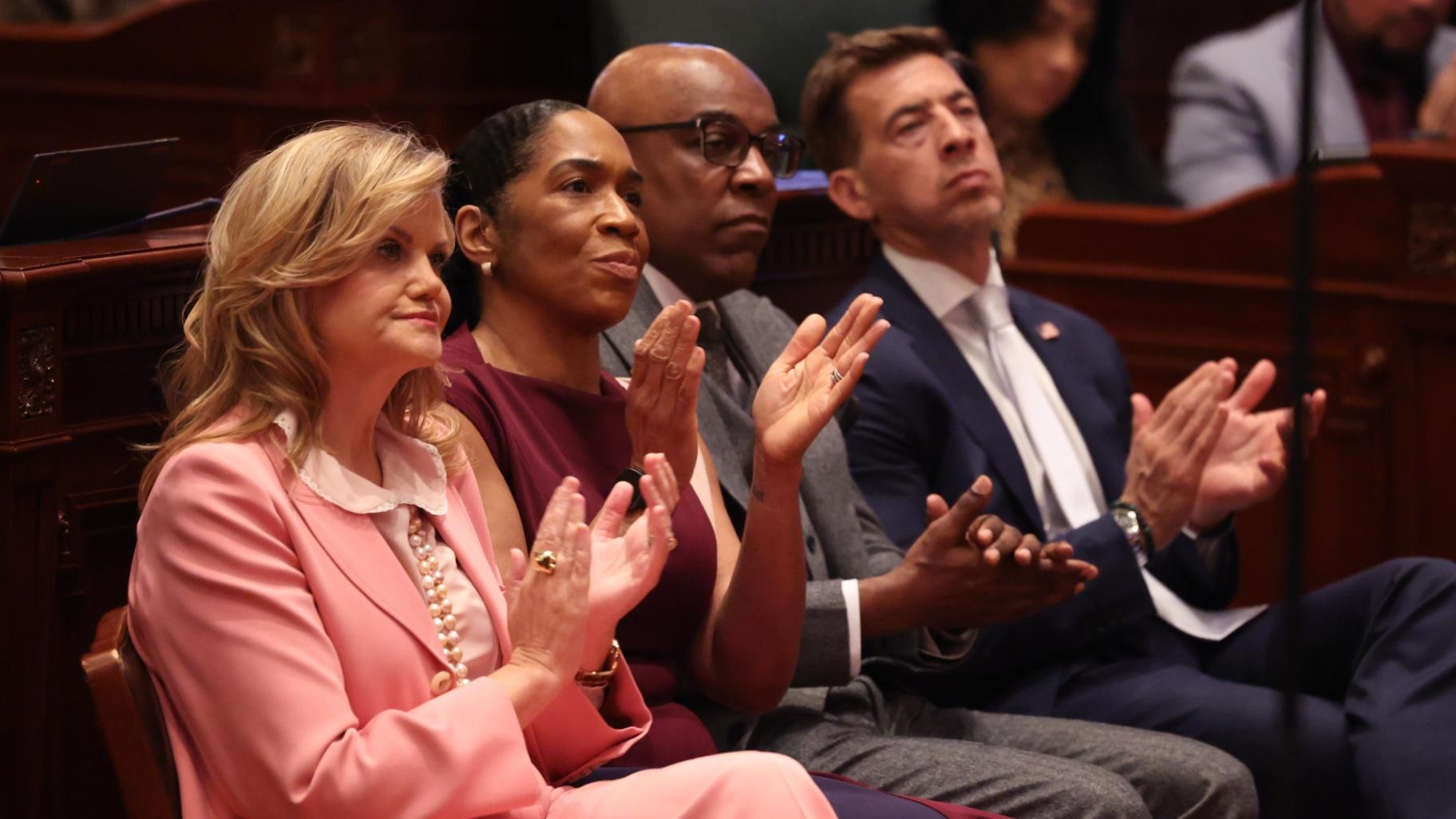 Illinois first lady MK Pritzker, from left, Lt. Gov. Juliana Stratton, Illinois Attorney Genera Kwame Raoul and Secretary of State Alexi Giannoulias listen to Gov. JB Pritzker deliver his annual State of the State and budget address on Feb. 18, 2026, at the Illinois State Capitol in Springfield. (Brian Cassella/Chicago Tribune via Pool)
Policy Priorities
In addition to his budgetary pitch, Pritzker is also pushing for sweeping changes to zoning policy across the state in an effort to address housing shortages, as well as new funding to boost construction and down payment assistance programs. He also noted rising utility costs facing Illinois residents, some of which has been driven by the demand caused by data centers. To address those prices, Pritzker called for a two-year pause for new data center tax credits to ensure “that our growth does not undermine affordability and stability for our families.”
But Curran said blaming data centers for rising utility bills is a “copout,” laying the blame instead on Pritzker for failing to boost energy production in the state.
“I like to hear the governor wants to focus on the high cost of living in Illinois. I would like to hear more focus also on the high cost of doing business in Illinois – those go hand in hand,” Curran said. “We heard kernels of that here. I’m hoping the governor leans more into that as we go forward.”
During his address, Pritzker also reupped his previously unsuccessful proposal to enact a statewide ban on students using cell phones during the school day except for limited exceptions. He also called for a Children’s Social Media Safety Act that would put a limit on nighttime notifications, increase privacy requirements for minors, require parents to approve in-app purchases, and let parents dictate what children can do on platforms.
“This bill will put decisions about children’s online safety back into the hands of parents by allowing them more easily to restrict their kids’ access on exploitative websites and apps,” Pritzker said. “Social media algorithms have been proven to create mental health issues in adolescents and foster polarization and misinformation in society as a whole.”
Curran said he supports tackling issues like a school cell phone ban and reining in social media, saying lawmakers need to be “fostering a safer environment for families and schoolchildren.”
Early in his address, Pritzker led a moment of silence to commemorate the late Rev. Jesse Jackson, who died Tuesday. Jackson, the governor said, was “a giant who spent his life on the front lines of the Civil Rights Movement.”
Despite an increase in spending over the previous fiscal year, Pritzker called the budget prudent and told lawmakers that discretionary spending is rising by less than half a percent.
“It levels off and in some cases reduces programs that are important to me – some of which were proposals of my own,” the governor said. “But I believe that the imperative of responsible governance and overcoming the fiscal irresponsibility of past decades must come ahead of the interests of any one politician, program, or party.”
The governor also acknowledged the political tumult over the past year, including a massive surge in immigration enforcement, that deepened already-significant polarization.
“I am begging my fellow politicians, my fellow Illinoisans, my fellow Americans to realize that right now in this country we are not fighting over policy or political party,” Pritzker told lawmakers. “We are fighting over whether we are going to be a civilization rooted in empathy and kindness — or one rooted in cruelty and rage.”
With Pritzker’s presidential ambitions and the 2028 looming large, many Republicans said the governor’s speech was clearly focused beyond Illinois.
“I’m not sure that I can call it a budget address,” said state Sen. Terri Bryant (R-Murphysboro.) “It seemed a little bit more like a campaign speech and increasing his national profile.”
Contact Nick Blumberg: [email protected] | (773) 509-5434 | @ndblumberg