Politics
Supreme Court Upholds Block of Trump’s National Guard Deployment in the Chicago Area, For Now
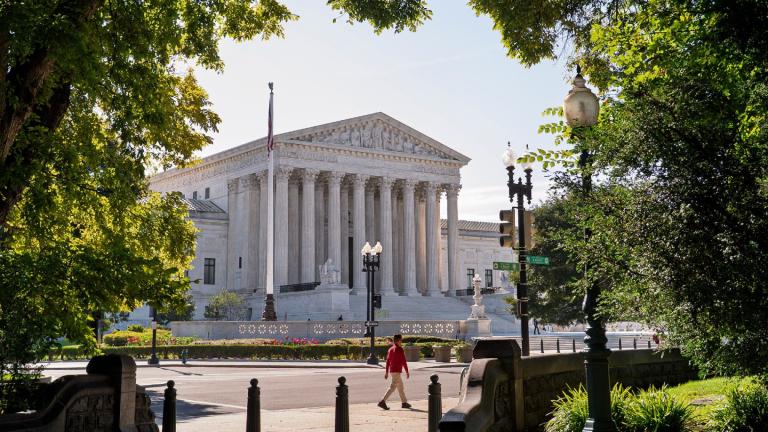
 With the Supreme Court Building under renovations, the justices hear oral arguments on President Donald Trump's push to expand control over independent federal agencies, on Capitol Hill in Washington, Monday, Dec. 8, 2025. (AP Photo / J. Scott Applewhite)
The Supreme Court on Tuesday refused to allow the Trump administration to deploy National Guard troops in the Chicago area to support its immigration crackdown.
The justices declined the administration’s emergency request to overturn a ruling by U.S. District Judge April Perry that had blocked the deployment of troops. An appeals court also had refused to step in. The Supreme Court took more than two months to act.
“At this preliminary stage, the Government has failed to identify a source of authority that would allow the military to execute the laws in Illinois,” the court wrote in its ruling. “The President has not invoked a statute that provides an exception to the Posse Comitatus Act.”
The order is not a final ruling but it could affect other lawsuits challenging President Donald Trump’s attempts to deploy the military in other Democratic-led cities.
The outcome is a rare Supreme Court setback for Trump, who had won repeated victories in emergency appeals since he took office again in January.
Gov. JB Pritzker hailed the ruling as a “big win for Illinois and American democracy,” saying it’s an important step in curbing the Trump administration’s “consistent abuse of power and slowing Trump’s march toward authoritarianism.”
“While we welcome this ruling,” he said in a statement, “we also are clear-eyed that the Trump Administration’s pursuit for unchecked power is continuing across the country. Illinois will remain vigilant, defend the rights of our people, and stand up to further abuses of authority by Donald Trump and his cronies.”
Department of Justice attorneys previously called on U.S. District Judge April Perry — who issued the order, known as a TRO — to hold off on any future steps in the case until the high court had a chance to rule.
In October, attorneys for both the Trump administration and the state of Illinois agreed to extend that temporary restraining order halting that deployment sought by Trump until a judgment can be reached in the state’s lawsuit.
Trump administration attorneys OK’d the indefinite extension, likely with the belief that the high court would rule in their favor and toss out the TRO altogether.
“This decision doesn’t just protect Chicago — but protect cities around the country who have been threatened by Trump’s campaign against immigrants and Democratic-led cities,” Mayor Brandon Johnson said in a statement. “My administration will maintain our commitment to protecting Chicagoans from federal overreach and continue to ensure Donald Trump is held accountable before the law.”
The president’s emergency appeal came eight days after a federal judge temporarily blocked the federalization and deployment of 300 members of the Illinois National Guard, 200 members of the Texas National Guard and 14 members of the California National Guard into Illinois.
The Trump administration has claimed the deployment is necessary as federal agents in Illinois have been met “with prolonged, coordinated, violent resistance that threatens their lives and safety,” telling the Supreme Court this has become part of a “disturbing and recurring pattern.”
Attorneys representing Illinois called on the Supreme Court to deny the administration’s “dramatic step” of deploying National Guard troops over the state’s objection, claiming the Trump administration “cannot show that such extraordinary relief is warranted.”
Federal officials have only a “flimsy pretext” to deploy military officials to Chicago, according to the state’s lawsuit. Deploying National Guard troops to Chicago “will cause only more unrest, including harming social fabric and community relations and increasing the mistrust of police.”
The lawsuit accused Trump and members of his administration of ordering troops to Chicago as part of a campaign that dates back to 2013 to denigrate Chicago, home to former President Barack Obama, a longtime political rival of the president.
“The extremely limited circumstances under which the federal government can call up the militia over a state’s objection do not exist in Illinois, and I am pleased that the streets of Illinois will remain free of armed National Guard members as our litigation continues in the courts,” Illinois Attorney General Kwame Raoul said in a statement following the ruling.
In issuing the TRO, Perry said she saw “no credible evidence there is a danger of rebellion in the state of Illinois,” adding that she found “no evidence that the president is unable, with the regular forces, to execute the laws of the United States.”
The court agreed with arguments from Chicago and Illinois attorneys that the term “regular forces” likely refers to the U.S. military. The Trump administration had argued it refers to "civilian law enforcement officers," such as Immigration and Customs Enforcement or the Federal Protective Service.
“This interpretation means that to call the Guard into active federal service … the President must be ‘unable’ with the regular military ‘to execute the laws of the United States.’” the court wrote in its ruling.
“So before the President can federalize the Guard … he likely must have statutory or constitutional authority to execute the laws with the regular military and must be ‘unable’ with those forces to perform that function,” the court continued.
Trump has deployed the Guard to Washington, D.C., and Memphis, Tennessee, to help fight what he says is rampant crime. Los Angeles was the first city where Trump deployed the Guard, arguing it was necessary to protect federal buildings and agents as protesters fought back against mass immigration arrests.
Justice Samuel Alito, who dissented the ruling, along with Clarence Thomas and Neil Gorsuch, wrote that the court had “unnecessarily and unwisely departed from standard practice.”
“On top of all this,” Alito wrote in his dissenting opinion, “the Court fails to explain why the President’s inherent constitutional authority to protect federal officers and property is not sufficient to justify the use of National Guard members in the relevant area for precisely that purpose.”
Heather Cherone and the Associated Press contributed to this report.