Science & Nature
Northern Lights Dazzle in Chicago, Another Show Possible Wednesday
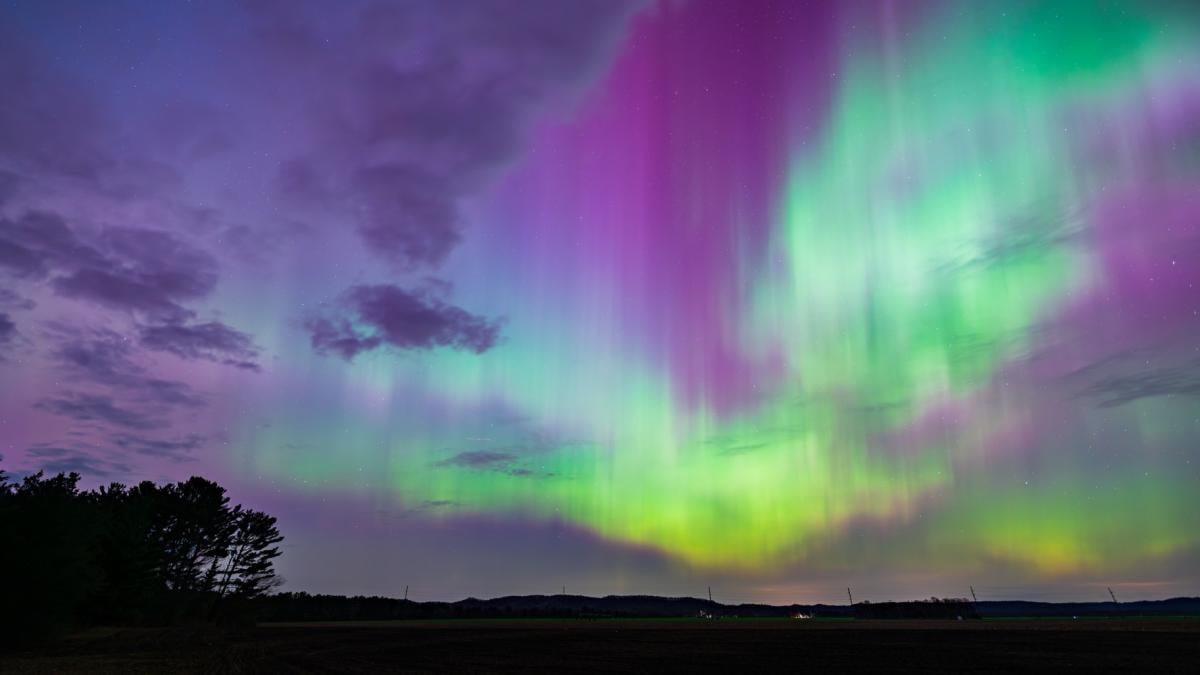 Aurora borealis, seen in the U.S. in 2023. (Jonah Lange / iStock)
Chicagoans — and folks across the country — were treated to a dazzling display of the aurora borealis (northern lights) Tuesday night and there could be an encore in the works Wednesday.
Eruptions from the sun, known as coronal mass ejections (CMEs), passed by Earth late Tuesday and caused a major disturbance in the planet's magnetic fields, resulting in a spectacular aurora visible at latitudes far south of the poles.
Another fast-moving and even more energetic CME is hurtling toward Earth and is expected to arrive midday Wednesday, according to the Space Weather Prediction Center.
People reported seeing Tuesday night's aurora with the naked eye, even in Chicago.
The Space Weather Prediction Center, operated by the National Oceanic and Atmospheric Administration (NOAA), had been tracking multiple CMEs — often described as a “solar burp” or gas bubble — that erupted over the past couple of days.
When these bubbles of charged particles are directed toward Earth, they eventually interact with the planet’s magnetic field and are scattered toward the poles resulting in the aurora’s signature air glow. If the CMEs are particularly strong, that energy creates aurora’s visible further south than typical viewing hot spots near the Arctic Circle.
Space weather prediction has gotten better in recent decades thanks to increases in computing power and the number of telescopes and spacecraft monitoring the sun, among other advancements, according to Michelle Nichols, director of public observing at the Adler Planetarium.
But scientists still don’t have aurora predictions down to, well, a science, she added, noting it’s nowhere near the level of precision astronomers have for events such as, say, a solar eclipse, which are forecast hundreds of years in advance to the minute.
There’s no comparable “path of totality” or ability to guarantee that a person standing in a certain spot at a certain time will witness an aurora.
“When you’re talking about something so incredibly complex, trying to pinpoint an aurora location for a specific spot on the planet, that is extremely hard to do,” Nichols said. “I don’t know if we ever will get really great at that.”
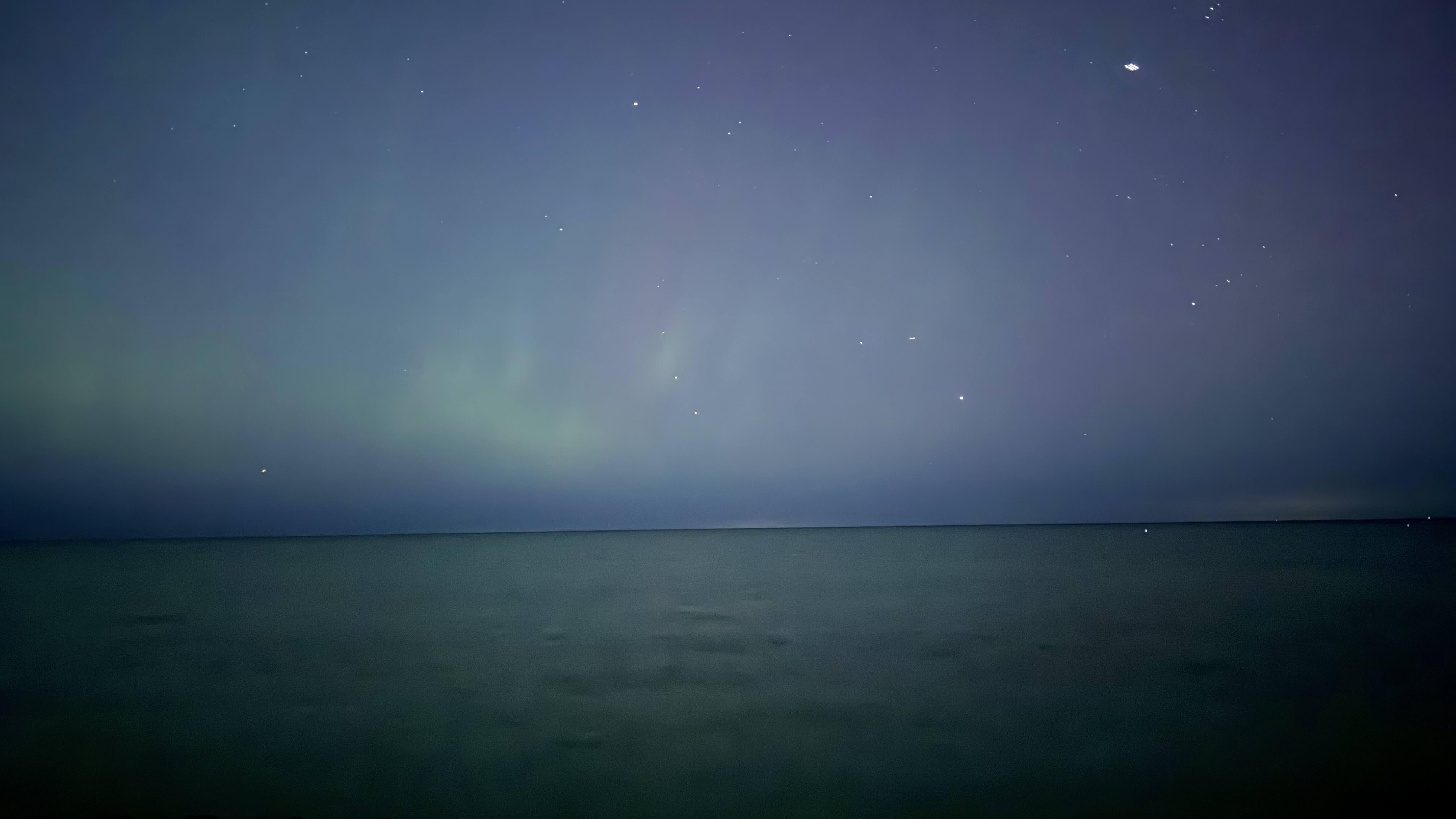 Faint aurora seen through an iPhone camera in October 2024 from Chicago's lakefront. (Patty Wetli / WTTW News)
Here’s what’s known about the current conditions:
CMEs were observed on Nov. 9 and 10, with trajectories placing them on a collision course with Earth. (Not all solar “burps” are aimed toward Earth.) The second burst is moving faster than the first, and might even catch up to and merge with the leader (this is called a “cannibal CME”). It, or they, will likely hit late Tuesday.
Then on Tuesday morning, a major solar flare erupted, followed by an “energetic and fast-moving CME” that blasted from the sun. Traveling in the wake of the other two — like a cyclist drafting a semi-truck — this third CME could arrive Wednesday.
The combination of the three CMEs, plus the magnitude of Tuesday’s solar flare, prompted the Space Weather Prediction Center to issue a G4 (severe) geomagnetic storm watch for Wednesday. (The scale only goes to G5.)
“Watches at this level are very rare,” the prediction center said, but also acknowledged that the flurry of solar activity “is making for a very complicated and difficult forecast.”
What happens next is anyone’s guess, according to Nichols.
“The length of time that all these effects occur for, it could be short, it could be 15 minutes. It could be hours, it could be longer than that. It just depends,” she said.
The greatest disruption — which can include impacts on satellite communications or GPS signals — doesn’t necessarily occur on the arrival of the CME, she said.
Effects can be felt even after the CME has passed, in the same way that a boat creates waves in its wake, Nichols explained.
Hold the phone
There are a number of ways for the public to track the incoming storm and any potential for aurora viewing.
Apps such as My Aurora Forecast (iOS and Android) do just what they say; the website spaceweather.com issues aurora text alerts (for a subscription fee); and the Space Weather Prediction Center continually updates its forecast, and has been doing so even during the government shutdown.
When it comes to aurora watching, Nichols offered some tips on interpreting NOAA’s alphabet soup of scientific jargon.
She said she personally starts paying attention whenever a G3 watch is issued, so a G4 is significant.
There’s also a “kp” index, which ranges from 0 to 9. This index essentially measures how much of a punch a CME packs, Nichols said.
Think of 0 as a light tap, a 5 as a slap, and a 9 as a knockout blow. Nichols considers a 6 or 7 noteworthy.
Pair a G3/G4 with a kp of 6 to 9 and Nichols said she’d definitely stay up past bedtime to look for the northern lights and keep an eye on alerts.
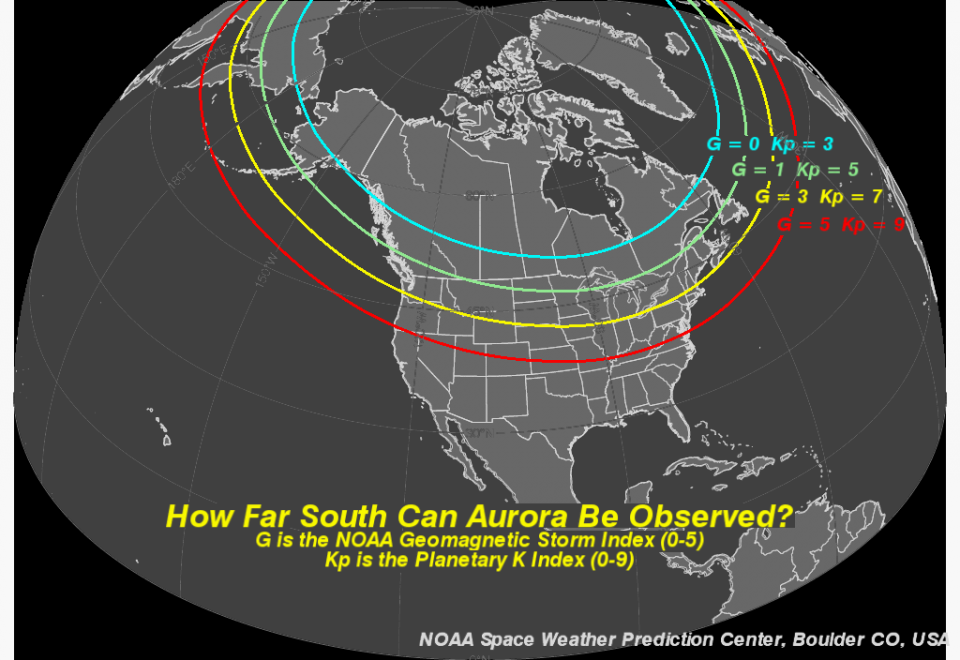 How to read the jargon in a space weather forecast: Mind your G’s and kp's. (National Oceanic and Atmospheric Administration)
Her biggest piece of advice is to have a smartphone handy.
“Auroras are one of those phenomenon you can sometimes see them better with your phone than you can with your eyes,” she said. “If you think there could be an aurora occurring in our area … scan the sky with your phone. You might start to see the glow on the phone camera screen before you see it with your eyes, and you may never see it with your eyes.”
Phone-aided or not, experiencing an aurora is something a person never forgets, Nichols said.
Her first sighting happened purely by chance in 2001 or 2002.
“We were taking the trash out and I looked up like I normally do,” she recalled. “And I went, ‘Wow, there’s a lot of light pollution. Wow, it’s really orange tonight.’ And then I realized I was looking at an aurora. Absolutely no doubt what I was looking at.”
Even though she was working at the Adler, she’d had no idea conditions were ripe to see the aurora in Illinois.
“We didn’t have all the predictive capability — no phone alerts and email alerts and all that kind of stuff that the general public now has access to,” Nichols said. “And I thought, ‘Oh wow, if I have the opportunity to occasionally see this in my area, I’m going to pay attention to this.’”
This article originally published on Nov. 11, 2025, and has been updated.
Contact Patty Wetli: [email protected]