Crime & Law
Detainees at Broadview ICE Facility Denied Access to Legal Counsel, New Lawsuit Alleges
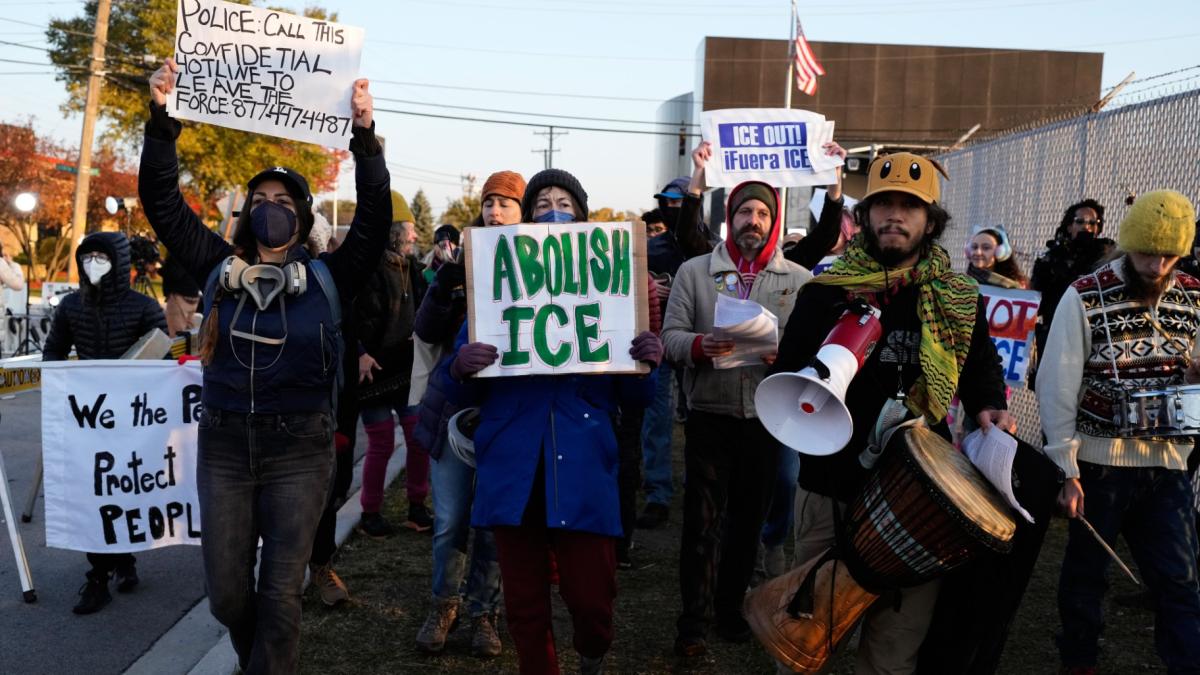 Protesters gather outside an ICE processing facility in the Chicago suburb of Broadview, Ill., Friday, Oct. 31, 2025. (AP Photo / Nam Y. Huh)
Detainees at an Immigration and Customs Enforcement processing center in suburban Broadview have been blocked from speaking with legal counsel and subjected to “inhumane” conditions during their incarceration, a new lawsuit alleges.
The suit, brought on behalf of Broadview detainees Pablo Moreno Gonzalez and Felipe Agustin Zamacona by the MacArthur Justice Center and the ACLU of Illinois, claims ICE officials have “cut off detainees from the outside world” by preventing them from making confidential phone calls to their lawyer or a prospective lawyer.
“By blocking access to detainees inside Broadview, Defendants have created a black box in which to disappear people from the U.S. justice and immigration systems,” the lawsuit states.
The Broadview facility has been the site of repeated protests in recent months as the Trump administration has rapidly escalated its immigration enforcement efforts in Chicago and the surrounding suburbs.
The site operates as a processing facility — where detainees are expected to spend a matter of hours before being moved to a detention center — but the lawsuit claims people have been kept in Broadview for “up to a week or more.”
According to the lawsuit, as of June 4, the median time a detainee was held at Broadview was nearly 48 hours — already four times longer than the supposed 12-hour limit for detainees.
But by mid-June, ICE data showed the median detention time at Broadview had risen to three days, the lawsuit states, adding that the facility does not “have the capacity or capability to hold the number of detainees" currently being held.
“They are being confined at Broadview inside overcrowded holding cells containing dozens of people at a time,” the lawsuit states. “The federal officers who patrol Broadview under Defendants’ authority are abusive and cruel. Putative class members are routinely degraded, mistreated, and humiliated by these officers.”
DHS Assistant Secretary Tricia McLaughlin on Friday called the lawsuit allegations “garbage” and claimed any statements about “subprime conditions” at the Broadview ICE facility are false.
“All detainees are provided with 3 meals a day, water, and have access to phones to communicate with their family members and lawyers,” she said in a statement.
McLaughlin also said ICE has “worked diligently” to obtain additional detention space in order to avoid overcrowding in Broadview.
Beyond allegedly preventing detainees from contacting outside attorneys, the attorneys themselves have also been blocked from entering the facility to speak with their clients, the lawsuit claims.
Attorneys’ efforts to contact clients inside are “rebuffed or ignored” by ICE officials, the complaint states, while phone calls made to the facility are “sent to an unattended line, and their calls and emails go unanswered.”
According to the lawsuit, ICE agents have coerced detainees to sign paperwork they do not understand that in some cases can lead to them relinquishing their rights while allowing immigration officials to deport them before they ever see an immigration judge.
“Incommunicado detention is not tolerated in our democracy,” the lawsuit states. “Defendants have an obligation under the U.S. Constitution and federal law to provide the people they detain with due process and to treat them with basic decency.”
Alexa Van Brunt, director of the MacArthur Justice Center’s Illinois office and lead counsel on the suit, called this a “vicious abuse of power and gross violation of basic human rights” that she said "must end now.”
“Everyone, no matter their legal status, has the right to access counsel,” she said in a statement, “and to not be subject to horrific and inhumane conditions.”
Federal prosecutors in the case revealed during a hearing Friday afternoon that both Moreno Gonzalez and Zamacona were transferred out of Broadview to a jail in Kansas early Friday morning, just hours after the lawsuit was filed.
U.S. District Judge Robert Gettleman granted a request from the attorneys representing the men ordering their return to the Northern District of Illinois. That may mean the men are sent back to Broadview, where they would remain held while they seek a Habeas Corpus petition granting their release.
Gettleman also ordered that federal authorities must take all steps to allow attorneys access to Moreno Gonzalez and Zamacona, saying no attorney should be kept away from their clients, “particularly in a case of this magnitude.”
Attorneys for the men said a “human rights emergency” is unfurling in Broadview that requires immediate action. Gettleman didn’t rule on their request for a temporary restraining order, but instead set a hearing to hear further evidence next week.
“I know this is rather rushed,” Gettleman said at the onset of Friday’s hearing, “but the nature of the case and the requested relief obviously requires immediate attention.”