Politics
National Guard Troops Have Arrived in Illinois. What’s Their Directive and Where Might They Be Deployed?
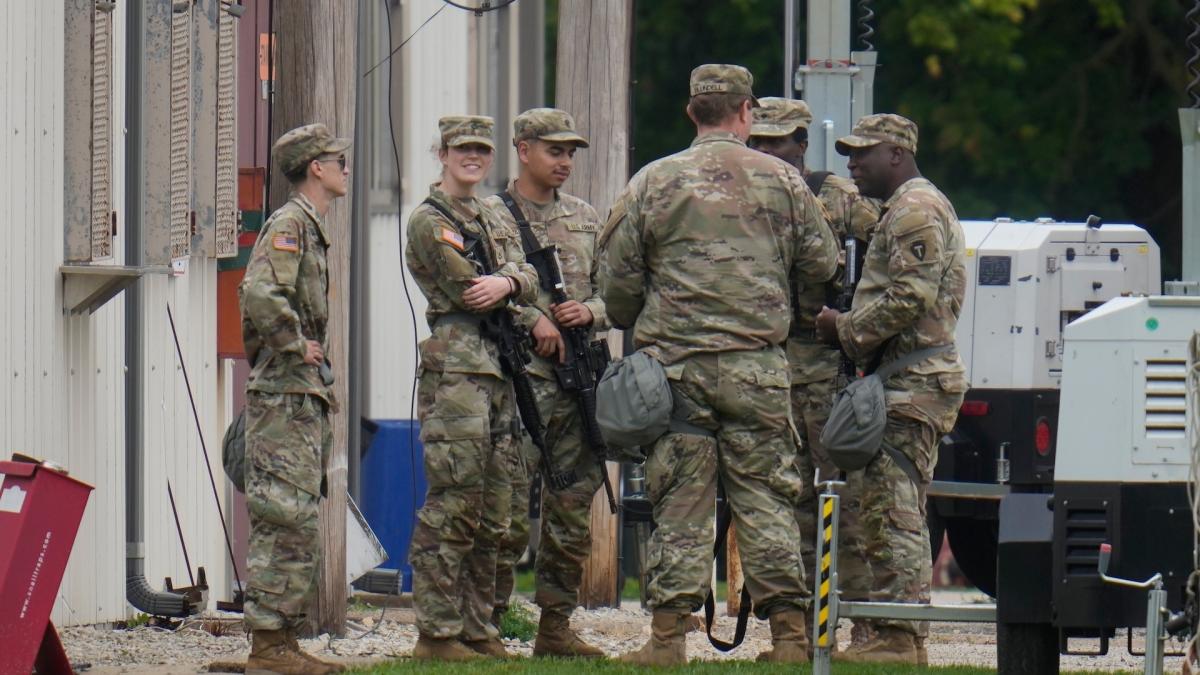 Military personnel in uniform, with the Texas National Guard patch on, are seen at the U.S. Army Reserve Center, Tuesday, Oct. 7, 2025, in Elwood, Ill., a suburb of Chicago. (AP Photo/Erin Hooley)
Keep up on the most important Chicago news. Sign up for WTTW News’ Daily Chicagoan newsletter.
Hundreds of National Guard troops sent from Texas arrived in Illinois as part of an unprecedented deployment this week with a directive from the Trump administration to protect federal immigration agents “in places where there are violent demonstrations.”
So where might that be?
A Pentagon official on Tuesday confirmed to WTTW News that 200 federalized Texas National Guard troops had arrived in Illinois with orders to protect “federal functions, personnel, and property” — or more specifically, Immigration and Customs Enforcement agents carrying out “Operation Midway Blitz.”
The troops are currently stationed in the U.S. Army Reserve Center in Elwood, which is located 55 miles southwest of Chicago just south of Joliet.
Why are the National Guard troops here?
For months, President Donald Trump has openly discussed sending troops into Chicago to combat violent crime in the city — going so far as calling it a “hellhole” — even as the number of shootings (down 36%) and homicides (down 27%) have decreased dramatically since last year.
Trump has repeatedly targeted Democrat-led cities for troop deployments, having already sent the National Guard into Los Angeles and Washington D.C, with additional plans to do so in Chicago and Portland, Oregon.
While Trump has cited crime numbers as one cause, his administration is now claiming the troop deployment is necessary in Illinois following clashes between ICE agents at protesters outside an immigration processing center in suburban Broadview.
Over the weekend, federal Border Patrol agents in Chicago shot a woman whom they claimed rammed her vehicle into theirs in the Brighton Park neighborhood and deployed tear gas that affected residents and Chicago police alike after a crowd gathered at the scene.
On Wednesday, Trump said in a social media post that Illinois Gov. JB Pritzker and Chicago Mayor Brandon Johnson “should be in jail” for failing to protect ICE agents.
Where might the troops be deployed?
Defense Secretary Pete Hegseth said in a memo the troops would be deployed “in places where there are violent demonstrations in the state, or where they’re likely to occur based on current threat assessments.”
ICE does not run any immigrant detention centers in Illinois, but it does have two other facilities: its field office in downtown Chicago, and the processing center in west suburban Broadview.
If the National Guard troops have orders to protect ICE agents and property, it’s likely they’ll be sent to Broadview. But there have also been recent incidents with federal agents in Chicago after protests quickly form following raids or actions in neighborhoods.
What is going on in Broadview?
The Broadview processing center has been the site of repeated protests in which federal agents have utilized tear gas, pepper balls and rubber bullets to disperse crowds gathered outside.
The village’s mayor has accused ICE of “making war” in the community there, as those chemical munitions have harmed residents, police and first responders, in addition to peaceful protesters legally exercising their First Amendment rights.
ICE and the Department of Homeland Security have portrayed the protests as “riots,” though demonstrators have said it’s the federal agents who have antagonized others.
“People were protesting, we were just standing there, they would come out and just start pushing people, they were pushing people,” Marina Galindo, a Maywood resident who attended a protest last month, told WTTW News. “They weren’t giving people the chance to move back. They were like, ‘Get back,’ but not everyone can walk backwards.”
ICE has constructed an 8-foot-tall fence it says is necessary to protect the facility and its staff, though the village claims that was done illegally and says it must come down as it could prevent firefighters from responding to local businesses in the area. The village has sued to get that fence removed.
Last week, members of the Illinois State Police and Cook County Sheriff’s Office constructed a designated protest zone outside the facility, and the village has restricted protesting hours from 9 a.m to 6 p.m. each day.
What about in Chicago?
While ICE’s Chicago field office has not seen the same level of protests as Broadview, there have been several incidents involving federal agents in Chicago in recent days.
Pritzker claimed those agents have displayed “unprecedented escalations of aggression” against Chicagoans, following their usage of chemical agents near a Logan Square elementary school, the decision to detain Chicago Ald. Jessie Fuentes (26th Ward) as she objected to the presence of federal agents in a hospital, the raid of an Austin Walmart and the detention of four people outside a Bronzeville shelter on Oct. 1 by masked federal agents who jumped out of unmarked vans.
Johnson and Pritzker have been particularly critical of the conduct of federal agents who raided a South Shore apartment building on Sept. 30. Approximately 300 federal agents conducted the late-night raid, with some landing on the building from Blackhawk helicopters, according to a video produced by federal officials and posted on social media.
Nearly all of the residents of the building were detained, including four children who are U.S. citizens.
Chicago police leaders have also been widely criticized after federal agents shot a Chicago woman who was charged with ramming a vehicle driven by a Border Protection agent, sparking protests. The woman survived and now faces federal charges.
Dozens of Chicagoans converged on the scene of the shooting to protest the actions of federal agents in a neighborhood home to many Latino residents.
Johnson this week said he’s received no communication that National Guard troops have entered Chicago and called such a deployment “illegal” and “unconstitutional.”
What about the state’s lawsuit?
A federal judge is set to rule Thursday on a temporary restraining order requested by Chicago and Illinois officials that could halt the National Guard deployment.
U.S. District Court Judge April Perry has already ordered Trump administration lawyers to tell her when National Guard troops “will arrive in Illinois; what municipalities within Illinois troops will be sent to and what the scope of the troops’ activities will be once here.”
Similar efforts have also been undertaken elsewhere.
Over the weekend, U.S. District Court Judge Karin Immergut, a Trump appointee, ruled Trump’s claims of daily unrest in Portland were “untethered to facts” and risked violating the U.S. Constitution by imposing military rule.
Immergut blocked federal officials from deploying the Oregon National Guard to Portland for 14 days. After her ruling, federal officials ordered members of the California National Guard to Oregon prompting Immergut to amend her order late Sunday to block federal officials from deploying any National Guard troops to Portland.
Perry has scheduled a hearing in Chicago for 11 a.m. Thursday.
Heather Cherone, Joanna Hernandez and the Associated Press contributed to this report.