Science & Nature
Baby Fish Shed New Light on Health of the Chicago River in First-of-Its-Kind Study
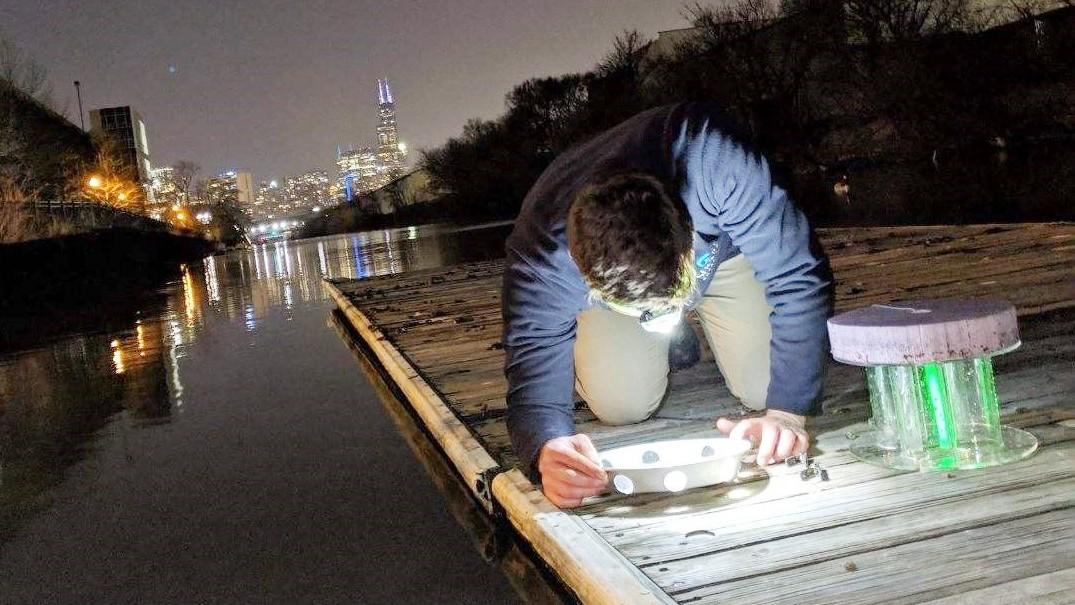 Research biologist Austin Happel checks a light trap for signs of larval fish in the Chicago River. (Courtesy of Shedd Aquarium)
Want more local nature coverage? Sign up for WTTW News’ weekly Urban Nature newsletter.
The Chicago River has proven itself fit for swimming. But what about raising a family?
Fifty years ago, only five to 10 hardy species of fish were living in the river. Today, after much work to clean up the waterway, more than 70 species of adult fish have been recorded via surveys conducted by entities including the Illinois Department of Nature Resources and the Metropolitan Water Reclamation District.
Yet no one’s ever tallied the number of larval fish in the waterway, at least not that Austin Happel, research biologist at Shedd Aquarium, could find, so he set about establishing a baseline.
The presence of larval (baby) fish would indicate a couple of things about the river’s health, Happel said.
One, it would suggest adults were present in enough abundance to reproduce. Two, it would demonstrate the fish were finding habitat conducive to their particular spawning needs.
To get a sense of the larval fish population, Happel and his team stationed light traps at 10 sites spread up and down the river’s North and South Branches. From 2020 through 2022, traps were checked weekly from late May through August.
It was a more cumbersome process than fishing for larger adults, Happel said. And for most of the captured larvae, considering that tiny baby fish are notably indistinguishable from each other, identification at the species level required DNA testing.
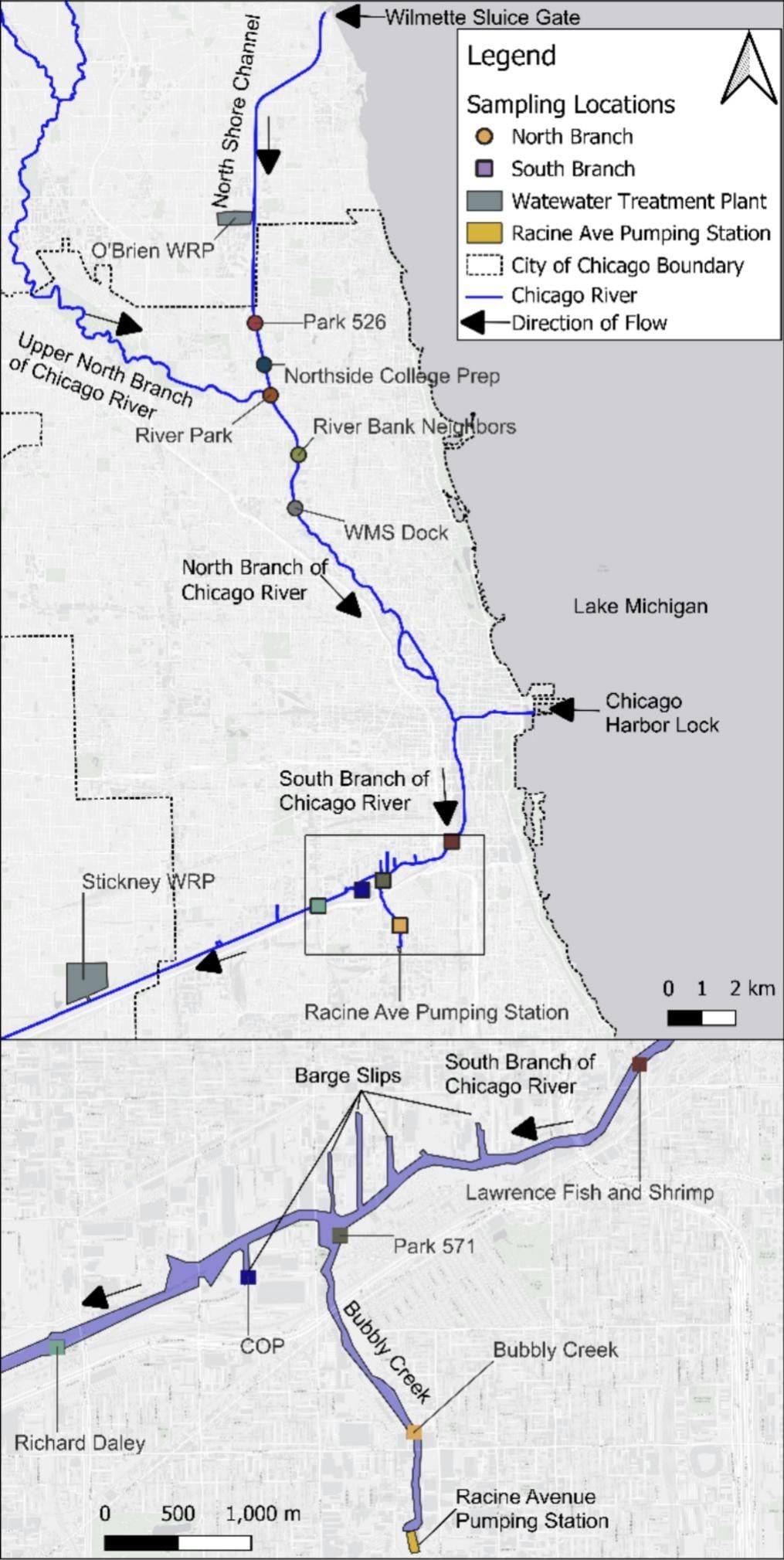 Sites on the Chicago River where larval fish were captured for a study led by Shedd Aquarium. (Shedd Aquarium)
The findings were recently published in the Journal of Great Lakes Research, revealing 24 different species of larvae, a number Happel considered a positive sign that “populations are proliferating locally within the river.”
Sport fish including black crappie, bluegill and largemouth bass were among larvae, along with forage fish such as gizzard shad, golden shiner and spotfin shiner.
There were a few surprises, though, both in terms of which species were revealed and where they were found.
As expected, the survey turned up species that are pollution-tolerant, but also, unexpectedly, a couple of species that aren’t — specifically brook silverside and mimic shiner. These were present in the South Branch, but not the North.
“What’s going on in the South Branch of the Chicago River that’s allowing higher biodiversity?" Happel asked.
It could be water quality — treated wastewater pours into the North Branch from the O’Brien Water Reclamation Plant — or it could be habitat. One theory is that “off-channel” areas in the South Branch such as barge slips and Bubbly Creek offer shelter from predators along with ample food.
Are these areas shallower? Do they have vegetation? Do they provide more algae or zooplankton or woody debris? Conversely, where are fish still struggling and what’s missing in those stretches of the river?
“I feel like it’s a conveyor belt of ideas and research topics,” Happel said, “just trying to understand how this urban system operates and what we can learn here.”
Happel and his team have already begun collecting data to investigate some of these questions. In the past year, they’ve obtained extensive water quality readings and they’ve also mapped habitat in the South Branch using information from existing surveys as well as gathering their own via a form of sonar.
“Those data sources kind of allow us to see under the water,” he explained.
There may be a pile of rocks, a stand of vegetation or undulations along the bottom of the river. Any or all of these variables could be contributing to the success of larval fish at a given location. So the team also collected more larval fish to see how their whereabouts matched up with those different habitats.
The findings will help determine the effectiveness of restoration efforts such as the floating wetlands constructed by Urban Rivers or the work Friends of the Chicago River has been doing to establish emergent wetlands vegetation such at cattails and lizard’s tail.
That latter project would provide spawning habitat for gar and northern pike, species that should be in the river but are rarely found.
Walleye is another top predator also largely missing from the river. Happel is keeping an eye on River Park, along the North Branch, where a dam was removed and replaced with rapids — the only spot in Chicago where the river has the kind of flowing water over gravel that walleye need for spawning.
His team has captured the larvae of white sucker fish downstream of those rapids, “and others have documented that where white suckers spawn, walleye spawn,” Happel said. “So there’s potential there, … walleye could spawn there.”
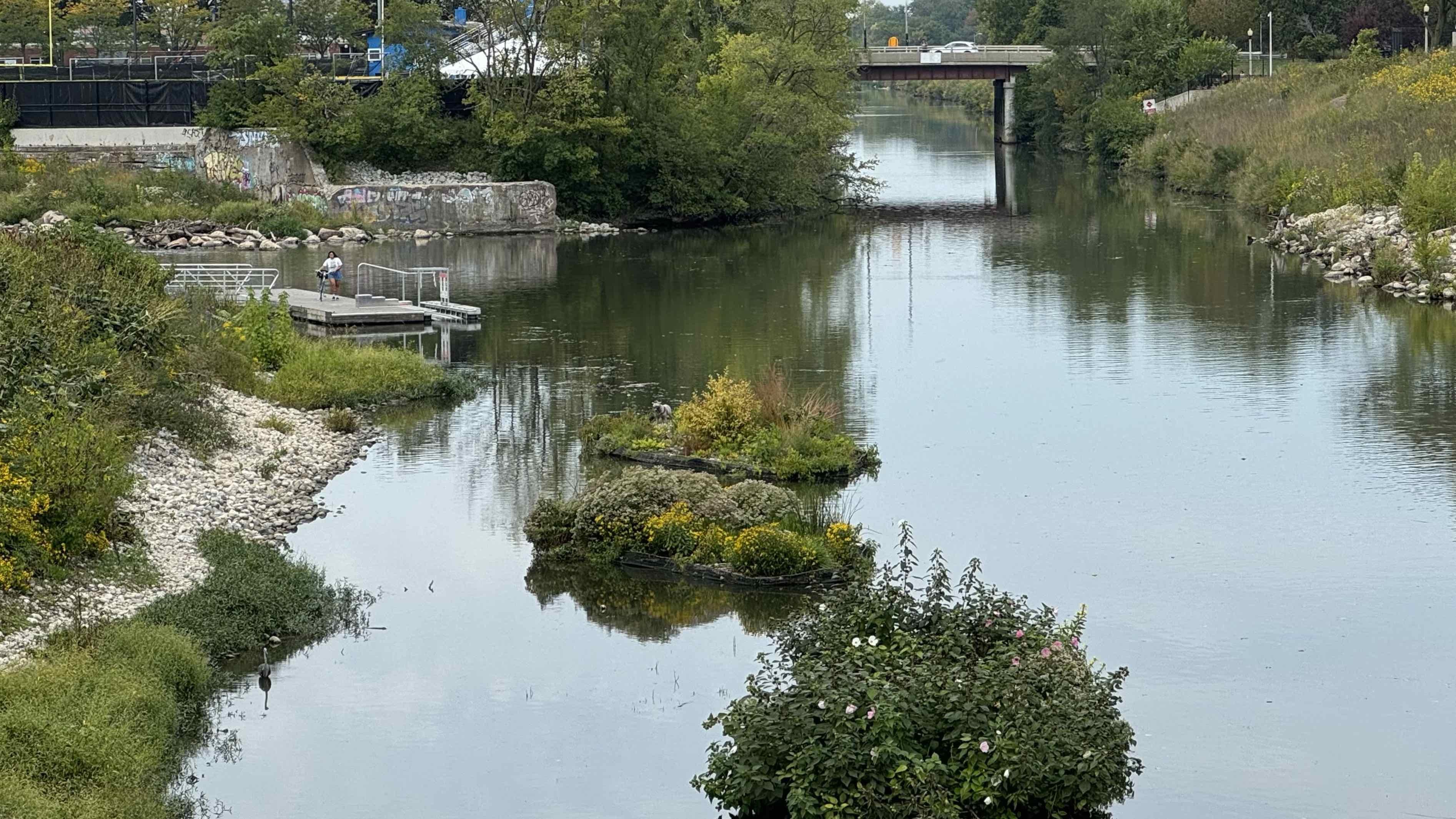 Floating wetlands in the North Branch of the Chicago River could increase habitat for spawning fish. This area is also near the rapids that could be conducive for walleye spawning. (Patty Wetli / WTTW News)
The key is that researchers now have a baseline to use for comparison in the same way they’ve been able to chart the trajectory of adult species. Theoretically, future surveys should show more species in greater abundance at restoration sites.
This wait-and-see nature of restoration projects requires long-term commitment. It could take multiple generations of fish to begin to see what Happel called a “really big pulse” in terms of the number of species and their abundance.
“It took 20, 30 years to go from less than five species in a survey to 15 species in a survey,” he said of adult fish numbers.
Though the river is already in a far healthier state than it was even just a decade or two ago, it’s almost impossible to predict what it will look like 10 or 20 years from now.
“I find it hard to find a great comparison or a model that the Chicago River should be striving for,” Happel said.
The city’s river — heavily engineered, with a sluggish and meandering flow — is unique and, for a researcher like Happel, that’s part of its appeal.
“I like to say, ‘If we can figure out how this weird river here works, we should know how anything works,’” he said.
Contact Patty Wetli: [email protected]