Politics
Chicago Faces $1.15B Budget Shortfall in 2026, $146M Gap in 2025: Johnson
 (Michael Izquierdo / WTTW News)
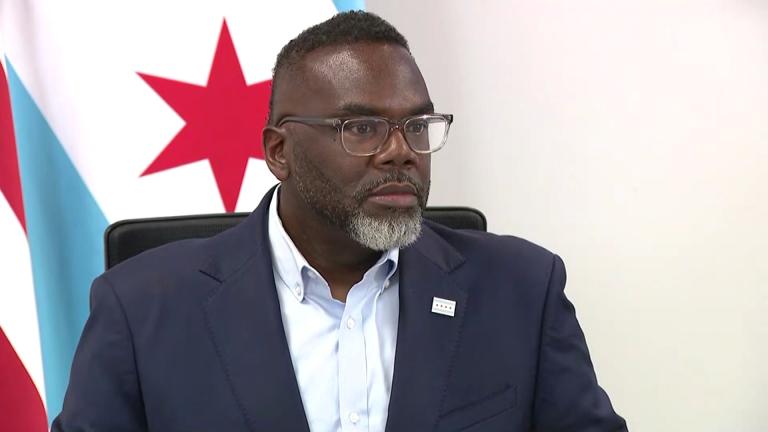
Saying Chicago must face “some hard truths,” Mayor Brandon Johnson painted a grim financial picture for the city Friday, detailing a projected $1.15 billion budget shortfall in the 2026 fiscal year.
On top of that mammoth shortfall, the city’s budget for the current year is deep in the red because of lower-than-expected corporate tax revenues and the decision by leaders of Chicago Public Schools not to make a $175 million payment to its employee pension fund for the second year in a row. The city must now fill a $146 million deficit by the end of the year, officials said.
“Chicagoans deserve the truth about the fiscal conditions of our city,” Johnson said during a virtual briefing about the forecast that he said contains “some hard truths.”
The projected gap is 2.7% higher than officials estimated a year ago and is more evidence that Chicago’s finances remain out of whack, pinched by soaring pension costs, spiraling personnel costs and a massive amount of debt.
Chicago’s financial condition is also threatened by a looming economic slowdown, rising inflation and efforts by the Trump administration to scale back funding for Chicago as the president continues to target his political opponents, officials said.
“Our economy does remain resilient, but fiscal discipline is certainly required in this moment,” Johnson said.
The last time Chicago’s projected budget deficit soared to more than $1 billion was in 2021, the height of the COVID-19 pandemic that triggered an economic catastrophe. The projected budget gap for 2026 is more than 14% larger than the gap Johnson faced a year ago.
Read the full budget forecast here.
The city faces a nearly $2.85 billion pension bill in 2026 in order to comply with a state law that requires two of Chicago’s pension funds be funded at a 90% level by 2055 and the other two by 2058, ensuring they can pay benefits to employees as they retire, according to the forecast released Friday.
That is nearly 3% more than city officials expected to pay toward pensions a year ago, due in large part to the passage of a new state law that will boost the retirement benefits for some Chicago police officers and firefighters.
The budget projections include an additional payment to the city’s four pension funds of $219.4 million.
Between 2023 and 2025, the city paid $802 million more than required into its pension funds, helping to stabilize those deeply underwater funds.
Chicago will pay 11% more in 2026 than it did in 2025 to pay back what it has borrowed, officials said.
The city also expects to pay significantly more to cover health care costs for its employees, with costs expected to rise by 18.2% in 2026. In recent years, the city’s health care costs have risen 9%, officials said.
The city’s 2026 spending plan also includes approximately $200 million to cover the cost of the tentative agreement with Chicago firefighters, who have been working without a contract for four years and are due retroactive pay increases, officials said. That deal has not yet been approved by the City Council or members of Local 2.
Part of the city's 2026 budget gap will be covered by funds that flowed into the city's tax increment financing, or TIF, districts but are not needed to fight blight or spur redevelopment.
Those “surplus” funds will be returned to the city and other taxing agencies, with half going to Chicago Public Schools. CPS is counting on $379 million from the city's TIF districts to balance its budget.
However, Budget Director Annette Guzman told reporters that the city expects a smaller TIF surplus this year, which could force CPS to amend its budget and make additional cuts or borrow funds.
Johnson declared $570 million in the city’s TIF districts to be in surplus for 2025, a record-breaking amount that sent $311 million to CPS.
For the second year in a row, Chicago finds itself mired in red ink during its current budget year even as it confronts a massive shortfall looming next year. The city imposed a hiring freeze in all non-public safety departments at the end of August, Guzman said.
The deficit the city is facing this year is almost entirely due to the decision by the members of the Chicago Board of Education to approve a budget that does not pay $175 million to the pensions of employees who are not teachers.
CPS has made that payment since 2020, but declined to do so in 2024 and again this year as it grappled with a $734 million deficit of its own.
The school board rejected Johnson’s pleas to take out a loan to cover that pension payment.
Chicago ended 2024 with a $161 million deficit, officials said. That forced officials to use what they called the city’s “unassigned fund balance” to ensure that Chicago’s budget was back in the black by Dec. 31.
The decision to use those uncommitted funds, essentially every penny left over in the city’s main bank account after all of the city’s other bills had been paid, will make this year’s budget gap harder to close than any other year in recent memory.
The city’s financial condition is unlikely to improve anytime soon, according to the forecast.
In 2027, Chicago will likely face a budget shortfall of $1.16 billion. In 2028, officials will be forced to grapple with a projected gap of $1.225 billion, assuming that the national economy does not markedly improve or weaken, according to the proposal.
Johnson is scheduled to detail his proposal to close the projected gaps in the city’s 2025 and 2026 budget by mid-October, Guzman said.
“My responsibility as the executive is to present a budget that reflects the values of what the people of Chicago desire,” Johnson said. “Without significant shifts in how we balance our budget, the services that the people of Chicago have begun to rely upon, they would certainly be in jeopardy.”
Johnson said last month he would not propose a property tax hike to help balance the city’s 2026 budget.
Chicago’s 2026 spending plan must make “structural changes” to put the city on solid financial footing, Johnson said.
Johnson said he would look to the working group he formed in April to make specific recommendations about those changes. That group’s report is due Sunday.
“There are some areas of government that are duplicative and don’t yield the most efficient response to the needs of the people,” Johnson said. “There are ways in which government needs to move into the 21st century. There are just antiquated systems that drag our systems down and does not allow us to move with the expediency that’s necessary.”
The projected budget gap assumes that the city will lose $40 million because of the General Assembly’s decision to end the state’s 1% grocery tax at Gov. JB Pritzker’s request.
The city faces an Oct. 1 deadline for the City Council to vote to continue to collect that tax without interruption and avoid blowing an $80 million hole in its budget. The next City Council meeting is scheduled for Sept. 25, giving supporters of that effort little room for error.
Assuming the city misses that deadline but agrees to reinstitute the tax as part of the overall budget deal, the city could start collecting that tax on July 1, halfway through the year, Guzman said.
Chief Financial Officer Jill Jaworski did not join Johnson, Guzman and Comptroller Michael Belsky during the presentation of the city’s annual budget forecast, which kicks off months of intense negotiations over the city’s spending plan.
Cassio Mendoza, a spokesperson for Johnson, told reporters Jaworski was “out of town” Friday.
Two days before Johnson told reporters he would not propose a property tax hike to close the city’s budget gap, Jaworski told Bloomberg News that a property tax increase was “likely (to) ... be part of the package” presented to the City Council this fall.
A year ago, Johnson proposed a $300 million property tax hike, the largest increase since 2016, saying he had no choice but to break one of his central campaign promises in order to avoid draconian cuts to city services and thousands of layoffs.
The City Council unanimously rejected that proposal, sending Johnson’s 2025 spending plan back to the drawing board.
Property taxes are the city’s largest source of revenue and the most effective way for city officials to raise revenue and ensure expenses do not outstrip costs. Most other revenue-generating proposals, like imposing a sales tax on services, not just goods, would require a change in state law.
Convincing the Illinois General Assembly and Pritzker to change state law in order to impose new taxes would be a difficult and time-consuming effort.
Since the city faces a deadline of Dec. 31 to approve a spending plan for 2026, any change in state law would have to be approved during this fall’s veto session, when a supermajority is required to pass new legislation.
Ultimately, the $17.1 billion 2025 budget that narrowly passed the City Council hinged on $165.5 million in additional taxes and fees as well as several one-time fixes after Johnson refused to support any cuts to city services or layoffs.
Johnson refused to rule out balancing the city’s 2026 budget with layoffs and furloughs, saying Friday it was “too early” make that determination.
Any proposal to reduce the city’s workforce would face immediate pushback from labor organizations, many of which backed Johnson in the 2023 mayoral campaign.
Johnson said last month that Chicago officials must consider hiking taxes on large corporations to help fill the budget gap and allow the city to fund new investments designed to boost working-class Chicagoans, particularly on the West and South sides.
Johnson has also repeatedly emphasized that the taxes Chicago directly levies are showing more robust growth than the taxes levied by state officials as part of a campaign to convince state officials to give the City Council greater ability to raise revenue.
Hearings on Chicago’s 2025 budget are set to begin Sept. 9.
Contact Heather Cherone: @HeatherCherone | (773) 569-1863 | [email protected]