Arts & Entertainment
How a Chicago Artist Turned Jail Bars Into an Instrument
Cell bars from the oldest section of Cook County Jail were used as an xylophone-like instrument at the University of Illinois Chicago’s Gallery 400 on Wednesday.
As the nearly 100-year-old jail dormitories were demolished in 2021, artist Maria Gaspar was able to salvage 18 cell bars and a couple of bricks. She transformed the jail bars into a “sonic sculpture,” part of a performance piece titled “We Lit the Fire and Trusted the Heat (after Angela Davis).”
In the piece, vibraphonist Thaddeus Tukes played between the drums and vibraphone — from New Orleans second line, to swing, to salsa. Each shift in song came to a halt from faint tapping on the jail bar sculpture.
Behind Tukes was a projection of a claw excavator demolishing one of the jail dormitories.
Gaspar grew up in Little Village, neighboring Cook County Jail. That proximity, and reflections on incarceration and liberation, have informed her practice. In one of her works, she collaborated with currently and formerly incarcerated artists at Cook County Jail, projecting their work outside on the jail’s wall.
The sonic sculpture piece began in 2023, with several other musical collaborators and different configurations of the bars. After its performance Wednesday, WTTW News sat down with Gaspar, Tukes and Jimmy Soto, the longest serving exonoree in Illinois history who was once incarcerated at the jail, to reflect on the performance. The conversation has been edited for length and clarity.
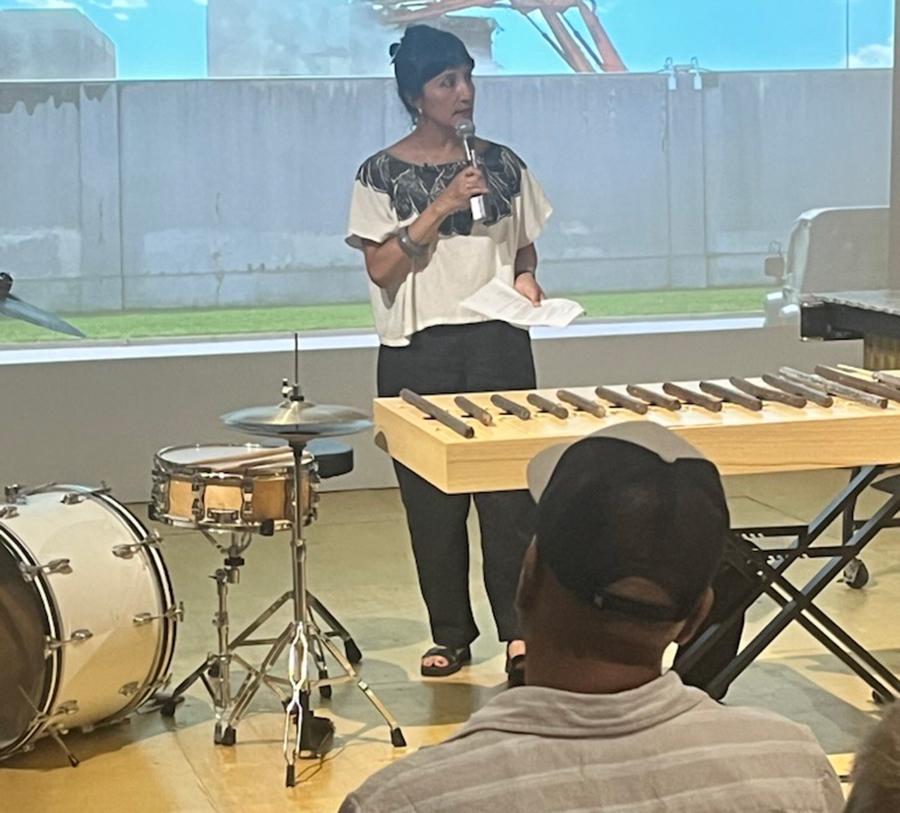 Artist Maria Gaspar grew up in Little Village, neighboring Cook County Jail. That proximity, and reflections on incarceration and liberation, have informed her practice. Her latest piece transforms jail bars into an instrument. (Danny Sternfield / University of Illinois Chicago)
WTTW News: Maria, you grew up near the jail in Little Village, but was there a moment that struck you about its presence?
Maria Gaspar: I think it was being a kid and being part of the Mexican Day parade, and the floats get set up right next to the jail. We were always invited to be on a float. At the time, I just thought it was part of, you know, just the backdrop. But we often had some communication between the guys in Division 1 and the people on the street, there was always a conversation: ‘Viva Mexico,’ or, ‘Hey, what’s up, girl,’ or whatever it was. But yet, we were divided by this concrete wall. So that was really striking to me. That was maybe my first memory of it.
Can you talk about getting the bars from the judge?
Gaspar: I was shooting the video every day for about three weeks. I was there during the working hours of the demolition company. I met a lot of people. There were people coming from court, or maybe a loved one getting to the 60 bus. Then I met a judge who came by to take photographs, and he asked me what I was doing, and I told him. And then maybe 10 minutes later, he returns with the bar and said, ‘Here you go.’ It seemed like it, he thought of it as a memento. He said, ‘Well, there’s more.’ And I said, ‘Oh, where?’ And so I figured out where that was, which was at the entry point of the demolition site. Somebody, maybe guards, laid out the bars on the floor. I think what was happening is staff members were just going in and getting a piece of it.
Did seeing them laid out inspire the xylophone?
Gaspar: No, no. At first, when I brought them to the studio, I think I already knew that I wanted to make them changeable. I started to arrange them in the studio on the floor, and I kept moving them and making these new kinds of forms, very linear, somewhat minimalist. I thought, well, how do I capture the natural resonance of the bars, which is actually very difficult to do, because it requires them to be somewhat elevated. I had all these different kinds of tools, wrenches, mallets, and then I was just striking them. I recorded all of those sounds, and I just listened to them and thought about what I can do with it. I thought about hanging them like a chime. But I didn’t want them to be in their natural position, which was vertical. I wanted them to be passive. And so that then led to a kind of xylophone. I call it a sonic sculpture.
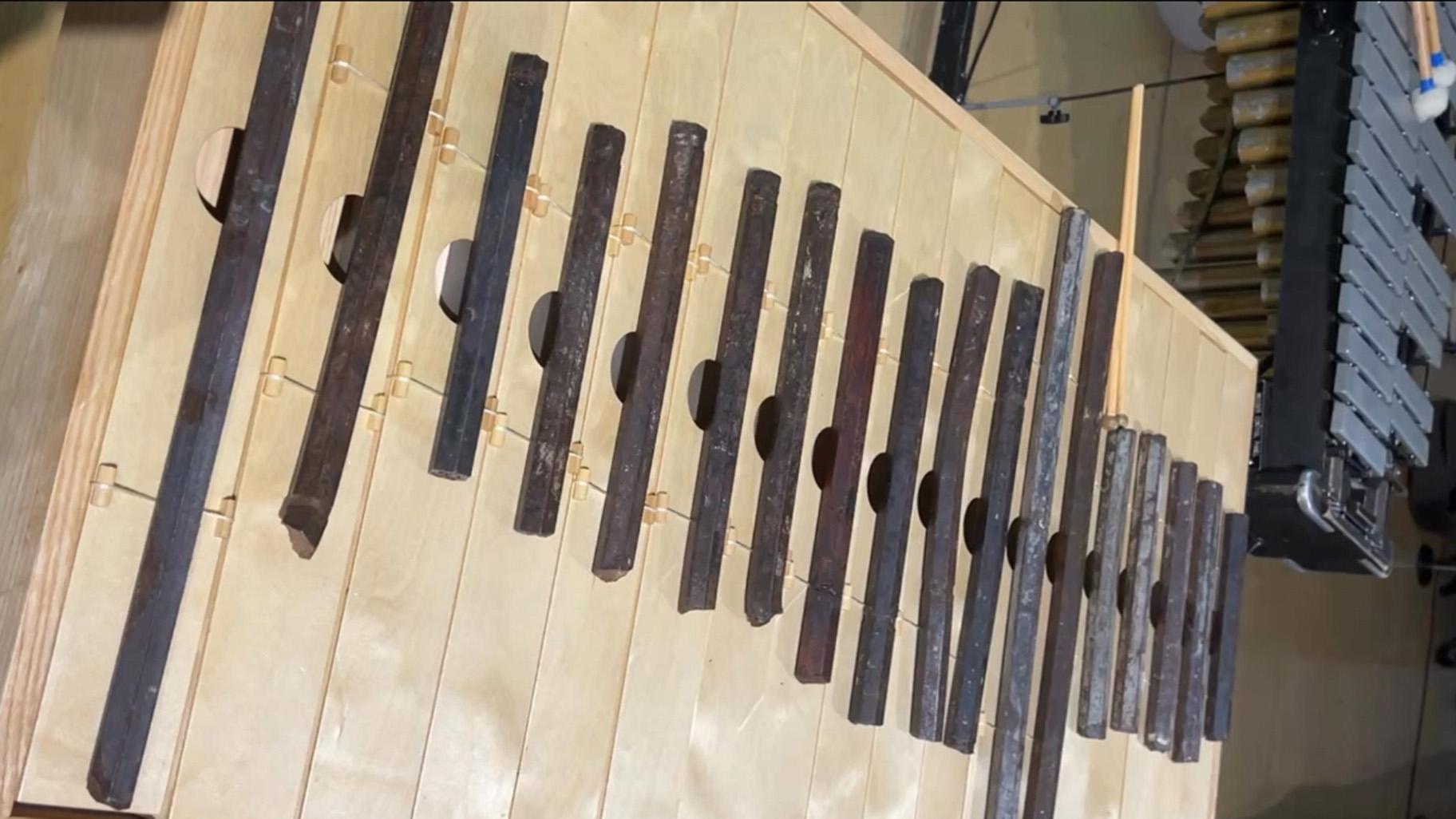 In 2021, the oldest section of Cook County Jail was demolished. Artist Maria Gaspar gathered 18 cell bars from the demolition and created this “sonic sculpture” to be played like a xylophone. (Blair Paddock / WTTW News)
Thaddeus, what does it feel like for you to repurpose these bars?
Thaddeus Tukes: I feel like it’s a lot of responsibility. It’s very powerful for me. They sound kind of haunting, right? And even practicing them at home, it still elicits that feeling, that memory and association of the purpose they generally serve. Even in my small way, feeling empowered over a very large system to say, ‘Hey, I can take what you meant for harm and use it for beauty and for good.’ That doesn’t solve anything, it doesn’t erase anything, but for a moment, we can have a glimpse of the possibility that something like this that’s meant to hurt us can be transformed into good, especially in a case where we probably lose optimism about that in real life.
When you’re choosing the music and what you’re playing, how do you square that with the demolition behind you?
Tukes: I think my approach with this piece has always been to kind of reach multiple emotions. When you’re incarcerated, you are going to have some moments where you laugh. You are going to have some folks make buddies that years later, they’re still friends with those guys. I haven’t had that direct experience, but I’ve had experience that can invoke similar emotions of not having your own freedom. It’s a range of emotion that I’m going for, but I think it’s all within this context of the perception of freedom versus the actual agency to dictate your future, which I think we all experience.
Gaspar: I was thinking about Ruth Wilson Gilmore’s idea of abolition geography. And I think when I was starting this work, I think I was thinking more about carceral geography and the way she puts it. OK, what does it look like? Then what can we create instead? What do we do with the $900 million [allocated to build two new prisons in Illinois]? What can we do with it instead of building a prison? For me, what Thaddeus is doing is the abolition geography. It’s both the critique, but it’s also the offering. It’s the creation of something new. I think they’re always in relationship, both being able to have a power analysis and a critique, and then also offer something back.
Jimmy, what’s the contrast like for you, being behind those bars while you were inside versus them being used as a musical instrument?
Jimmy Soto: [Officers] would use it to check the strength of the bars to make sure nobody’s tried to escape. So they would do it at really inopportune moments, when you’re sleeping, and they would wake you. So you’re startled by that. It was so violent, the way they hit it. To hear him perform it, my gosh, you know, music is transcendent. During my incarceration, music was really a way for me to just close my eyes and go to another place. So the same thing, although, you know, he does embody the pain that’s associated with being incarcerated, he also brought some beauty to it when you hear these notes. There were two sides of it: the pain, and then again, the joy. When they’re demolishing it, my cell could see out [where we see in the projection]. To see it going away, it was like, it’s disappearing the way they disappeared me.
Contact Blair Paddock: @blairpaddock.bsky.social | [email protected]