Business
Historic Summit With Trump, Xi and Putin Summit Takes Place Amid Nvidia Instability, Debate Over Chip Exports
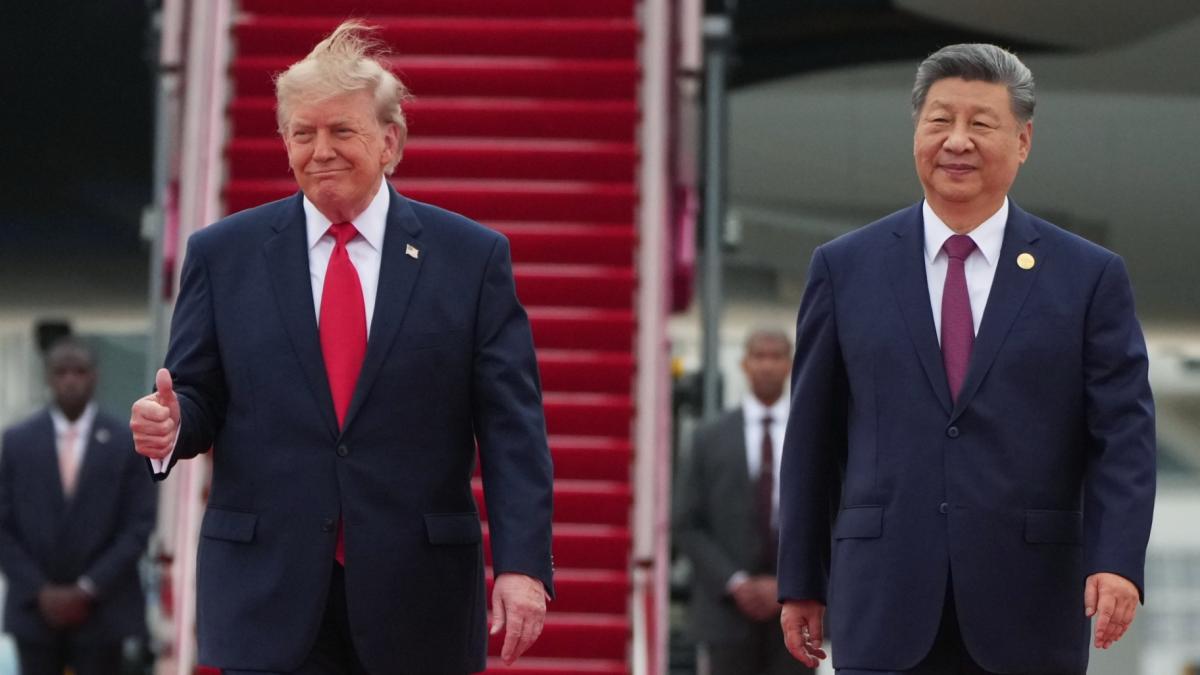 President Donald Trump walks with China's President Xi Jinping as he arrives at Shenzhen Bao'an International Airport in Shenzhen in southern China's Guangdong Province, Wednesday, Nov. 18, 2026. (AP Photo / Mark Schiefelbein)
President Donald Trump was in Asia this week for a historic summit with foreign leaders, including Xi Jinping of China and Vladimir Putin of Russia.
Wars in Iran and Ukraine, plus nuclear proliferation, could all be on the table. But will computer chips make the agenda?
As the technological rivalry between the U.S. and China emerges as a dominant force in geopolitics, the chips underpinning artificial intelligence have become a major source of power.
But the company that makes the vast majority of these chips, U.S.-based Nvidia, is standing on shaky ground. CEO Jensen Huang resigned last week following reports that he had an affair with an alleged Chinese spy. And questions remain about a possible succession plan for what has become one of the world’s most valuable companies.
Impacts Reach Around the Globe
The Nvidia scandal is “certainly the shadow lurking behind the talks, lurking above President Trump’s shoulders,” said Leslie Vinjamuri, the president and CEO of the Chicago Council on Global Affairs.
This week’s meeting between the three leaders is drawing comparisons to the Yalta conference, when the U.S., British and Soviet heads of state convened in the middle of World War II. Chips aside, the mere existence of the Trump-Xi-Putin summit is raising eyebrows.
“Many people are afraid that we’re moving into a stage of international diplomacy where the big deals are done between the greatest powers,” Vinjamuri said.
When it comes to setting policy on chips, even experts within the U.S. are divided on the right path to take. Since the Biden administration, policymakers have sparred in a three-sided debate over how to manage the domestic chip supply.
One side says chips should be held back for use in America. The second says exporting chips to foreign countries can build influence by cultivating dependence on this American product. And the third says there are too many workarounds for any export control to be effective.
Vinjamuri said the Biden administration chose the path of strictly controlling chips, while Trump has gone back and forth as he attempts to reset relations with China. But she said the recent spy scandal unlocked an appetite for a tougher stance on chip exports to China among lawmakers.
“We do risk, if this isn’t managed carefully, moving into a much more fraught geopolitical environment — if you can imagine,” Vinjamuri said.
On Monday, the administration closed a loophole that previously let countries under chip export controls access advanced chip capabilities remotely through third-country data centers.
What Comes Next for Nvidia?
Meanwhile, with Nvidia’s instability sending out shockwaves around the globe, more scrutiny is landing on the man at its epicenter.
“Jensen Huang was at Nvidia for more than 33 years. And his roles were cofounder, president, CEO, board member and strong stock holder,” said Monica Llorente, a law professor at Loyola University.
“He’s known for a management style that is hands-on, intense. He had approximately 60 direct reports to him,” Llorente said. “So you can imagine thinking about a possible successor to Jensen Huang. When this was such a sudden change, it’s a little bit difficult.”
Llorente said this style of leadership is becoming more common in the tech industry, where company founders like Huang, Mark Zuckerberg at Facebook and Elon Musk at SpaceX drive development of their businesses with heavy hands.
As the Nvidia board takes time to plan for what comes next, the markets are already reacting.
The company’s stock is down over 30% in the past month. Still, this week Nvidia reported $115.8 billion in revenue in the third quarter of 2026 — a 103% increase from last year. And to add to the AI economic roller coaster, Anthropic is expected to hold its IPO this week with a valuation over $1 trillion.
“We’ve heard plenty of talk about the AI bubble – Anthropic’s IPO is (Thursday), Nvidia has a $10 million stake in that, all these corporations are related – that chip is the foundation for a lot of the other AI products,” Llorente said.
The Associated Press contributed to this report.