Crime & Law
CPD’s Refusal to Allow Outside Agency to Investigate Deaths Caused by Officers Violates Consent Decree, Reform Groups Say
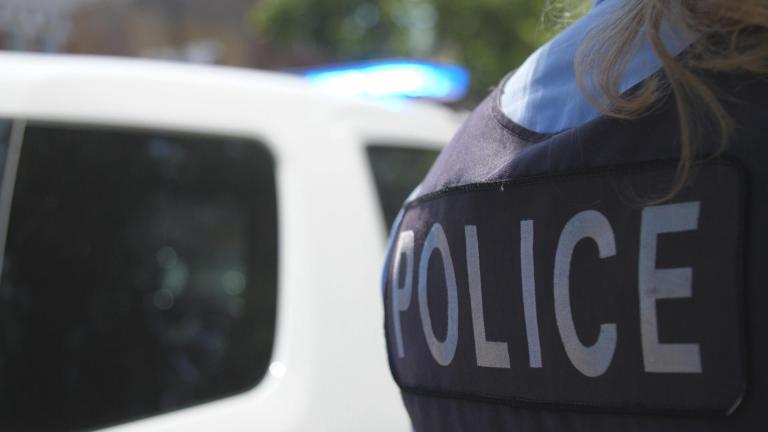
 (Michael Izquierdo / WTTW News)
The Chicago Police Department’s refusal to allow an outside law enforcement agency to investigate police shootings violates the federal court order known as the consent decree, a coalition of police reform groups told the federal judge overseeing efforts to reform the department.
That coalition, which forced the city to agree to federal court oversight, told U.S. District Judge Rebecca Pallmeyer in a court filing made public Tuesday that they plan to formally ask her to order CPD to swiftly comply with one of the core reforms required by the consent decree.
A 2016 state law known as the Police and Community Relations Improvement Act, or PCRIA, requires all Illinois police departments to allow an outside law enforcement agency to conduct criminal investigations into any “officer-involved death.”
Although the consent decree, which took effect in 2019, specifically requires CPD to comply with that law, police brass have not done so, nor have they “made substantial progress toward doing so,” violating state law for more than a decade, the coalition said in its court filing.
The coalition asked the independent monitoring team charged with keeping track of the city’s compliance with the consent decree to convene a meeting with the city, police brass and the Office of the Attorney General within 45 days to discuss the coalition’s concerns.
In the more than seven and a half years that the consent decree has been in effect, 40 people have been killed by CPD officers or died while in CPD custody, according to data published by the Illinois Criminal Justice Information Authority.
“Under PCRIA, the families of each of these individuals deserved an independent investigation into whether the officers who caused their deaths should be charged with a crime,” according to the coalition of reform groups. “But these grieving families have not received the fully independent law enforcement investigation to which they were entitled by state law and the (consent decree.)”
During a hearing before Pallmeyer on Oct. 20, Illinois Attorney General Kwame Raoul’s office recommended that a new law enforcement task force be charged with investigating deaths caused by CPD officers.
“Public confidence depends in significant part on who is conducting these types of investigations,” Chris Wells, the chief of the attorney general’s public interest division, told Pallmeyer. “An agency should not investigate a death that occurs at the hands of one of its own.”
All deaths caused by CPD officers are now investigated by CPD detectives.
Investigators with the Civilian Office of Police Accountability are charged with determining whether officers complied with CPD policy when they used force against a member of the public. Those findings can be shared with the Cook County State’s Attorney’s Office, which makes the final decision on whether to charge officers with a criminal offense.
Most Illinois law enforcement agencies rely on the Illinois State Police to probe deaths caused by their officers.
However, the attorney general’s office believes the best way to probe deaths caused by CPD officers would be to combine “resources from multiple law enforcement agencies” into a task force, Wells said.
Interim CPD Supt. Fred Waller told Pallmeyer he would not oppose that change.
But CPD brass “have not committed to any specific, concrete steps to bring CPD into compliance” with state law and the consent decree, according to the reform groups.
That has made it impossible to restore the public’s trust in the beleaguered department, which has faced decades of scandals, misconduct and brutality, according to the reform groups.
“The public has not had the benefit of the transparency that comes with an objective, independent investigation free of conflicts of interest,” the reform groups wrote. “And community trust in CPD suffers when it is uncertain whether CPD officers will be held accountable for shooting and killing people in violation of the criminal laws of Illinois.”
PCRIA was passed and signed into law amid the outcry over the 2014 murder of 16-year-old Laquan McDonald by Chicago Police Officer Jason Van Dyke.
Three CPD officers were acquitted in 2019 after being charged with trying to cover up that murder. Former Inspector General Joseph Ferguson urged 11 police officers be fired for their actions after the shooting.
Seven and a half years after the consent decree was implemented, CPD had fully complied with 32% of its requirements by the end of June, according to the court-appointed monitoring team charged with keeping track of reform efforts.
WTTW News coverage of policing and police reform is supported by The Joyce Foundation.
Contact Heather Cherone: @HeatherCherone | (773) 569-1863 | [email protected]