Politics
Speed and Enforcement Are Top Issues Raised at Chicago Park District’s First Town Hall on Motorized Devices
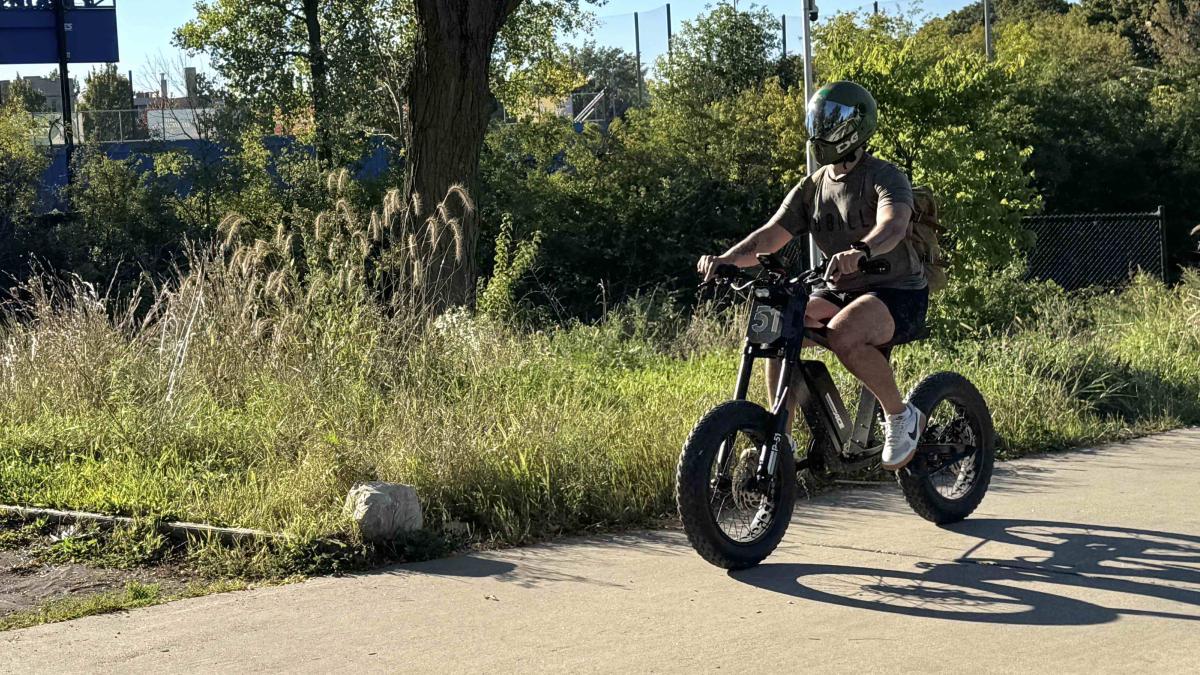 The Chicago Park District is gathering feedback on the use of motorized devices on park paths. (Patty Wetli / WTTW News)
The Chicago Park District is grappling with a new Illinois law set to take effect Jan. 1 that governs the use of e-bikes and other micromobility devices such as e-scooters on roads and paths.
Though the legislation was designed to create standardized statewide rules, it left an opening for park districts to further restrict use of the devices. In the city, where the Chicago Park District’s current code doesn’t even have a speed limit for old-fashioned human-pedaled bicycles, officials are weighing options for ordinance amendments.
Pam Whitmer, director of policy for the district, laid out the specifics of the new state law Tuesday night at the first of three scheduled town halls designed to gather public feedback.
In short: E-motos (motorized cycles without pedals) and high-powered e-bikes capable of exceeding 28 miles per hour will be prohibited from bike paths under the new law. The Park District can’t alter that directive, Whitmer noted, but added the law doesn’t define “bike path.”
All other micromobility devices — motorized unicycles (“unis”), e-skateboards, lower speed e-bikes and e-scooters — are permitted at speeds up to 28 miles per hour.
Forest preserve districts and other municipalities have capped speeds at 15 to 20 miles per hour, Whitmer said.
Video: E-bikes and e-scooters are driven down paths in Legion Park and River Park as the Chicago Park District gathering feedback on the use of motorized devices. (Patty Wetli / WTTW News)
Consensus at the sparsely attended meeting was that the Park District needs to enact tougher limits than the state, particularly regarding speed.
“It’s too fast,” Scott Anselmo, a Ukrainian Village resident, said of the 28-mile-per-hour threshold.
In a sentiment that was echoed by others, Anselmo added that experienced cyclists on conventional bikes might be able to reach 20 to 25 miles per hour with serious exertion, but motorized devices hit even higher speeds “effortlessly.”
“You’ve given a lot of people a lot of power in the bikes that they ride, that’s going beyond the scope of what the path was designed for,” he said.
John Friedmann, a member of Horner Park’s advisory council, said the higher speeds allowed for e-scooters and other motorized devices seemed out of line for multi-use paths shared with joggers, parents with strollers and dog walkers, among others.
“That’s an accident waiting to happen,” Friedmann said.
He also questioned why the Park District had restricted shared e-scooters on the lakefront path and 606/Bloomingdale Trail but not elsewhere: “If they’re not safe there, why are they safe in other parks?”
Regardless of what restrictions the Park District adopts, attendees said they weren’t confident the rules would be enforced.
“We can write all the laws in the world we want and if we don’t enforce them, it doesn’t matter,” said one man who opted to be identified only as Erik.
The Park District is holding a second in-person town hall Wednesday evening at Ellis Park, 3520 S. Cottage Grove Ave., and a virtual session Oct. 6 at noon.
According to Whitmer, the goal is to present proposed ordinance amendments to the Park District’s board of commissioners at the group’s November meeting. A 45-day public comment period would follow, with potential approval coming in January.
Contact Patty Wetli: [email protected]