Science & Nature
UChicago Physicist, U of I Environmental Scientist Awarded MacArthur ‘Genius Grants’
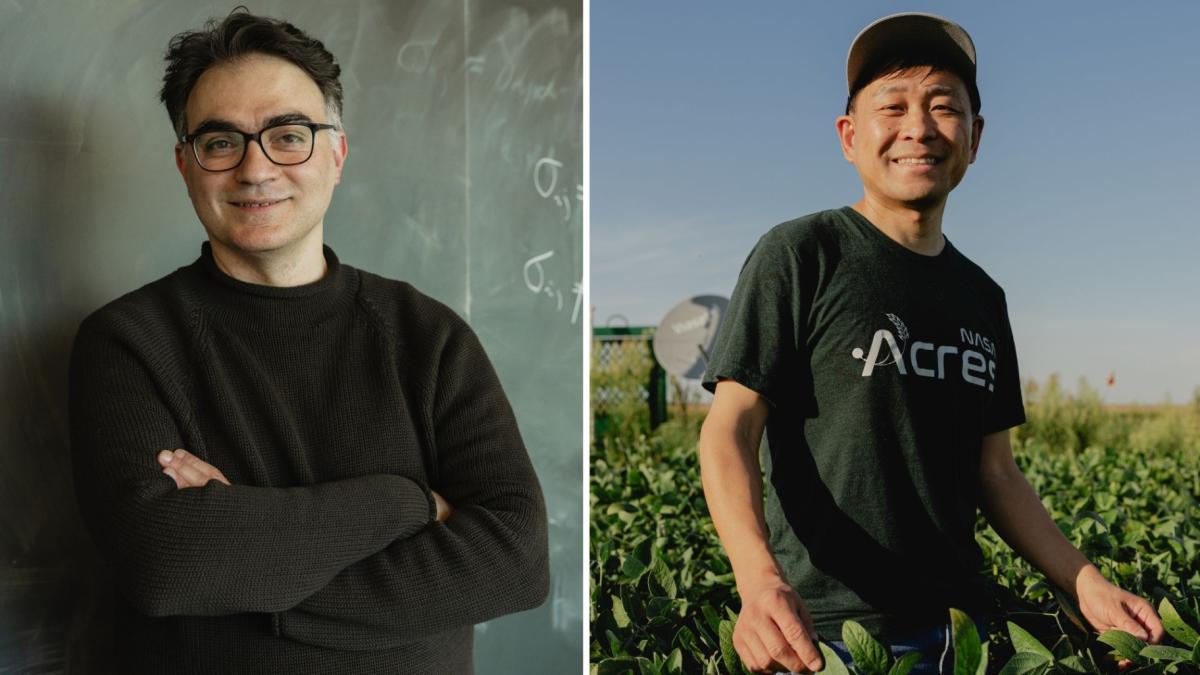 Vincenzo Vitelli, left, a physicist at the University of Chicago, and Kaiyu Guan, an environmental scientist at the University of Illinois, were among a group of 20 fellows chosen for this year’s MacArthur Fellows Program. (Courtesy of John D. and Catherine T. MacArthur Foundation)
A physicist at the University of Chicago and an environmental scientist at the University of Illinois are among the fellows chosen this year to receive the prestigious MacArthur “genius grant,” the MacArthur Foundation announced Tuesday.
The MacArthur Fellows Program aims to identify creative individuals who have a track record of excellence in a field of scholarship or area of practice and demonstrate the ability to impact society in significant and beneficial ways, according to the foundation’s website.
Physicist Vincenzo Vitelli and environmental scientist Kaiyu Guan were among the 20 fellows chosen this year.
Vitelli is a physicist at the University of Chicago building theoretical frameworks to describe the behavior of matter and materials with unique properties, which allows for a deeper understanding of real-world systems and lays the groundwork for new classes of materials.
“The common feature among all the systems that I’ve been studying is that they’re complex systems composed of many parts, of many constituents, but each constituent can process information and it can do so by defeating laws of physics like conservation of energy, conservation of momentum, simply because they are complex objects,” Vitelli said in an announcement video. “It’s a celebration of the fact that the world is a place where things keep moving — at least that is the world I see and that is the world that I try to describe in my mathematics.”
Guan is an environmental scientist at the University of Illinois combining earth observations, process models and machine learning to understand and predict how crops, the environment and human agricultural practices interact across agricultural landscapes.
“We can actually see the scenarios of climate change, so we can project to the next 20 to 30 years, or even longer time, for that particular field and then how we potentially can mitigate the impact,” Guan said in an announcement video. “I do believe in the very foreseeable future, we should have the ability to monitor, model and optimize every farmland on this planet. If we can do that, we can really optimize our food systems and production system to achieve the benefits for humanity.”
Fellows receive a “no-strings-attached” $800,000 award that is paid in quarterly installments over five years.
View the full list of this year’s MacArthur fellows.
Previous MacArthur fellows based in Chicago include social justice artist Tonika Lewis Johnson, artist and architect Amanda Williams, sociologist Reuben Jonathan Miller, jazz cellist and composer Tomeka Reid, statistician Rina Foygel Barber, fiction writer Ling Ma and multimedia artist Ebony G. Patterson.
“For 45 years, MacArthur Fellows have defied boundaries, by questioning conventions, crossing disciplines, and driving collective progress,” Kristen Mack, vice president of communications, partnerships and the fellowship program at the MacArthur Foundation, said in a statement. “The 2026 Fellows continue that creative tradition—they explore the depths of our humanity; they reveal untold origins to modern challenges; they expand the edges of scientific inquiry and life-saving research. They show us new ways to understand the world.”
Contact Eunice Alpasan: [email protected]