Crime & Law
375 Days Without Stepping Foot Outside: Lawsuit Alleges No Yard Time for Some Incarcerated at Menard Prison
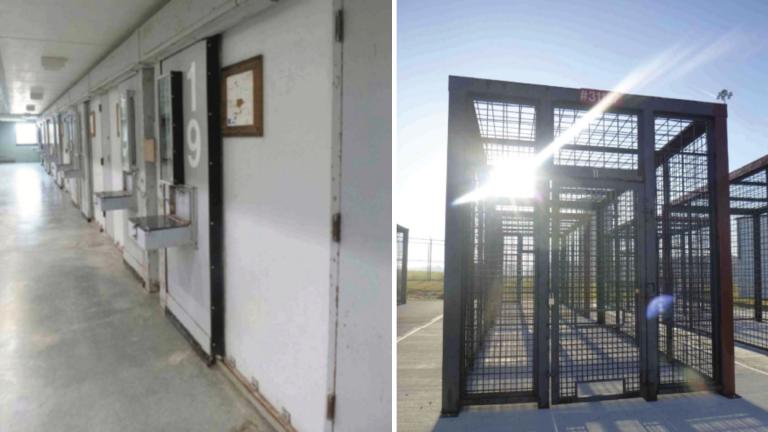
 A restrictive housing cell at Menard Correctional Center. (Illinois State Police via MacArthur Justice Center)
Three men at Menard Correctional Center allege they weren’t allowed to go outside for months on end, instead confined to filthy and unventilated cells so small they couldn’t fully extend their arms.
Omar Johnson said he went 375 days without stepping foot outside, Clarence Jones went 356 days and Alexander Castillo about eight months.
“Menard is called the pit — a dark cloud hangs over this place, often making you feel helpless and hopeless,” Alexander Castillo stated in a news release. “[The solitary cells] are dark, dingy, small, and cramped, at times suffocating.”
Johnson, Jones and Castillo, alongside the nonprofit civil rights organization MacArthur Justice Center and the firm Akin, filed a lawsuit Monday against administrators at the Illinois Department of Corrections and Menard Correctional Center, alleging that they inflicted cruel and unusual punishment on the plaintiffs. The extensive time in restrictive housing without yard access caused the men severe physical and psychological harm, the lawsuit alleges.
All three men were housed in the southern Illinois prison’s restrictive housing unit, known as North 2 or N2. Unable to stretch outside, all of them allege they experienced weight loss due to muscle atrophy.
“The ability to exercise is a constitutionally protected basic human need, just like food, water, and warmth. And just like food, water, and warmth, exercise is not a luxury or privilege that must be earned, or that can be coercively withheld from an incarcerated person,” the lawsuit states. “Yet, that is exactly what has been systematically perpetrated against the Plaintiffs.”
The Illinois Department of Corrections declined to comment due to ongoing litigation.
People are generally housed in restrictive housing, also known as solitary confinement, as a result of a disciplinary hearing or when suspected of a potential disciplinary infraction. The cells in this unit, the lawsuit alleges, are “filthy, dank, and dilapidated.”
Even while locked in restrictive housing, incarcerated people still have rights to out-of-cell time. The Illinois Administrative Code requires that individuals in restrictive housing “shall be afforded the opportunity to recreate outside their cells a minimum of eight hours per week distributed in increments over no less than two days per week.”
For those in extended restrictive housing, meaning restricting a person to their cell for 22 hours or more per day for 29 days or more, but less than one year, there’s a required minimum of 10 hours of unstructured out-of-cell time, such as yard, showers or a barber visit and a minimum of 10 hours of structured out of cell time, such as chaplaincy, mental health services or law library, according to the code.
None of the plaintiffs had formal yard restrictions, but the department subjected each of them to “de facto yard restrictions by virtue of their placement in N2,” the lawsuit alleges.
The men allege going months on end without the ability to exercise or adequately move their bodies, instead spending most of their time in bed or immobile in cramped cells. Physically, this could lead to degradation of cardiovascular, respiratory, gastrointestinal and musculoskeletal functioning, the lawsuit claims. Mentally, it could bring psychological harms such as anxiety, anger or psychosis, the suit adds.
All three men filed grievances about out-of-cell time, but those pleas for relief were all denied by staff, the lawsuit alleges.
“The Defendants’ denial of exercise from the Plaintiffs was not due to any imminent concern for the safety or security of others,” the lawsuit states. “There was no justification for the long-term denial of exercise, movement, and out-of-cell time each of the Plaintiffs endured.”
The lawsuit alleges that this denial of exercise is “no accident,” and that IDOC and Menard administrators employ specific policies and practices resulting in the plaintiffs being confined for extended periods of time.
Administrators systematically refuse to run outdoor recreation and prevent access to any indoor recreation or out-of-cell activities, the lawsuit alleges. That extends to access to gyms, education, contact visitation, religious services or the physical law library.
Staff also “stack” restrictive housing time, meaning they will hold people in segregation for long periods of time through multiple consecutive disciplinary sanctions and investigative stints, according to the lawsuit.
On the rare occasions when the men were allowed out of their cells indoors, the lawsuit states that they were forced to wear handcuffs that restricted their ability to freely move their bodies.
Additionally, Menard has been on continuous facility-wide lockdowns nearly every day over a roughly three year period, the lawsuit states.
The suit alleges that by imposing near-constant lockdowns, administrators have acted partly pursuant to state regulation, “[r]ecreational opportunities shall not be required during institutional lockdowns or during institutional emergencies, including, but not limited to, riots, strikes, fires, work stoppages, power outages and natural disasters.”
“This regulation is facially unconstitutional because it authorizes Defendants to indefinitely deny segregated prisoners recreation and thus the right to exercise, which is a basic human necessity protected by the Eighth Amendment,” the lawsuit states.
It’s not the first lawsuit alleging abhorrent conditions of confinement in restrictive housing. In 2016, individuals held in restrictive housing across all IDOC facilities challenged their conditions in Davis v. Hughes, which proceeded to trial last October. A verdict has yet to be issued.
As an expert in the Davis case, a former correctional administrator evaluated the conditions of IDOC’s restrictive housing units in 2023, including Menard’s, and according to the lawsuit, concluded that they violated national and international standards.
Contact Blair Paddock: @blairpaddock.bsky.social | [email protected]