Arts & Entertainment
‘Like Lightning Struck’: Community Marks 60 Years Since the First Division Street Riot, Puerto Rican Rebellion
Chicagoans may have spotted Puerto Rican flags flying across the city this month as the community prepares for this weekend’s parade and festival.
The 48th annual Puerto Rican People’s Day Parade is set to take off from Division Street and Campbell Avenue at noon Saturday and will be part of the larger festival happening Thursday to Sunday.
While events for the community are planned for the entire weekend to celebrate Puerto Rican pride and culture, this year also honors the history of Chicago’s Boricua community — marking the 60-year anniversary of the first Division Street riot.
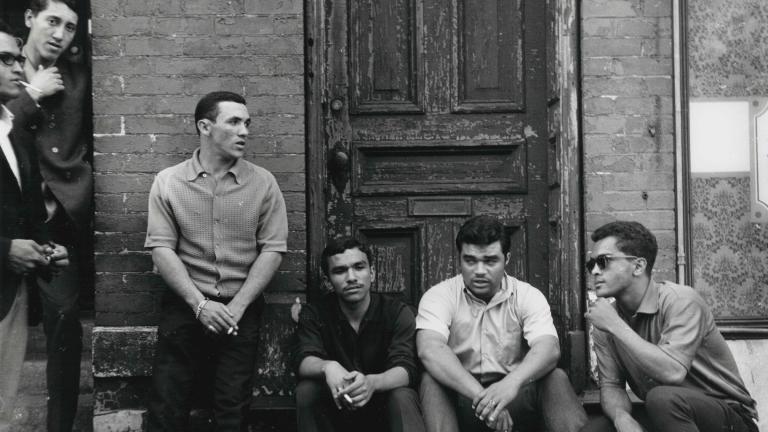
For some in Chicago’s Puerto Rican community, stories about the riots of ‘66 and ‘77 are often heard in passing, but people might not know how pivotal they were in changing the political environment at the time.
There were two riots: the first in 1966 and the second in 1977, both from Puerto Ricans in Humboldt Park who were responding to police brutality and historic neighborhood disinvestment.
José López, executive director of the Puerto Rican Cultural Center, witnessed the June 12, 1966, riot.
He described going to the Puerto Rican parade, which was held downtown at the time, before returning to the pharmacy where he worked. There, as he saw people walking back into the community from the parade, he noticed an altercation across the street at a bar.
When police arrived, López said, he saw one of the young men run into an alley where the police chased and shot him.
“The people picked him up and literally carried him to St. Mary’s Hospital,” López said. “In the process, it was like, like lightning struck, or like a wildfire.”
The man he described was likely Cruz Arcelis, who was shot by CPD patrolman Thomas Munyon.
Igniting the wildfire, López said, was a long history of neglect from the city in the Puerto Rican community with segregation keeping city services and jobs away from Puerto Ricans.
He recalled seeing buildings with rent signs that were inscribed with “no negroes, no Puerto Ricans, no dogs,” highlighting racial tensions that led to the riot.
“It just went crazy, and obviously people used everything they had to attack the police,” López said. “Police cars were overturned. They were burned. It was literally a warlike situation.”
The clashes with police ultimately continued until June 15, 1966. Javier Vargas, the documentary filmmaker behind “Humboldt Park Riots,” said clashes continued upward of five days following the initial shooting.
Vargas spent years gathering interviews with witnesses in both riots.
He said that 11 years later, on June 4, 1977, while superficial changes had been made allowing Puerto Ricans to hold positions in office and in the Chicago Police Department, the root causes of disinvestment and police brutality remained the same.
“The conditions for the ‘77 riots were the same conditions as the ‘66, I mean, there was really no difference,” Vargas said. “Police officers were stopping you for no reason, they would take you from one neighborhood and put you in another neighborhood that was the opposite gang then call out, ‘Hey, Puerto Ricans in the park,’ and then let the White gangs go and chase you.”
Much like its earlier counterpart, the 1977 riot began after the Puerto Rican parade, which was held downtown.
But tensions were already high that day, Vargas said, because the FALN (Fuerzas Armadas de Liberación or Armed Forces for Liberation) took credit for bombing a Cook County office building.
As people left the parade downtown, they gathered in Humboldt Park where police had been present due to gang activity earlier that same day. Vargas said police were ordered to clear the park of everyone regardless of gang affiliation.
As police moved into the park, sweeping it of residents, Officer Thomas Walton made his way to the tennis courts that ran adjacent to California Avenue. There he found Rafael Cruz and Julio Osorio. According to Vargas, Osorio was holding a hairbrush that was mistaken for a gun by Walton.
In a New York Times report on that day, the Chicago Police Department said Osorio had a gun and had fired at two CPD officers, missing the police but fatally wounding Cruz. Officers returned fire, police said, killing Osorio.
Vargas said Cruz and Osorio were shot in the back.
“The people that they have removed out of the park started looting and burning buildings — the whole Division Street was up in flames, and people looting, and they (the police) had no control,” Vargas said.
The riot was quelled by Chicago police, only for mass protests to erupt from community members in the ongoing days. Those protests would put pressure on the city to recognize the severity of the struggles faced by Puerto Ricans in Chicago.
While the riot in 1977 was shorter, the political consequences paved the way for the creation of organizations and institutions like the Young Lords, the Dr. Pedro Albizu Campos Puerto Rican High School and the Puerto Rican Cultural Center (PRCC).
In 1978, the Puerto Rican parade was moved to Humboldt Park and has been celebrated there since — making this weekend’s celebration the 48th consecutive year that it’s been held in the neighborhood.
Ald. Jessie Fuentes (26th Ward) connected the lineage of the uprisings to the work being continued today.
“We are honoring the resilience of the Puerto Rican community and our ability not just to celebrate culture and show the best of who we are as Puerto Ricans, but to pay homage to the history that has gotten us to this point,” Fuentes said.
Fuentes announced earlier this week a memorial street-naming in honor of Cruz and Osorio.
Since the pressure put on the city by the riots, their subsequent protests and decades of organizing, the Puerto Rican community has been able to attain more representation in politics, institutions and even the CPD.
“We have to be able to continue to educate people on those conditions and, you know, we’ve done a lot of work in the last 60 years to change those conditions,” Fuentes said. “Just in the last year and a half we’ve brought in over 225 affordable housing units to Humboldt Park. We’re sending more Puerto Ricans to the police force. That doesn’t make it perfect, but it means we have representation and an understanding of our culture.”
While progress has been made in the more than half-century since the riots, there are still issues facing the community.
This year’s parade is specifically focused on platforming LGBTQ+ Puerto Ricans. The PRCC will honor Miguel “Ricky” Pérez, the first openly gay mayor of Isabella, Puerto Rico.
Sabrina Alicea, educator and co-founder of the Humboldt Park arts nonprofit Somos Arte, said she is excited to see the intentional effort from the parade this year.
“The community has done a really good job of amplifying the existence of our LGBTQ brothers and sisters — and that’s really beautiful to see,” Alicea said.
That said, she believes honoring the history of Puerto Ricans in Chicago requires a continued effort to keep fighting for marginalized members of the community.
“We’ve been a marginalized community from Day 1 and that doesn’t mean that we put our arms down and stop fighting for the things we believe in and taking up space,” Alicea said.
Much of her experience working in the Puerto Rican art scene has involved amplifying male perspectives. Through her work, Alicea said, she is fighting for women and LGBTQ+ artists to take center stage.
“Even within our marginalized community, we don’t need to be crabs in a barrel, we can all make space for each other and make space to lift each other up,” Alicea said. “Because it’s really important for our youth, for our community, for families to see that art can be for them, too.”
For more information on this weekend’s Puerto Rican festival and parade, visit puertoricanfest.com.