Crime & Law
‘Crock of S--t’: Unsealed Grand Jury Transcripts Detail Alleged Prosecutorial Misconduct in ‘Broadview Six’ Case
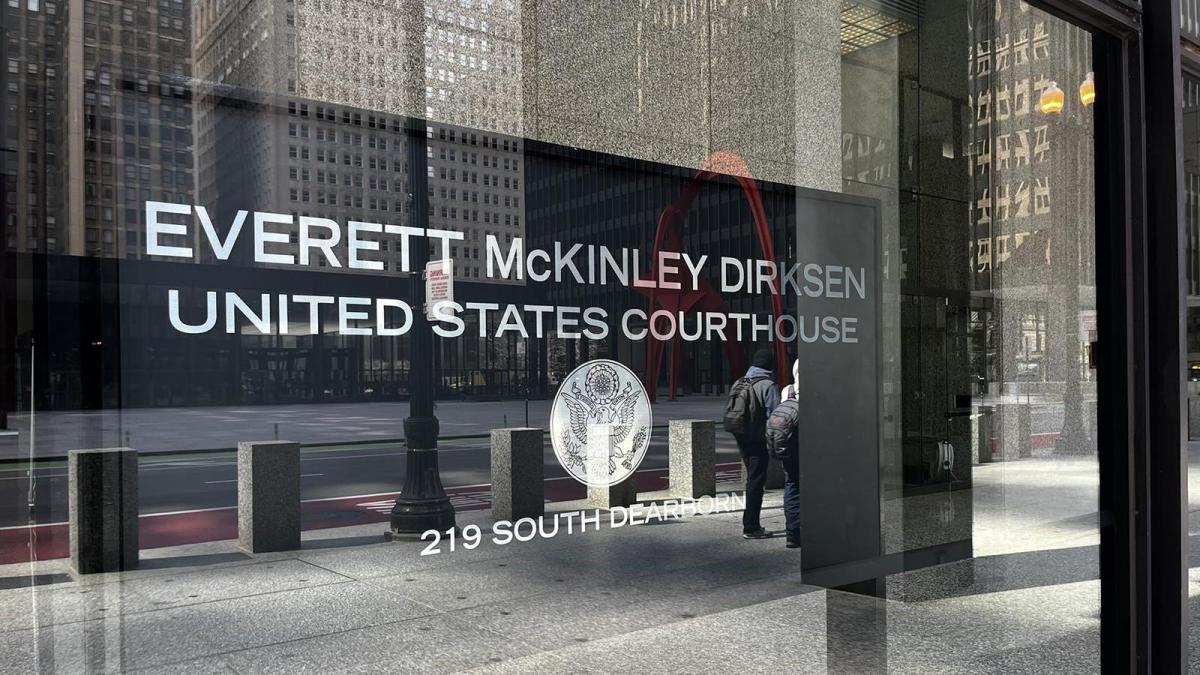 The Dirksen Courthouse is pictured in Chicago. (Capitol News Illinois)
Newly unsealed transcripts detail federal prosecutors’ alleged misconduct as they repeatedly pushed for felony charges from a skeptical grand jury in the “Broadview Six” protester case, even as one juror dubbed the case a “crock of s--t.”
Those revelations were included in partially redacted transcripts from the normally secret grand jury proceedings that led to a felony indictment in the politically charged case. During the hearings, prosecutors engaged in “appalling misconduct,” defense attorneys said, that ultimately tanked the case.
“These transcripts prove that the grand jury in the Broadview 6 case repeatedly attempted to say ‘no’ to this sham political indictment,” Chris Parente, who represents Oak Park Village Board Trustee Brian Straw, said in a statement. “The Department of Justice attorneys involved in this case refused to accept that reality or their Constitutional obligations, committing appalling misconduct and putting their DOJ marching orders above justice.”
U.S. District Judge April Perry granted an order to unseal the transcripts Tuesday after federal prosecutors and defense attorneys finalized redactions.
The contents of those transcripts include details that led to the collapse of the high-profile case, defense attorneys alleging a cover-up, Perry herself saying her trust in the prosecutors handling the case had been “broken” and Chicago’s U.S. Attorney Andrew Boutros issuing a public apology.
Scroll to read the transcripts
Straw, along with former 9th District congressional candidate Kat Abughazaleh, her campaign staffer Andre Martin, Democratic Committeeperson Michael Rabbitt, ex-Cook County Board candidate Catherine Sharp and musician Joselyn Walsh, were charged following a confrontation just before 8 a.m. Sept. 26 between protesters and federal agents outside ICE’s west suburban processing facility.
Prosecutors alleged the defendants were part of a group that surrounded a government vehicle, “with the intent to hinder and impede” a federal agent from proceeding to the Broadview facility and “discharging the duties of his office.” According to the initial indictment, the protesters “banged aggressively” on the vehicle’s windows and hood and broke one of its mirrors and a rear windshield wiper.
But the published transcripts from three separate grand jury proceedings — on Oct. 9, Oct. 16 and Oct. 23, 2025 — showed grand jurors repeatedly pushed back against the government’s narrative of the case as presented by Assistant U.S. Attorneys Sheri Mecklenburg and Matthew Skiba.
Transcripts show grand jurors had questions about whether any of the damage to the vehicle could have occurred prior to the incident and asked why the agent driving never felt the need to call for backup if he felt he was in danger.
When asked why only those six people were charged, Mecklenburg said the investigation into the incident was ongoing, and suggested she could be back before the grand jury in the future to seek additional indictments, according to the transcripts.
Perry had previously reviewed redacted versions of transcripts from the grand jury proceedings, but after defense attorneys pushed her to look over the fully unredacted versions of those records in May, the judge immediately demanded prosecutors appear before her to explain themselves.
Perry said she was “incredibly shocked” by the prosecutors’ conduct, telling attorneys during a closed-door meeting last month after reading “hundreds, if not thousands, of grand jury transcripts” throughout her career, she’d never seen the “types of prosecutorial behavior before a grand jury that I saw in those transcripts.”
Juror ‘Skepticism’ and Prosecutorial Misconduct
After an initial grand jury refused to indict the six last October, prosecutors improperly removed some members who disagreed with their theory of the case as they presented it again to a second grand jury.
In an Oct. 21 exchange, Mecklenburg repeatedly asked one grand juror if they had an “open mind for deliberation and returning a verdict if the facts meet the law?”
“Are you actually presenting any new actual facts or just a different viewpoint on your side?” the grand juror replied, according to the transcript.
Mecklenburg said she was “feeling the skepticism already” and asked again if the juror would be able to “listen with an open mind.” When they replied no, Mecklenburg told them, “Then you have to go.”
“I heard this case like last week and I thought it was a crock of s--t then and I still think it is,” the grand juror said, according to the transcript.
“OK,” Mecklenburg replied. “Thank you for your opinion for everybody.”
That same grand juror had previously asked if prosecutors get “unlimited tries” to present their case, to which Mecklenburg replied, “Well, I don’t think we have to worry about that. I think we’re going to be just fine.”
“I think the saying is the second time is the charm,” Skiba added, according to the transcript.
When the grand juror asked if Mecklenburg had any new evidence to present, she replied “I didn’t say there is no new evidence,” according to the transcript before adding, “If you feel that you can’t be — then excuse yourself. That’s fine.”
Mecklenburg also had improper ex parte communication with grand jury members outside the confines of the hearing, and allegedly engaged in “vouching,” in which they assured grand jury members the case would not have been presented unless the allegations against the defendants were warranted.
“I know you and I trust you and you know me and you trust me,” Mecklenburg told grand jurors on Oct. 9, according to the transcript, “and I would never ask you to charge somebody if I didn’t think there was probable cause and you know you’ve asked me before, ‘Well, what about this person?’ And I said ‘I don’t charge people unless I’m absolutely sure.’”
On Oct. 21, Mecklenburg acknowledged she’d spoken to a pair of grand jurors outside of the hearings, adding that she “did something today that I’m not supposed to do.” In both instances, she claimed the grand jurors had apologized to her about tension during the Oct. 9 proceedings.
None of this conduct was disclosed to Perry or defense attorneys until days before the case was set to go to trial when Boutros appeared before Perry to apologize and formally dismiss the remaining charges late last month.
Mecklenburg had a lead role in the Broadview case until she took a role with the Senate Judiciary Committee under U.S. Sen. Dick Durbin. She has since been terminated from that position after the alleged misconduct in the Broadview case became publicly known.
Skiba and two other assistant U.S. attorneys who also worked that case have since been replaced in recent hearings.
Boutros’ Role
Boutros later revealed in a rare “special report” that he had contact with the grand jury on the day it returned the indictment in the Broadview case.
He claimed in that report he only provided “general comments” during a brief speech about the need for grand jurors to be fair and impartial following “prior grand jury disturbances and potential tension.”
But the transcript of that speech shows Boutros did ask any grand juror who was “struggling” to set aside their personal feelings in any specific type of case, “such as the immigration cases,” to identify themselves because, he said, “we have a different procedure for that.”
Defense attorneys have accused the government of a cover-up and claimed the prosecution of their clients — all Democrats who were arrested for allegedly impeding an Immigration and Customs Enforcement vehicle in suburban Broadview — was politically motivated.
Since the case collapsed, Boutros has faced increasing pressure to resign from numerous Illinois politicians, including U.S. Sens. Dick Durbin and Tammy Duckworth. He has thus far resisted those calls, stating that since he took over last spring, he has “fixed — and continue(s) to fix” an office he said was previously doing “less than even the bare minimum.”
Boutros’ office dropped all charges against Walsh and Sharp in March, after prosecutors said they had “continued to evaluate new facts, evidence, and information to ensure that the interests of justice are served.”
Weeks later, prosecutors abruptly dropped the felony conspiracy charge against the remaining four defendants, just as they were ordered to turn over unredacted grand jury transcripts to Perry. By dropping that charge, Perry found the issue was “moot” and she no longer needed to review those records.
But defense attorneys continued pushing the judge to look over the entirety of the transcripts, sensing something was amiss after the government abandoned the lone felony count in the case.
Boutros denied having knowledge of any misconduct by his office before the grand jury until late April, when his office moved to drop the conspiracy count. Still, his prosecutors planned to take the remaining defendants to trial on misdemeanor charges.
And when Boutros appeared in court last month to dismiss the case, he still proclaimed to Perry that the charges were warranted and that the defendants’ alleged actions were “unacceptable in a civilized society.”
Perry replied that in making those statements, Boutros was “significantly undercutting your mea culpa” as he continued to “vilify these particular defendants.”
Read the transcripts below: