Crime & Law
CPD Officer Who Punched Teen in 2019 Incident Won’t Be Fired: Records
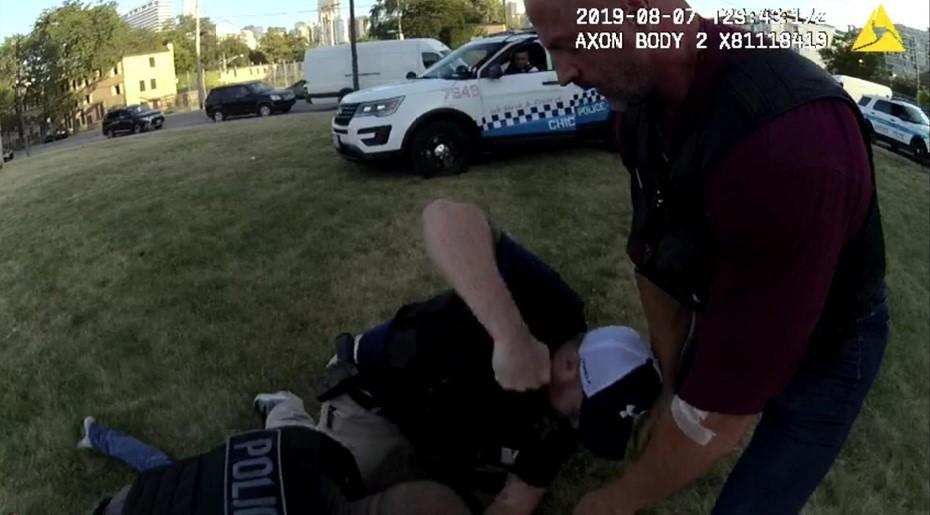 An image captured by a Chicago Police Department officer’s body-worn camera shows Officer Michael Bryant striking an individual during an incident in August 2019. (Civilian Office of Police Accountability)
The Chicago police officer who punched a 17-year-old in August 2019 in what investigators ruled was an unjustified use of excessive force and called a Black man who was filming the altercation “boy” will not be fired, according to documents obtained by WTTW News.
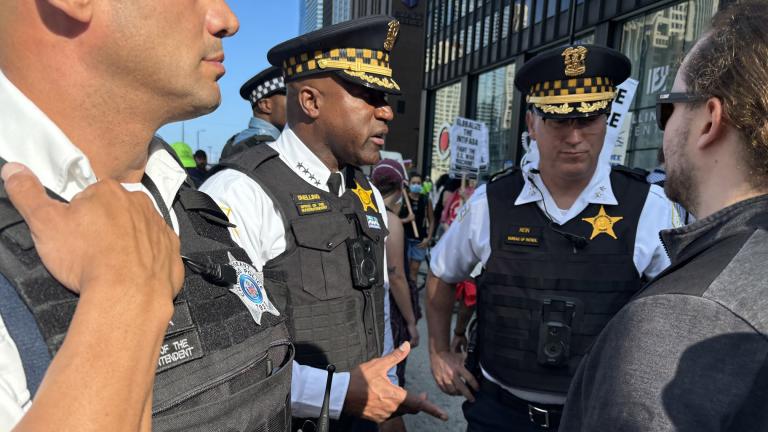
Instead, Officer Michael Bryant should be suspended for 25 days, Chicago Police Supt. Larry Snelling determined, rejecting the recommendation from the Civilian Office of Police Accountability to fire Bryant for his actions on Aug. 7, 2019, near Oak Street and Cambridge Avenue in Cabrini-Green, a complex operated by the Chicago Housing Authority that sits just west of the Gold Coast.
While Bryant committed misconduct during the incident, his actions were “not so egregious as to warrant separation,” Snelling told the head of the agency tasked with investigating police misconduct better known as COPA in an April 8, 2024, letter.
While COPA leaders could have asked the Chicago Police Board to resolve the dispute over whether Bryant should be terminated or suspended for 25 days, Chief Administrator LaKenya White agreed to accept Snelling’s recommendation of discipline and close the probe on May 13, records show.
Bryant, who declined to comment, could appeal his 25-day suspension to an arbitrator. Bryant earns $115,158 annually, according to the city’s database.
Bryant is assigned to the CPD unit designated to patrol public transit, according to a statement from a CPD spokesperson.
The incident began just before 7 p.m. on Aug. 7, 2019, when officers monitoring police cameras observed an individual with what they believed to be a handgun, according to COPA’s report. The teen was not identified by COPA, in keeping with its rules.
When Bryant arrived on the scene, he pointed his weapon at a group of Black men and pursued the teen officers suspected of having a gun, according to COPA’s report.
After the teen surrendered after a brief foot chase, Bryant used his fist to strike the teen in the head while detaining him, while using profanity, according to COPA’s report.
Once the teen was in handcuffs, Bryant left the area to search for his department-issued baton, as a crowd gathered and began objecting to his actions, according to COPA’s report. It is not clear from COPA’s probe how Bryant became separated from his baton.
“Officer Bryant approaches a black male holding a cell phone, the male asks Officer Bryant a question, and Officer Bryant responds, ‘f------ jag off with a gun, f--- you,’” according to COPA’s report. “Officer Bryant proceeds to push the cell phone out of his face. Officer Bryant walks off from the male, and the male follows him. The male asks Officer Bryant for his badge number and responds, ‘get that camera out my face, boy.’”
Calling an adult Black man “boy” is considered a racial slur, used before and after the Civil War, as a way to remind Black men they were not considered the equal of White men. In 2010, the U.S. Supreme Court agreed that the use of the word could serve as evidence of racist intent and discrimination.
Bryant told officers he did not punch the teen, despite video captured by officers’ body-worn cameras showing him strike the teen with a closed hand, according to COPA’s probe.
When Bryant struck him, there was no evidence that the teen was actively resisting arrest or posed a threat to officers, COPA concluded, finding Bryant used excessive force in violation of department policy.
However, Snelling concluded Bryant would have been justified in striking the teen either with a closed fist or an open hand because he could have reasonably believed the teen was attempting to reach the gun police suspected he had in his waistband, according to his response to COPA.
Snelling also said Bryant should not be disciplined for pointing his gun at the group of men in the courtyard, which COPA found to be in violation of departmental policy.
Instead, Bryant should be suspended for 25 days for attempting to strike the cell phone from the man’s hand and for calling him “boy,” and for “directing profanities” at the teen and the group of bystanders, Snelling concluded.
COPA determined that Bryant lied to investigators and department leaders when he told them he struck the teen with an open hand, not a fist, records show.
However, COPA did not prove that Bryant punched the teen, Snelling concluded, records show.
Chicago Police Department’s Rule 14 prohibits officers from lying to department officials and on official forms. Those who violate that rule are subject to termination.
“It would be absurd for (Police Officer) Bryant to go to such lengths to lie, repeatedly, on official police reports and in statements given to COPA knowing the jeopardy that a Rule 14 violation would place him in over a justified, authorized and reasonable use of force,” Snelling concluded.
However, COPA concluded that Bryant “appeared to provide false and/or inaccurate statements regarding this incident” during the agency’s probe and concluded his actions demonstrated an “intent to deceive.”
“This demonstrates significant issues with Officer Bryant’s credibility more generally,” COPA concluded.
Former Inspector General Deborah Witzburg found in a May 2023 audit that more than 100 Chicago police officers who lied while on the job were not fired, in defiance of decades of pledges from city officials who said they have zero tolerance for officers who make false reports.
Originally, COPA concluded its probe of this incident in December 2022. However, it reopened the investigation to comply with rules requiring Bryant “be presented with video or audio evidence related to the use of force” and “given an opportunity to amend his original statement.” That second interview occurred in June 2023, records show.
COPA took five years to complete its investigation of this incident, after the probe was delayed during the COVID-19 pandemic when COPA focused on complaints against supervisory officers and “high-priority cases,” according to Snelling’s letter.
“A Police Board member or an independent arbitrator reviewing this investigation will likely be troubled by the length of time this investigation took and the attendant due process issues raised by said delay,” Snelling wrote.
WTTW News coverage of policing and police reform is supported by The Joyce Foundation.
Contact Heather Cherone: @HeatherCherone | (773) 569-1863 | [email protected]