Arts & Entertainment
New Opera By Chicago Music Critic Unpacks Being a Son of Holocaust Survivors
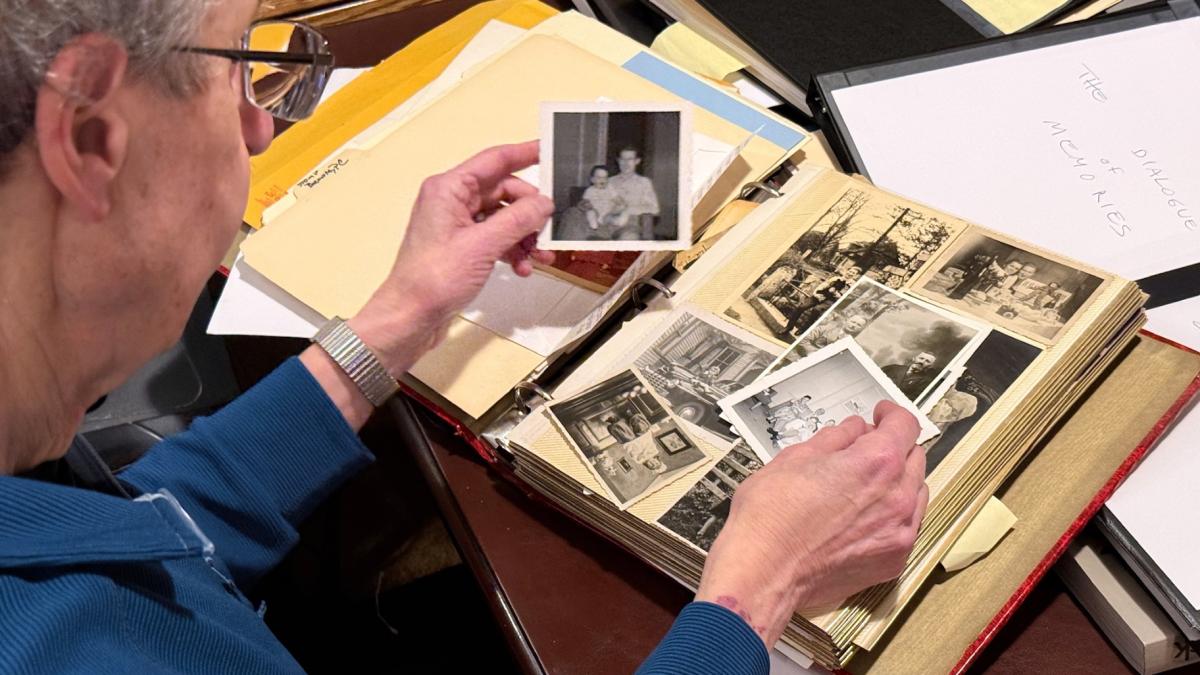 Journalist and former Chicago Tribune jazz critic Howard Reich with family photos. His new new opera, “The Dialogue of Memories,” is embarking on a three-city U.S. tour this month that culminates at the Studebaker Theater in Chicago on May 23 and 24. (Courtesy of Verismo Communications)
For Howard Reich, whose parents avoided discussing the Holocaust with him while he was growing up, it’s both a burden and a privilege to inherit the story he had to confront later in his life.
“It’s a burden to inherit this story and being so incapable of changing it; this happened to my parents, and I can’t fix that,” Reich said. “But it’s also a privilege. It’s a privilege to be able to tell their story as truthfully and honestly and candidly and openly as I am able to.”
A new opera from the local journalist draws from his experience of being a son of Holocaust survivors and grappling with the questions Reich couldn’t ask his parents. Also woven through the opera is Reich’s real-life discovery of his mother’s long-hidden past and conversations he had with Nobel Peace Prize laureate and Holocaust survivor Elie Wiesel.
Reich, a former longtime Chicago Tribune jazz critic, had an opportunity to first interview Wiesel in 2012 when the writer was awarded the newspaper’s annual literary prize. They continued their conversations the next four years until Wiesel died. Those conversations were captured in Reich’s book, “The Art of Inventing Hope.”
The book is the basis of the new opera, “The Dialogue of Memories,” which is embarking on a three-city U.S. tour this month and culminating at the Studebaker Theater in Chicago on May 23 and 24.
“When you take words, which are already powerful, and combine them with music, they take on even greater urgency and emotional impact,” Reich said. “To me, music says what words cannot say.”
The opera comes ahead of the 10th anniversary of Wiesel’s death.
Through his conversations with Wiesel, Reich said he was able to ask the questions he couldn’t ask his parents.
What is our responsibility as children of survivors to our parents? How do we deal with this dark past that we’ve inherited? How do we deal with listening to music written by fiercely antisemitic composers like Richard Wagner? Are we living up to our parents’ expectations? How do we forge our own identities?
Reich said he felt relief after learning that Wiesel also struggled with many of the same questions related to coming to terms with the Holocaust and its aftermath.
He also found relief from the guilt he found himself experiencing.
“I would often feel very guilty about what my parents went through, and then I’ve got such a comparatively easy, comfortable life,” Reich said. “Though I don’t always feel that I’ve done everything I could have for my parents, to live up to this history, [Wiesel] gave me permission to not beat myself up about that.”
For much of his life, Reich avoided the subject of the Holocaust. But, he was forced to confront it when his mother, Sonia Reich, received a post-traumatic stress disorder diagnosis. Reich documented his journey uncovering her past in a Chicago Tribune story, which also became a book and a WTTW documentary, “Prisoner of Her Past.”
“Not until that story came out in 2003 — when I was 49 years old — did my colleagues at the Chicago Tribune learn that I’m the son of Holocaust survivors,” Reich said. “Even more than that, friends who grew up with me in Skokie, when they saw this story, they said to me, ‘Oh, we’re children of survivors, too.’ We all didn’t know that back then because that subject was not talked about the way it is today.”
Sonia Reich died last year.
Reich describes his opera — depicting Wiesel, Reich and his mother — as a “journey of illumination.” He said telling this story comes during a time when antisemitism is at the most widespread he has seen in his life. He also wants audiences to feel what it’s like to be in the room with Wiesel, and to feel his ability to reject despair and hold onto hope.
“I hope other children of survivors and grandchildren of survivors, who perhaps struggled with some of the same issues and questions I have, will know that they are not alone,” Reich said.
“The Dialogue of Memories” will be performed at the Studebaker Theater on May 23-24. For details and tickets visit www.musicofremembrance.org.
WTTW News arts coverage is supported by the JCS Arts, Health & Education Fund of the DuPage Foundation.
Contact Eunice Alpasan: [email protected]