Crime & Law
Column: What the Culture of Silence Around Abuse in the Latino Community Taught Me and Why I’m Speaking Out
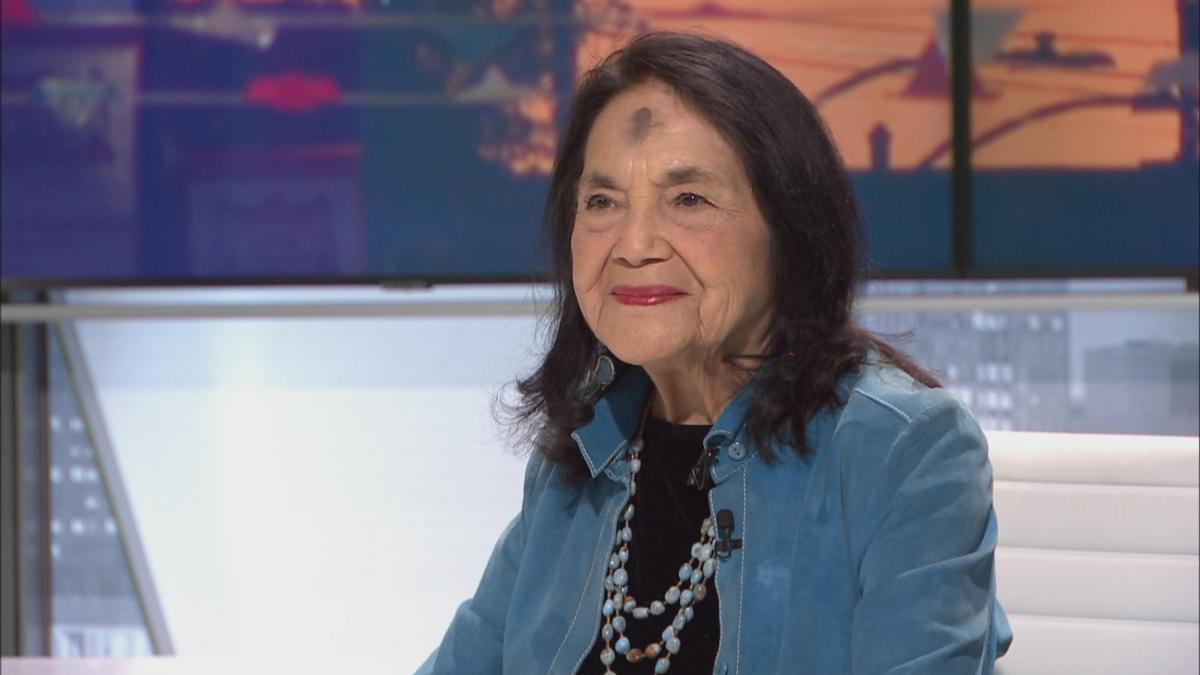 Labor leader Dolores Huera appears on the Feb. 25, 2023, episode of "Latino Voices." (WTTW News)
It’s been just over a week since a New York Times investigation reported allegations that Cesar Chavez groomed and sexually abused young girls involved in the farmworker rights movement.
The movement’s co-founder Dolores Huerta also revealed that she was sexually assaulted by Chavez. Nationwide support has grown in response, with a sentiment echoing the Me Too movement: “We are all Dolores Huerta.”
Here in Chicago, the impact has also been felt. Chavez’s face was quickly removed from the “Libertad” mural at Barrett Park along Cermak Road.
“The Chicago Park District takes recent allegations of misconduct by Cesar Chavez seriously. We have removed Chavez from the mural at Barrett Park and are conducting a districtwide review of any other park features that may honor him,” Irene Tostado, deputy director of communications for the Chicago Park District, said in a statement. “Where appropriate, we will take further action consistent with our values and standards.”
Several organizations across the city have also spoken out in support of the victims and Huerta. At the same time, there has been backlash. Some comments across social media express disbelief or loyalty to Chavez, questioning Huerta’s claims or defending his legacy, with remarks such as, “Why now?” and “Why did she wait so long?”
The answer has always been there, but many people refuse to accept it. Women are often not believed, and in many cases, they are blamed.
In Latino culture this conversation can be especially complex. As a first-generation Mexican American, I grew up deeply embedded in Mexican traditions and culture, and one thing I consistently heard when someone was accused of sexual assault was, “I don’t think he did it,” or “I think the girl is lying.” As if it isn’t already difficult enough for a victim to speak up, these reactions can create an environment of silence and fear.
Data reflects this broader reality. CDC research shows that more than one in three Hispanic women report experiencing some form of sexual violence, with experts noting that cultural stigma likely means the true number is even higher.
I am also a survivor of sexual assault.
When I was 20 years old, I was taken advantage of by a male therapist. This is the first time I am writing about it publicly.
At the time, I was in a very vulnerable state. My parents were struggling to accept my sexual orientation and insisted that I attend therapy sessions. At first, the sessions felt normal and routine — until they weren’t. The questions became inappropriate, crossing professional and personal boundaries. At that time, in the state I was in, I couldn’t process it right away.
Predators, especially those older and in positions of authority, often know how to manipulate and take advantage when they have the upper hand or when a victim is in a vulnerable state. By the second time I was assaulted, I walked out of the session and suddenly snapped into reality. I knew something awful happened to me.
In my case, I spoke out. I immediately called my best friend, and then I called my mother. I wanted to press charges. The therapist was working in partnership with a local church, and my mother contacted him right away.
In the weeks that followed, I remember feeling violated, ashamed and confused. We eventually had a conversation with the priest from the church where the therapist was working. The priest convinced my parents not to take the man to court. His words still stay with me: “You’re over 19. It’s going to be hard to prove. You don’t want to put your family through that.”
To this day, those words remain embedded in my memory.
I have healed, but my story is just one of thousands. Many survivors speak out and are still met with doubt, silence or pressure not to pursue justice. That is why these conversations matter. Behind every statistic is a real person, a real story and a real struggle to be believed.
I speak out today because there’s people who can’t, because it’s too painful. They would rather just keep it locked in a box. It is too painful to say it out loud and relive it.
Behind every statistic is a real person, a real story and a real struggle to be believed.
In Huerta’s first interview following the allegations against Chavez, she spoke with journalist Maria Hinojosa about the emotional impact of the revelations and the broader issue of how society treats women and survivors.
The civil rights icon who helped build the United Farm Workers union alongside Chavez recalls being raped by him in the 1960s.
“I felt isolated and alone, and the way he set it up, he was my boss, and I had this admiration for him,” Huerta said in the Latino USA interview.
Huerta said the experience forced her to confront the reality that even leaders admired for their activism can carry a darker side. She also revealed that the assaults led to two secret pregnancies, and her daughters were raised by other families.
“To know he had this dark side of him, I think it speaks to the fact that there’s a lack of respect for women and girls in our society,” Huerta told Latino USA. “And that this is so prevalent. Men get away with this all the time; that’s something that really needs to be addressed in our society.”
Huerta also expressed regret for not speaking out sooner, saying she kept the abuse a secret to protect the movement.
When you find yourself questioning a victim’s story, take a step back and ask why. Why is disbelief often the first reaction instead of concern or compassion?
Recently, my family learned that my 35-year-old male cousin was sentenced to 210 years in prison for multiple sex crimes involving a child. The charges stem from an investigation that began in March 2022. The victim, who was 10 years old at the time, said it had happened repeatedly over several years before she came forward.
Instead of immediately believing the child, my cousin’s father began calling family members, trying to convince them that his son could not have done such a thing. He pleaded with relatives to attend court in support of my cousin — some of my relatives did go. Watching this unfold reinforced what I have seen and heard my entire life: Sexual assault is often met with denial, especially within families and communities trying to protect their own.
This is what I mean when I say sexual assault carries deep cultural stigma. A stigma that silences victims, protects abusers and pressures families to choose loyalty over truth. That stigma must change. We need to believe women, men and children who come forward with their stories and create space for survivors to be heard without fear or doubt.
According to RAINN, an anti-sexual violence organization and operator of the National Sexual Assault Hotline, only about 28 out of every 1,000 sexual assaults lead to a felony conviction, highlighting how difficult these cases are to prosecute and why many survivors struggle to seek justice.
“Women and girls and boys, because this isn’t only about women, it also affects boys. They need to be protected. We have to attack this illness,” Huerta told Latino USA.
Her words reflect a difficult but necessary truth: We can honor the work that helped communities while still confronting the harm that was done.
Protecting survivors must come first, and creating a culture where everyone is believed is part of that responsibility.
If you or someone you know has experienced sexual assault, RAINN offers a free and confidential hotline in English and Spanish at 1-800-656-4673 or by texting “HOPE” to 64673.