Politics
Chicago Police Disproportionately Used Force Against Black Chicagoans, Study Commissioned by Department Finds
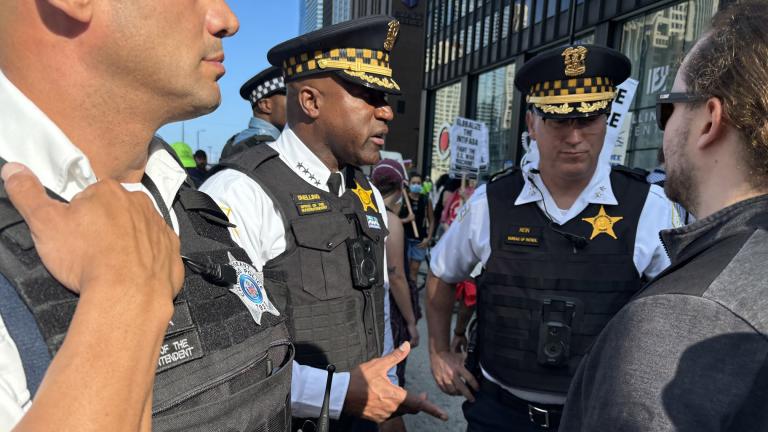
Chicago police officers disproportionately used force against Black Chicagoans, even when considering they are more likely to be arrested or suspected of committing a crime in the city, according to the results of a court-ordered, first-of-its-kind study that examined four years of data.
CPD officers also disproportionately used force against Latino Chicagoans, as compared with White Chicagoans, according to the study. In addition, CPD officers used greater levels of force against both Black and Latino Chicagoans than White Chicagoans, according to the study.
The study, conducted by social scientists from the University of Texas at San Antonio and the University of Pennsylvania hired by CPD brass and crafted with the approval of a court-appointed monitoring team, blamed “systemic factors” for the disparity, not the actions of individual officers.
Read the full study and its executive summary.
The study also found that the number of times CPD officers used force against Black and Latino Chicagoans “rose significantly toward the end of 2023,” according to the study, which did not attempt to determine the reason behind that increase.
A spokesperson for CPD said the department “continues to make significant strides in our consent decree compliance efforts. We know we have more work to do and will continue to build on the foundation we have set.”
Officers are now offered “consistent training” on when — and how — they are allowed to use force against members of the public, according to the spokesperson. In addition, a special division of CPD reviews and analyzes uses of force “to facilitate stronger accountability by identifying areas for improvement, including in policy and training.”
CPD leadership has taken no action in response to the study’s findings, as required by the consent decree, according to the CPD court-appointed monitoring team charged with keeping track of efforts to comply with the federal court order, known as the consent decree, which was prompted by a 2017 probe that found officers routinely violated the constitutional rights of Black and Latino Chicagoans.
Advocates for police reform said the study — published nearly a year ago — is more evidence that Chicago leaders’ oft-professed commitment to reform lacks substance and is just the latest warning that the opportunity for lasting reform is slipping away.
“This report is an indication that CPD is not moving with the urgency it demands,” said Alexandra Block, of the American Civil Liberties Union. “This should have been a huge red flag, waving madly.”
WTTW News is the first to report on the study, which was completed in March 2025, and is the first one crafted by independent experts using scientifically valid methods to assess whether CPD is disproportionately using force against Black and Latino Chicagoans.
The report was provided to WTTW News by the coalition of police reform groups that forced the city to agree to federal court oversight, which obtained it through a Freedom of Information Act request.
Because Asian and Native American Chicagoans were stopped so infrequently, the study made no conclusion about disparities involving those races.
U.S. District Court Judge Rebecca Pallmeyer will convene a virtual public hearing at 1 p.m. Saturday to give members of the public a chance to weigh in on CPD’s efforts to comply with the federal court order known as the consent decree. The binding court order will mark its seventh anniversary on March 1.
CPD has fully complied with 22% of the consent decree’s requirements, according to the most recent report from the monitors.
Arewa Winters, an elected member of the Austin (15th) Police District Council, said she was still waiting for real change to come to Chicago as a result of the consent decree.
“I don’t feel like we’ve gotten any major wins,” said Winters, who started pushing for police reform after a Chicago Police officer shot and killed her 16-year-old nephew, Pierre Loury in 2016. “We’re getting very tired. This is not anyone’s day job.”
Winters said pushing CPD to change has felt like “going up a mountain wearing rollerblades.”
“There’s not a day that goes by that I don’t want to throw in the towel,” Winters said. “But I feel a responsibility to bring our voices into these rooms.”
Four Years of Data Examined
The study examined more than 8,000 unique incidents in which a CPD officer used force against a member of the public between Jan. 1, 2020, and Dec. 31, 2023. Less than 7% of the incidents involved a White Chicagoan, according to its findings.
During those four years, approximately 73% of the time officers used force against a member of the public, that individual was Black, according to the study.
In addition, approximately 16% of CPD’s use-of-force incidents involved Latino residents, according to the study.
The study determined that officers disproportionally used force against Black and Latino Chicagoans by comparing CPD data on the race of reported crime suspects and arrestees with use-of-force reports. The study’s authors created a series of benchmarks “to assess city-wide patterns in use of force and how racial disparities in force can be accounted for by location and context in which the events occur,” according to the study.
The population of Chicago is 31.4% White, 29.9% Latino, 28.7% Black and 6.9% Asian, according to the 2020 U.S. census.
“If force was just a random sample of the population, then one would expect it to look like the population,” according to the study. “However, because individuals involved in force are not a random sample, it is important to compare the demographics of subjects involved in use of force to a population that is most likely to be at risk of a force event, such as those involved in criminal behavior or being arrested by the police.”
Among Chicagoans suspected of a crime, “Black individuals had a 52% higher risk and Hispanic individuals had a 33% higher risk compared to White individuals,” according to the study.
In addition, Black Chicagoans arrested on suspicion of a crime “experienced a 39% higher relative risk of force compared to White individuals, while Hispanic individuals had a 7% higher risk,” according to the study.
The most significant predictor of force rates across all racial groups is the number of arrests, according to the study, which found that was especially true for Black Chicagoans. Most use-of-force incidents occurred on the city’s South and West sides, according to the study.
The vast majority of violent crimes and murders occur on Chicago’s South and West sides and have for decades. Those wards, home to mostly Black and Latino residents, also have some of the highest rates of 911 calls for police service per population, according to an audit by Chicago’s inspector general released in August 2023.
Calls for help involving reports of domestic violence led to a quarter of all reported uses of force, according to the study.
The study reaches no conclusion on whether CPD officers were more likely to use force against Black or Latino Chicagoans because of racial bias, nor did the study examine whether those incidents compiled with CPD policy.
Michael Harrington, of Network 49 on the city’s North Side, said the study makes it clear there is a “horrific imbalance,” in the way CPD officers treat Black people, more than 12 years after the murder of Laquan McDonald by former Officer Jason Van Dyke prompted a probe by the U.S. Department of Justice that found CPD had engaged in a pattern of unconstitutional use of force.
“We want strong and good policing,” Harrington said. “With police officers acting with respect and fairness. Those messages are just not sinking in.”
No Response to Court-Ordered Study
The consent decree requires CPD to “regularly” review data detailing officers’ use of force “to assess the relative frequency and type of force used by CPD members against persons in specific demographic categories, including race or ethnicity, gender, age, or perceived or known disability status.”
The completion of the study by Professors Michael R. Smith and Rob Tillyer at the University of Texas San Antonio and John MacDonald at the University of Pennsylvania was “a significant milestone for the city and the CPD,” according to the latest report from the monitors.
However, “CPD has not yet used the results of the report to ‘identify and address any trends that warrant changes to policy, training, tactics, equipment, or department practice,’ as required,” according to the monitors.
Use of Force at Issue
The coalition of police reform groups told Pallmeyer in September that the increase in the number of times officers have shot, Tased, struck and choked a member of the public since 2022 violates the consent decree.
Illinois Attorney General Kwame Raoul’s office told Pallmeyer in November immediate steps must be taken to ensure that the reform push that has cost Chicago taxpayers hundreds of millions of dollars results in meaningful change in the lives of ordinary Chicagoans.
CPD officers used the highest level of force against a member of the public — including a gunshot, chokehold or a baton strike to the head or neck — 84 times in 2024, more than double the number of times officers used the highest level of force in 2023, according to CPD data cited by the coalition.
Chicago police officers used force against members of the public 1,645 times during the first six months of 2025, an increase of nearly 10% as compared with the first half of 2024, according to CPD data.
In 2025, officers shot 22 people, killing nine, according to WTTW News’ analysis of data released by the Civilian Office of Police Accountability. Since the start of 2026, CPD officers have shot and wounded one person.
Chicago’s police oversight board, the Community Commission for Public Safety and Accountability, required Chicago Police Supt. Larry Snelling to explain why police officers are using force more often and to detail what he is doing to reverse that trend.
Snelling has repeatedly said that he does not believe that CPD officers are actually using force against Chicagoans more often but simply reporting those incidents accurately for the first time as compliance ramps up with the consent decree.
The study that determined CPD was more likely to use force against Black and Latino Chicagoans examined 16,196 use-of-force reports to determine they stemmed from more than 8,000 specific uses of force by officers against members of the public.
The “significant increase” from 2020 to 2023 identified by the study was based on the number of use-of-force incidents, not the number of reports filed by officers.
Crista Noel, founder of Women’s All Point Bulletin, said she was deeply frustrated that not only have CPD officers not stopped killing Black Chicagoans, but that they are using force more often.
“They have gone backward,” Noel said. “Just stop killing us. That’s all we’re asking for.”
WTTW News coverage of policing and police reform is supported by The Joyce Foundation.
Contact Heather Cherone: @HeatherCherone | (773) 569-1863 | [email protected]