Crime & Law
Police Oversight Board to Top Cop: Explain Why CPD Officers Are Using Force More Often
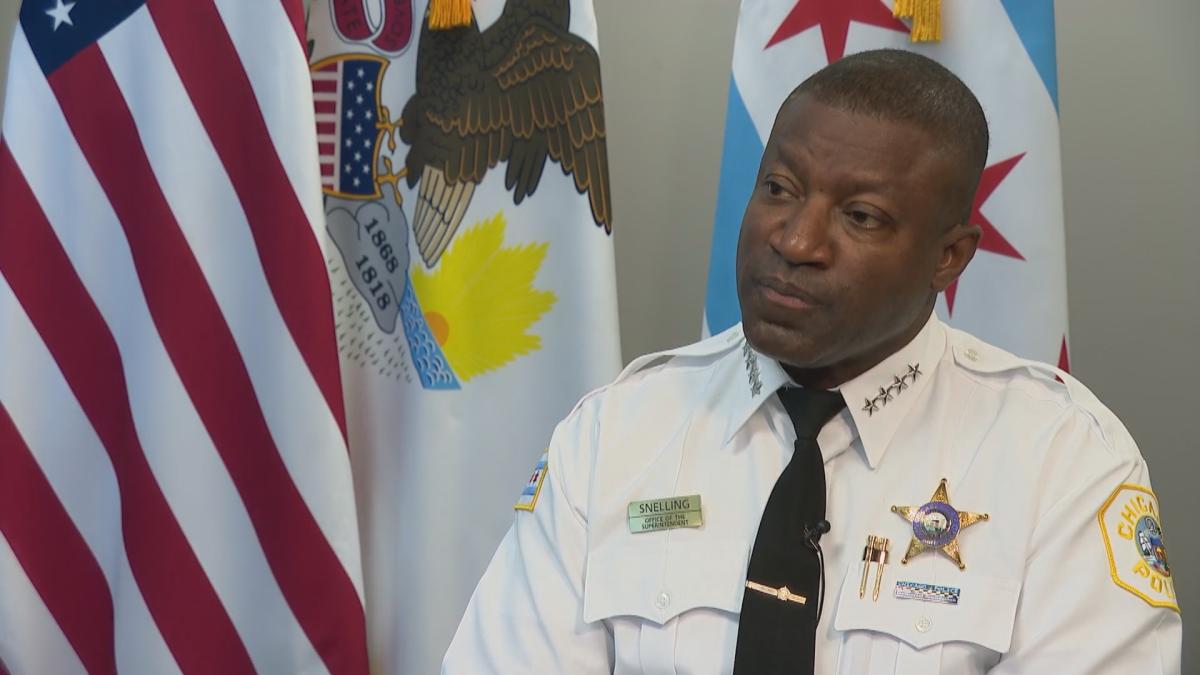 Chicago Police Supt. Larry Snelling. (WTTW News)
Chicago Police Supt. Larry Snelling must explain why the number of times police officers used force against individuals has significantly increased since 2022, and detail what he is doing to reverse that trend, according to a measure approved by Chicago’s police oversight board.
Snelling, who took over CPD in September 2023 after being appointed by Mayor Brandon Johnson and unanimously confirmed by the Chicago City Council, must also explain why the number of times officers pointed their guns at individuals increased 44% between 2022 and 2024, according to one of the goals unanimously set for Snelling to achieve in 2026 by the Community Commission for Public Safety and Accountability during its meeting on Jan. 29.
“It is imperative that CPD provide community members with an understanding and explanation of why these increases have been occurring and what, if anything, the department is doing to identify and address any trends,” according to the goals set by the commission, which has the power to set CPD policy and is responsible for evaluating Snelling’s performance.
Before accepting the last of the four goals set by the oversight board, better known as the CCPSA, Snelling pushed back, telling its seven members he had already explained the increase in uses of force and firearm pointing incidents during the commission’s December meeting and promised to be transparent about that data.
“When we come up with a goal, one of the things that I believe in, especially coming from a training background, we don’t want to throw something together,” Snelling said. “We want to make sure that whatever we’re doing is comprehensive. We want to make sure that whatever we’re doing is going to be effective moving forward. And we want to make sure that there’s something in it for everyone, especially our officers who go out there and face these things every day, we want to make sure that our officers are prepared to go out and deal with these situations in the most constitutional, respectful manner possible. So, with that, I accept goal number four.”
Snelling has repeatedly said that he does not believe that CPD officers are actually using force against Chicagoans more often but simply reporting those incidents accurately for the first time as compliance ramps up with federal court order that requires officers to stop routinely violating Black and Latino residents’ constitutional rights.
Snelling has also acknowledged that CPD officers are also using force more often against children but said that was due to the jump in large teen gatherings.
Snelling’s comments prompted a response from Commissioner Aaron Gottlieb, who represents the North Side on the CCPSA.
“I think everyone should be curious about why, last year, there were roughly 10,000 incidents of force and or firearm pointing,” Gottlieb said. “We’ve heard various explanations, publicly, even in December, for instance, that it’s due to better reporting, that very well, that very well may be true. We’ve also heard things like the increase in force against youth is because of things like teen takeovers, that may be true. We should all actually be curious about whether this is true, and that’s what the point of this goal is to actually get the information, so that statements are not made publicly without clear evidence that the public can use to actually determine if their statements are true or not.”
Those remarks brought a visibly angry Snelling to his feet, and back to the microphone.
“I want to make this clear,” Snelling said. “It seems that the suggestion is that we’re lying. And I want to make clear to everyone here that everything that you can find is on our dashboard. I want to be extremely clear that nothing that I say up here is a lie.”
Snelling said he had assigned captains in each of the department’s 22 police districts to “work toward bringing that down,” referring to the number of firearm pointing incidents and “making sure that our officers are following the constitution and not doing damage to the image of the Chicago Police Department.”
CPD officers used the highest level of force against a member of the public — including a gunshot, chokehold or a baton strike to the head or neck — 84 times in 2024, more than double the number of times officers used the highest level of force in 2023, according to CPD data.
During the first six months of 2025, CPD officials reviewed 29 reports documenting the highest level of force against members of the public, according to the mid-year report. By comparison, officials reviewed 25 reports documenting the highest level of force during the first half of 2024, records show.
Chicago police officers used force against members of the public 1,645 times during the first six months of 2025, an increase of nearly 10% as compared with the first half of 2024, according to the most recent data on use of force published by CPD.
In addition, CPD officers pointed their guns at individuals 2,229 times between Jan. 1, 2025, and June 30, an increase of approximately 9% as compared with the same period during the previous year, according to CPD’s mid-year report documenting officers’ use of force.
A coalition of reform groups told the federal judge overseeing the reform effort in September that increase violates the consent decree, and asked her to order officers to stop officers from shooting, tasing, striking and using chokeholds against members of the public.
Illinois Attorney General Kwame Raoul’s office told U.S. District Judge Rebecca Pallmeyer in November that the increase in the use of force threatens the entire reform push that started nearly seven years ago and has cost Chicago taxpayers hundreds of millions of dollars.
In all of 2025, officers shot 22 people, killing nine, according to WTTW News’ analysis of city data. Since the start of 2026, officers have shot one person, records show.
The commission also required Snelling to expand “public awareness and understanding of the investigative process” and to help the city develop a system of responding to 911 calls for help that involve “mental health crises, homelessness, or low-level disputes” without police officers.
In addition, Snelling must demonstrate progress in the ongoing effort to craft a system for officers to work with residents to address threats to public safety. That is also required by the consent decree.
The CCPSA has power to pass a resolution of no confidence in the superintendent with a two-thirds vote. That could trigger City Council action that could lead to the superintendent’s termination.
WTTW News coverage of policing and police reform is supported by The Joyce Foundation.
Contact Heather Cherone: @HeatherCherone | (773) 569-1863 | [email protected]