Health
Federal Health Subsidies Expire, Launching Illinois Residents Into Uncertainty as Safety Net Hospitals Prepare to Meet Need
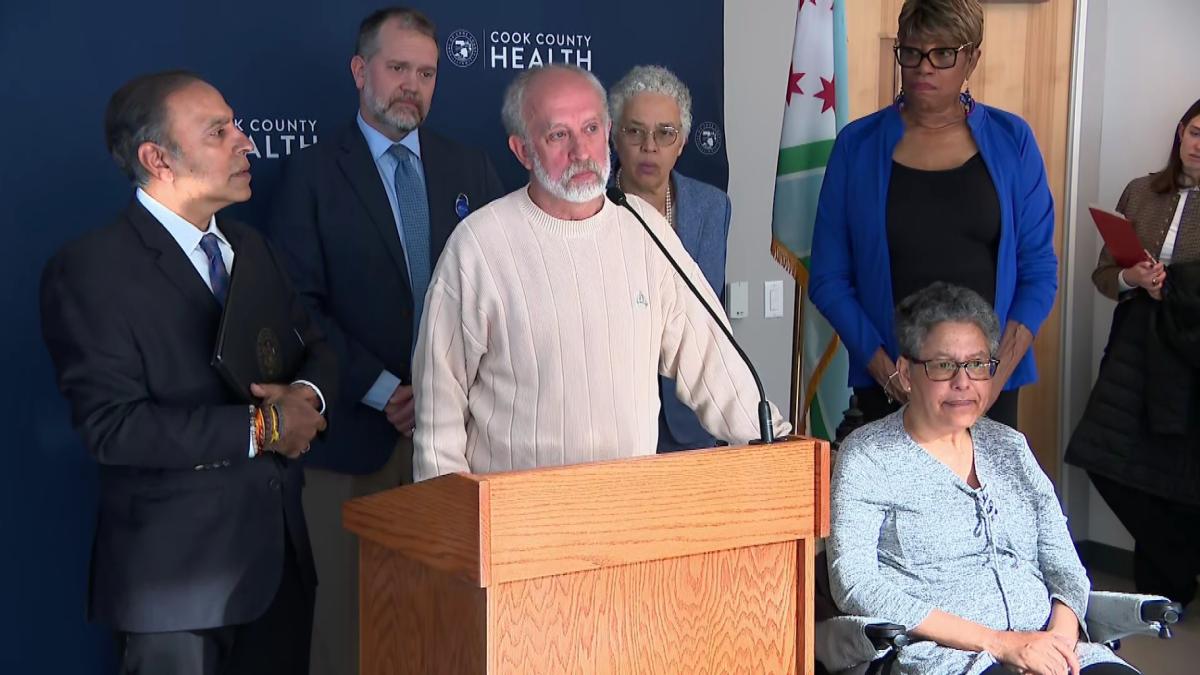 Doug Butchart speaks about the impact the expiration of the Affordable Care Act’s enhanced premium tax credits could have on health care costs for his wife Shadene, who has ALS, during a news conference on Jan. 5, 2026, at Cook County’s Bronzeville Health Center. (WTTW News)
Illinois resident Doug Butchart said the medical expenses for his wife, Shadene, who was diagnosed with ALS in 2017, were over $300,000 last year.
Shadene Butchart has relied on marketplace insurance ever since she was diagnosed with the neurodegenerative disease, but now, the recent expiration of the Affordable Care Act’s enhanced premium tax credits has put the cost of her care in limbo.
“We can’t afford not to have insurance, and not knowing the exact cost is very troubling,” Doug Butchart said. “The congressmen and the senators need to put themselves in our position.”
Doug and Shadene Butchart appeared alongside Cook County Board President Toni Preckwinkle and U.S. Rep. Raja Krishnamoorthi during a Monday news conference at Cook County’s Bronzeville Health Center to highlight the impact the expiration of the Affordable Care Act enhanced premium tax credits will have on residents.
The enhanced tax credits that have helped reduce the cost of health insurance for the vast majority of Affordable Care Act enrollees expired at the end of 2025. More than 500,000 Illinois residents depended on these credits to make health coverage affordable, according to Krishnamoorthi, who is currently running in a crowded Democratic primary for the U.S. Senate held by retiring U.S. Sen. Dick Durbin.
The health subsidies were at the center of the country’s longest government shutdown, in which Democrats forced a 43-day government shutdown in an attempt to extend the tax credits. Some moderate Republicans called for a solution to save their 2026 political aspirations. President Donald Trump floated a way out, only to back off after conservative backlash.
In the end, no one’s efforts were enough to save the subsidies before their expiration date.
Preckwinkle said individuals and families across the U.S. are now feeling the “consequences of federal inaction,” as they deal with steep increases in health insurance costs.
Cook County Health is expanding outreach and enrollment assistance, so residents can understand their options, maintain coverage, when possible, or transition to other safety net health plans, according to Preckwinkle. Cook County Health, which comprises of two hospitals and nearly a dozen health centers, provides health care to residents regardless of their ability to pay.
“The local government should not have to be forced to backfill for the federal government," Preckwinkle said.
The expiration of the tax credits affects a diverse cross-section of Americans who don’t get their health insurance from an employer and don’t qualify for Medicaid or Medicare — a group that includes many self-employed workers, small business owners, farmers and ranchers.
The expired subsidies were first given to Affordable Care Act enrollees in 2021 as a temporary measure to help Americans get through the COVID-19 pandemic. Democrats in power at the time extended them, moving the expiration date to the start of 2026.
The effects on Affordable Care Act enrollment remain to be seen.
Health analysts have predicted the expiration of the subsidies will drive many of the 24 million total Affordable Care Act enrollees — especially younger and healthier Americans — to forgo health insurance coverage altogether. Over time, that could make the program more expensive for the older, sicker population that remains.
When health coverage disappears, the cost often gets absorbed by hospitals, counties and taxpayers, according to Krishnamoorthi.
“When people lose insurance, their health needs don’t disappear,” Krishnamoorthi said. “Care gets delayed. Medications go unfilled. Conditions worsen. Eventually, people show up at community health centers and safety net hospitals, often sicker and with fewer options.”
The Affordable Care Act subsidies enabled millions of Americans to obtain and maintain health insurance and strengthen their access to preventative services, chronic disease management and timely medical care, according to Cook County Health CEO Dr. Erik Mikaitis.
“For safety net health systems like ours, these subsidies helped stabilize care delivery by reducing uncompensated care and allowing patients to access services in appropriate settings,” Mikaitis said. “This allowed us to grow our services and care for more people. Today, that progress is at risk.”
In December, the U.S. Senate rejected two partisan health care bills: a Democratic pitch to extend the subsidies for three more years and a Republican alternative that would instead provide Americans with health savings accounts.
In the House, four centrist Republicans broke with GOP leadership and joined forces with Democrats to force a vote that could come as soon as January on a three-year extension of the tax credits. But with the Senate already having rejected such a plan, it’s unclear whether it could get enough momentum to pass.
The Associated Press contributed to this report.
Contact Eunice Alpasan: [email protected]