Politics
Faith Under Fire: Chicago Religious Leaders Talk ICE Presence
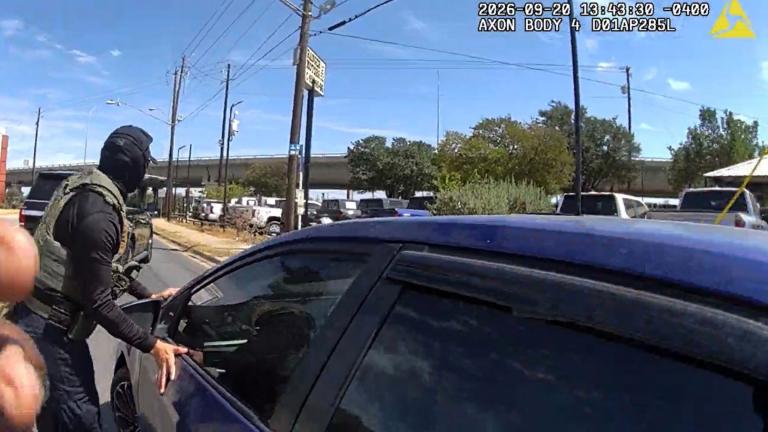
Chicago’s faith leaders are speaking out on immigration enforcement after Immigration and Customs Enforcement agents shot the Rev. David Black — a Chicago pastor — seven times with pepper balls outside the Broadview detention center.
The incident has renewed attention on how ICE treats people of faith in and outside its custody.
ICE’s own national detention standards state that “detainees shall have the opportunity to engage in practices of their religious faith.” But faith leaders in Chicago are questioning whether that promise is being kept.
On Oct. 11 marchers affiliated with the Coalition for Spiritual and Public Leadership marched from a nearby parish to the Broadview facility, hoping to send people inside to provide Holy Communion.
No one from the march was allowed inside the facility. In a statement posted on X, the Department of Homeland Security said the Broadview processing center “was not able to accommodate visitors on such short notice, for their safety as well as that of detainees and staff.”
ICE detention standards require each facility to have an on-site religious services coordinator or chaplain to provide services for detainees. If they cannot meet a detainee’s specific religious needs, outside clergy or service providers may be brought in after a background check and proper notice.
The Broadview facility does not have a chaplain, according to WBEZ.
Cardinal Blase Cupich, the archbishop of Chicago, released a statement on immigration last week. “Let me be clear. The Church stands with migrants,” Cupich said.
Here’s where four more of Chicago’s faith leaders stand on the issue.
Juan Vargas
The Rev. Juan Vargas is a Catholic priest serving the Our Lady of the Rosary Parish on Chicago’s Northwest Side. Vargas took part in the Oct. 11 procession to Broadview but said he expected DHS would reject any attempt to enter the facility.
“In the back of my mind, I knew they were going to say no,” Vargas said. “They (CSPL) did as much as they could to get permission beforehand. It’s not like they just randomly chose people and said, ‘Hey, you guys are gonna go in.’ No, they actively looked for answers to make sure that they went through whatever background they needed to go through.”
Our Lady of the Rosary Parish holds services in both Spanish and English. The Spanish Masses have become the most attended, as Latino parishioners come together to find comfort and solidarity amid growing fear over ICE’s presence, according to Vargas.
But overall Mass attendance in the parish has been down, due to a fear of encountering ICE on the commute to church, Vargas said.
“This Sunday was the first Sunday that I realized there was a bit of a decrease in our Mass attendance,” Vargas said. “There’s been people that have been asking if there is an alternative, like, if we can go to Zoom.”
Rachel Weiss
Rachel Weiss is a rabbi for the Jewish Reconstructionist Congregation in Evanston.
Her synagogue at 303 Dodge Ave. sits within walking distance of several sites where ICE has made immigration arrests in Evanston — including the Home Depot on Oakton Street and a nearby neighborhood where a landscaper was arrested while working.
“As a leader in the Jewish community, this feels not so different than Germany 1938 where people are afraid to go outside, where people are being targeted specifically because of the color of their skin,” Weiss said. “I think many of our members are trying to figure out what in a practical way they can do.”
A U.S. Supreme Court ruling in September granted ICE the authority to use a collection of factors in determining who they arrest including race and location — like outside a Home Depot.
Weiss has encouraged employees at her synagogue who are Latino to refrain from working outside and to stop going to Home Depot.
“I think one of the ways that houses of worship can really be effective right now is that we are already organized groups of people who have values,” Weiss said. “(We’re) going to make sure that we are spending money in Latino-owned businesses in neighborhoods, that we are continuing to pay our workers, even if they’re not able to come to work.”
Rami Nashashibi
Rami Nashashibi is the executive director and founder of the Inner-City Muslim Action Network, a community organization serving people of color on Chicago’s South Side.
Nashashibi said the Muslim tradition challenges one to be a proponent of justice.
“There’s one tradition that says, ‘Be people of justice,’ even if it means standing against your own selves,” Nashashibi said. “So justice is not just about calling out other people — it’s about calling out ourselves, calling out us as a community, as a country, as faith communities: Are we doing more?”
The Inner-City Muslim Action Network has worked toward creating interreligious alliances since it was established in 1997. Nashashibi pointed to the Rev. Martin Luther King Jr.’s march through Marquette Park and the interfaith unity that defined the Civil Rights Movement.
“I think faith communities have to also rally in this moment, 60 years later, not just in Chicago, but to allow Chicago to be a model for what faith communities rallying together could look like for people across the country and even in some ways across the globe,” Nashashibi said.
Quincy Worthington
The Rev. Quincy Worthington, pastor of Highland Park Presbyterian Church, has visited the Broadview facility every week since early September. He was standing near the Rev. David Black when Black was shot with pepper balls by ICE agents.
“(It was) terrifying and shocking — again, a moment of righteous anger. It quickly shifted to the thought of, ‘If they’re doing this to us in broad daylight, if they’re doing this to clergy in front of cameras, what in the world is going on inside that detention center that has no oversight, and how are those people being treated?’” Worthington said.
Worthington said the Department of Homeland Security’s use of Bible references in August to justify immigration enforcement is an example of Christian nationalism being exploited.
“I think the use of scripture that they’ve utilized has been nothing short of an affront to the Gospel plain and simple. I think it’s abhorrent, and it’s one of the most offensive uses of scripture.”
Note: This article has been updated to clarify information about the Oct. 11, 2025, march in Broadview.