Arts & Entertainment
Exhibit Highlighting Filipino American History in Chicago Celebrates Opening Reception This Weekend
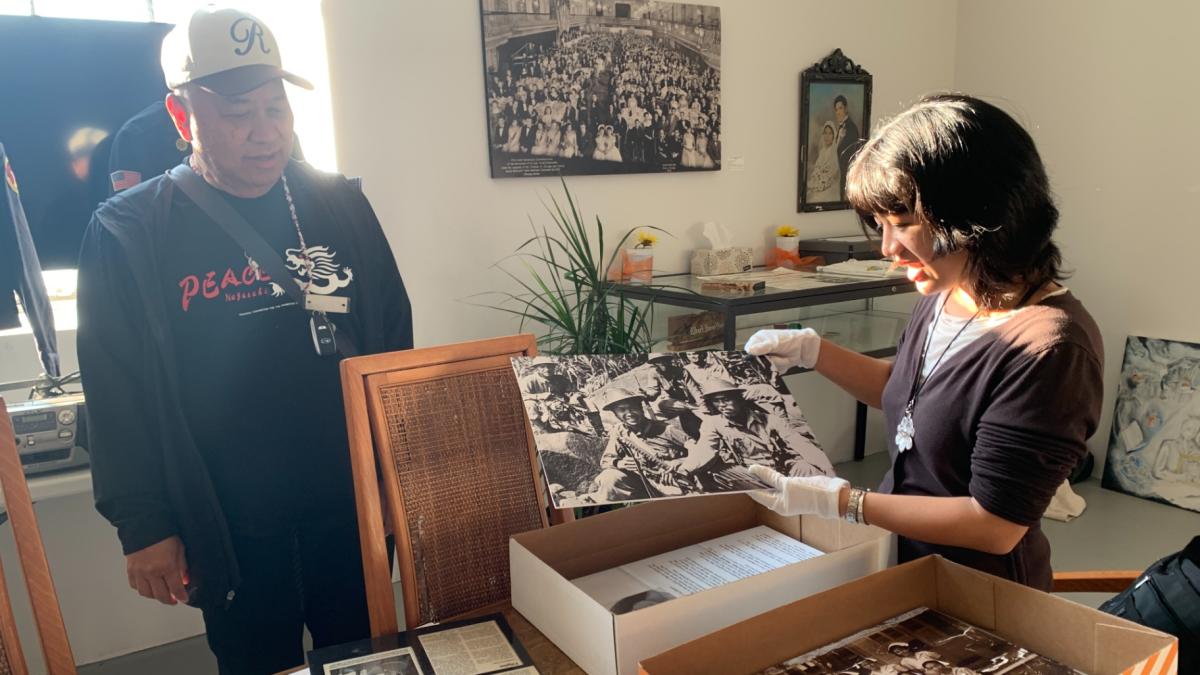 Filipino American Historical Society of Chicago President Ruben Salazar, left, and exhibit curator and FAHSC board member Reese Carolina Cuison Villazor, right, prepare the “Chicago in Quotas and Communities” exhibit at the organization’s museum space in Mana Contemporary on Oct. 16, 2025. (Eunice Alpasan / WTTW News)
When Filipino American Historical Society of Chicago founding President Estrella Ravelo Alamar died three years ago, she left behind an expansive collection of archival materials in her Hyde Park home detailing the Filipino diaspora in Chicago throughout the 20th century.
“Her wish was that she wants her collection to continue to be shared to the next generation,” FAHSC President Ruben Salazar said. “Not just Filipino Americans, but to everyone, because Filipino American history is really part of U.S. history.”
As part of Filipino American History Month in October, the FAHSC is unveiling a new exhibit, “Chicago in Quotas and Communities,” this weekend at the organization’s museum space in Mana Contemporary.
The exhibit is anchored by two contrasting U.S. laws that shaped Filipino migration: the 1935 Filipino Repatriation Act, which came at a time when the U.S. had an immigration quota limited to 50 people from the Philippines per year, and the 1965 Immigration and Nationality Act, which ended the national origin quota system and replaced it with an immigration system that gave preference to labor skills and family reunification.
“When our shifting legal status is called into question, how does the Filipino American community forge their own sense of belonging?” exhibit curator and FAHSC board member Reese Carolina Cuison Villazor said in regard to the ideas she hopes the exhibit will bring to the surface.
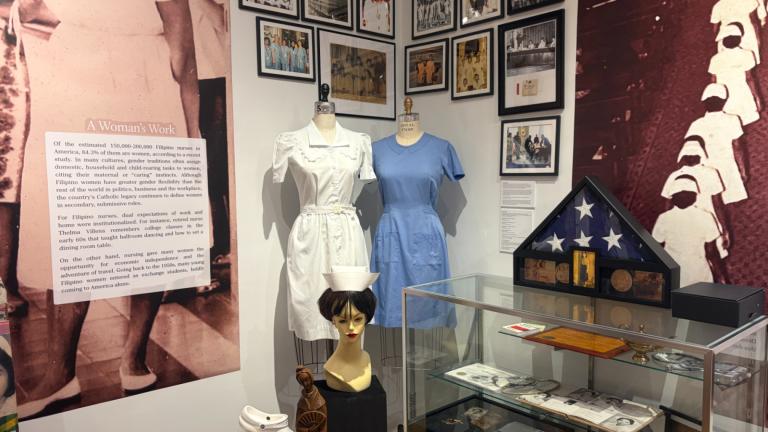
The exhibit showcases materials from FAHSC’s collection, through reproductions of photos, postcards and documents, that depict Filipino American life, ranging from Filipinos serving in the U.S. military during World War II to Filipino Americans hosting beauty pageants in Chicago in the 1980s. Many of the materials in the exhibit and broader collection depict members of Alamar’s family, who first arrived in Chicago in the 1920s and 1930s.
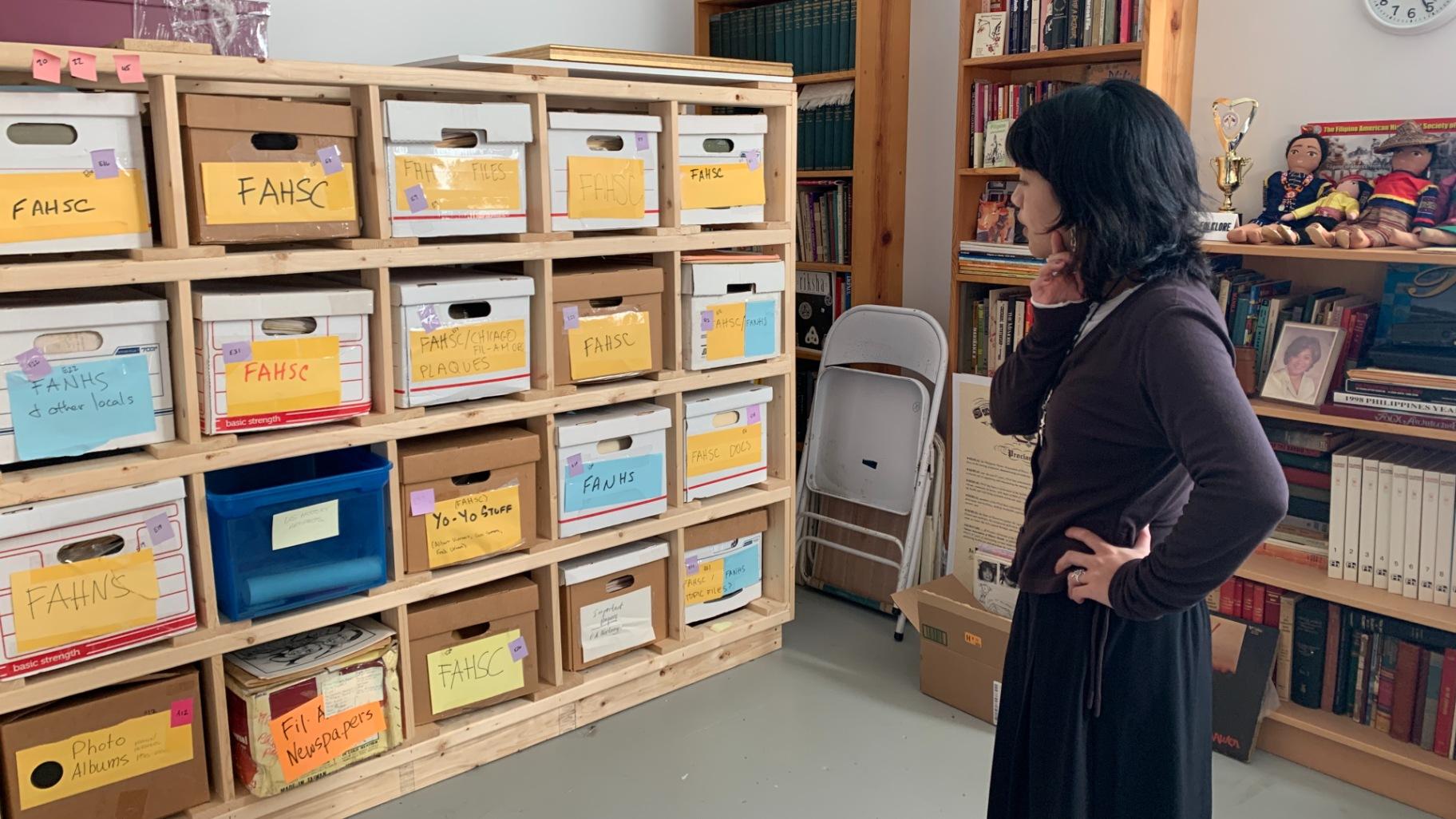 Exhibit curator and Filipino American Historical Society of Chicago board member Reese Carolina Cuison Villazor looks at the organization’s archival collection at its museum space in Mana Contemporary on Oct. 16, 2025. (Eunice Alpasan / WTTW News)
The Chicago metropolitan area is home to 145,000 Filipinos, according to a Pew Research Center analysis of U.S. Census Bureau 2019 data. The Philippines was a U.S. colony before the country gained its independence in 1946, but it’s argued that the impact of U.S. colonization is still felt in the Philippines today.
“History is a living interaction with the present,” Villazor said. “We shape how we remember our history in the present, how we recognize its reverberations in our present, particularly when it comes to migration and movement.”
FAHSC is celebrating its one-year anniversary at its current museum space at Mana Contemporary on the Lower West Side. Salazar said he hopes the fully volunteer-run organization will eventually get enough funding to hire staff to continue its archival work and open the museum on a regular basis.
The museum is currently open by appointment only.
The organization is still working to assess and create an inventory of all the items in its collection. The process involves continuing to scan photographs, document oral histories, preserve films and build a library for its books, according to Salazar. The organization has partnered with the Chicago Film Society, Chicago Cultural Alliance and University of Illinois Chicago as part of its preservation and archival efforts.
“We’d like to hopefully educate not just our next generation of Filipino Americans, but also make it well known to the mainstream, and hoping that our history is shared in the schools, so that we get respect and we get recognition,” Salazar said. “Hopefully more and more people know about our history and contributions as Filipino Americans.”
A reception for the new FAHSC exhibit will be held Sunday from noon to 2 p.m. at Mana Contemporary, Studio 316, with remarks from Salazar, Villazor, Chicago Cultural Alliance Executive Director Mónica Félix, film archivist Kaz Mendoza Rodriguez, community leader John Emiliano and more. The event also includes an opportunity for community members to share their migration stories.
Contact Eunice Alpasan: [email protected]