Crime & Law
Illinois Prisons Will Now Scan Physical Mail Sent to Incarcerated People
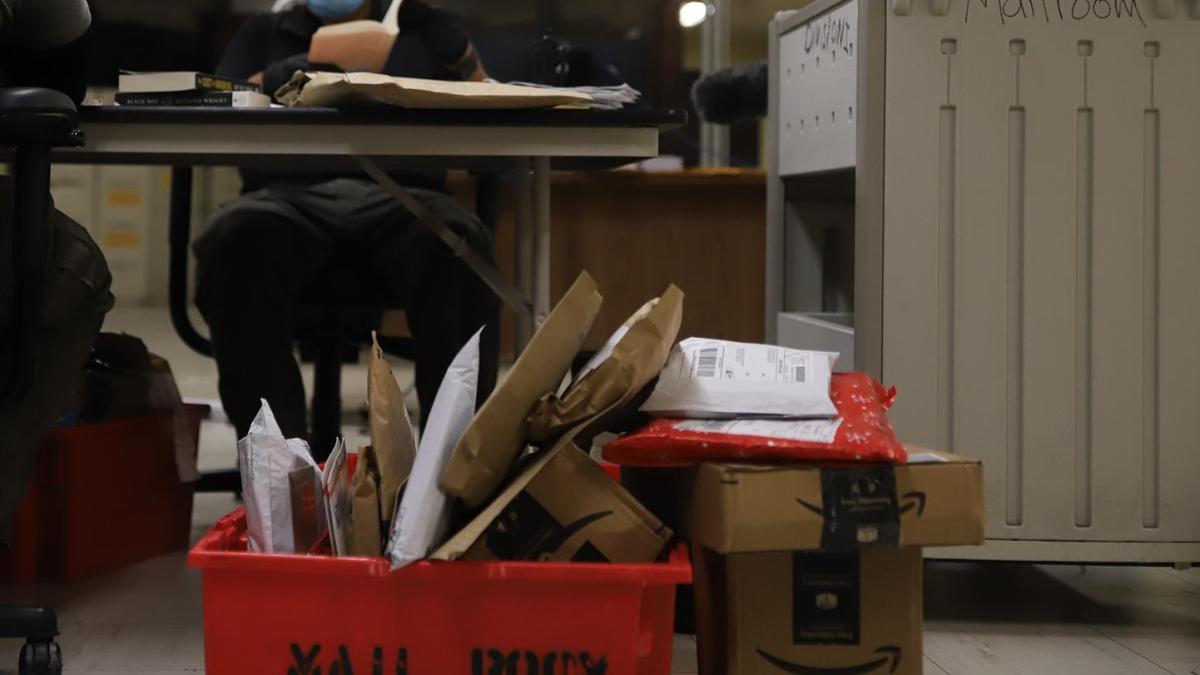 A group of jail personnel inspect stacks of letters and books in the mail room at Cook County Jail in a file photo. Illinois Department of Corrections will begin scanning mail in state prisons. (Cary Robbins / DePaul)
The Illinois Department of Corrections will now permanently scan most physical mail sent to incarcerated people and distribute it electronically.
Beginning immediately, non-privileged mail will be opened and inspected for contraband, scanned in color, then be uploaded to an individual’s tablet, the department announced Monday. Nearly all incarcerated people now have tablets, according to the department.
That does not include privileged material, such as legal mail. The department is also discontinuing the practice of visitors dropping off publications at facilities.
Advocates have long panned the department for inching toward mail scanning, pointing to the importance of physical mail as a connection to the outside world. AFSCME Council 31, the union that represents most correctional workers in the state, has encouraged the move, citing concerns over illicit substances in physical mail.
Earlier this month, the department filed an emergency rule to allow prisons across the state to electronically scan and distribute mail, citing safety concerns. But a bipartisan legislative committee objected to the rule, deeming it not an emergency.
IDOC will again go before the Joint Committee on Administrative Rules (JCAR) on Oct. 14. The department did not immediately respond to a question on how their permanent switch to mail scanning will impact their proceedings with JCAR.
AFSCME Council 31 has previously told WTTW News that this emergency rule is necessary.
“Our union has called for mail-scanning as a means of reducing the flow of harmful substances and other illicit contraband into state prisons,” said Anders Lindall, spokesperson for the union.
It’s unclear how many drugs enter IDOC facilities through the mail, according to data obtained by WTTW News in February. But the state might be getting a fuller picture due to a new state law: In August, Gov. JB Pritzker signed a bill into law that requires IDOC to collect and publish data concerning contraband found in their facilities.
The point of the law was to collect information in order to create policy to stop contraband from entering prison, said Jennifer Vollen-Katz of the prison watchdog group the John Howard Association. But before this information on contraband has been released, IDOC has taken measures to scan mail.
Now, advocates are concerned over how this could impact the wellbeing of those inside and their loved ones.
Holding drawings and letters from loved ones provides comfort and hope to those inside, said Erica Bently, co-director of MAMAS Activating Movements for Abolition & Solidarity. Her group provides support to mothers with incarcerated children.
“It’s just IDOC stripping all hope that people have,” Bently said.
Illinois joins at least 14 other states that scan physical mail entering prisons.
States that have switched to scanned mail haven’t necessarily solved their drug issues or gone without issue. In Pennsylvania, for example, the rate of random positive drug tests among incarcerated people more than doubled since the mail scanning system went into effect. In Ohio, lawyers alleged state employees are opening confidential mail.
Contact Blair Paddock: @blairpaddock.bsky.social | [email protected]