Crime & Law
ACLU of Illinois Says Supreme Court Ruling in LA Does Not Legalize Racial Profiling — But Does Make it Easier
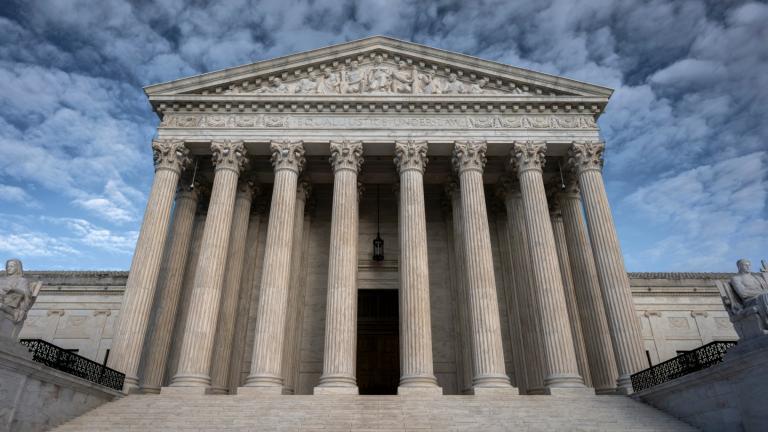
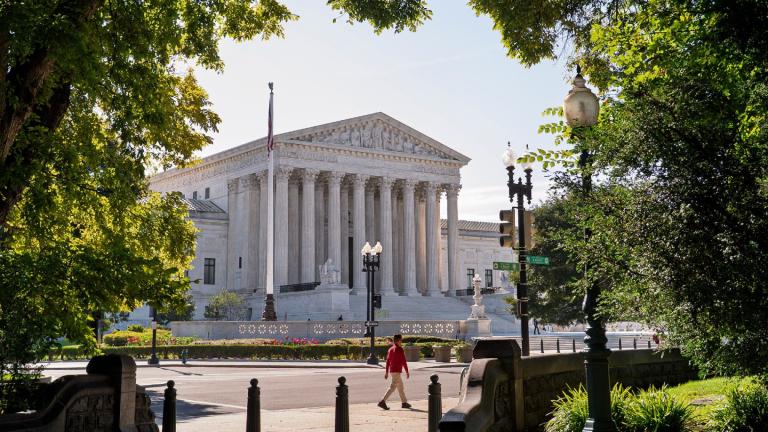
A U.S. Supreme Court ruling on Monday leaves open the possibility that ICE agents can use ethnicity among other factors when making immigration sweeps.
Justices struck down a lower court order that had temporarily barred federal agents in Los Angeles from questioning people based solely on ethnicity and work status along with other factors.
The ruling coincides with the U.S. Department of Homeland Security’s announcement of “Operation Midway Blitz,” which is expected to ramp up ICE’s presence in Chicago.
Below is a Q&A with Kevin Fee, legal director for the American Civil Liberties Union of Illinois.
(The interview has been edited for length and clarity.)
WTTW News: Briefly explain what the Supreme Court did on Monday. I’ve read stories saying the Supreme Court is essentially permitting racial profiling. Is that correct? What exactly did they do?
Kevin Fee: Well, they didn’t explicitly permit the practice of racial profiling. What the Supreme Court did on Monday was make a ruling on the so-called emergency docket or shadow docket — which has become, as of late, much more like their sort of ordinary docket — but what they did was make a sort of preliminary ruling granting the government’s request to stay an injunction that was put in place by a federal district judge out in Los Angeles. That ruling from the lower court barred immigration agents from stopping people based on a specific combination of factors. So what the court did from a legal perspective was just put a stay on the court order stopping the practice while the case winds its way through the courts for a final determination. The practical effect of that is potentially pretty profound because it lifts the shackles that had previously been placed by the district court on ICE agents to engage in racial profiling. So it could have very real immediate harm.
And so just to be clear, as of now, there’s nothing to prevent an ICE agent from racially profiling people. Is that correct?
Fee: Not exactly. To be precise, individuals could still petition a court for relief based on pure racial profiling, and they could very well get relief. The thing that’s happened is that the broad injunction that applied to the entire Central District of California — 20 million people — that prevented a specific practice of stopping people only based on a combination of race, language status, location and job status is stricken. So now it’s going to have to be looked at on a more case-by-case basis. I mean, the court did still leave open the possibility of federal relief for excessive force and for profiling on purely racial characteristics. Those things are still prohibited by the Fourth Amendment.
So right now, for example, if somebody who appeared to be Latino was talking Spanish, hanging out with another group of Latino men, dressed as though they could be day laborers or landscapers, hanging out outside a Home Depot, is it OK for an ICE agent to pick up that person because they think that combination of factors means that they’re potentially illegally in the country?
Fee: So before Monday they would have had to worry about running afoul of a court order if they stopped a person for those reasons. After Monday, they no longer have to worry about that court order (that has now been stayed). It doesn’t necessarily mean that that particular stop couldn’t be challenged in court and that the person challenging it might not win in court, but the safeguards that were available to people before Monday based on this injunction are no longer in place, which makes it much easier for ICE agents to make a stop like that without fear of legal repercussions.
In the normal course of events, the Supreme Court doesn’t hear every case that’s brought before it. What do we know about why the Supreme Court decided to hear this case? What is the significance of the court doing it through this shadow docket process?
Fee: So nobody knows for sure why the Supreme Court is making such robust use of its shadow docket. I think that there’s an ongoing lively debate about why that is. I think a lot of people fear that it is because of a sort of sense of loyalty to this administration that they are more prone to side with the government. … And so through the emergency docket, that doesn’t require them to wait for the case to wind its way through the courts and for them to set forth their full reasoning and allows them to instead rule in favor of the administration without much explanation.
Why does the expanded use of the shadow docket have so many legal scholars concerned?
Fee: I think it’s a combination of things. First of all, it really does raise folks’ concerns that the court is being used in a partisan way, but it also is concerning because it results in interim decisions that have real, and in some cases, profound ongoing harm on people. This being a really good example, in that the Supreme Court doesn’t give any real guidance to lower courts or to lawyers litigating these cases. As to why the Supreme Court has decided to grant this emergency relief, it really leaves folks in the dark about what the court is thinking and just leads to a sort of chaos when it comes to interpreting and challenging the actions of this administration.
What does that do for the process? If you’re a lower court judge trying to handle a deportation case, how do you understand how to proceed?
Fee: To be candid, it makes it extremely difficult. To their credit, lower courts are soldiering onward and doing their jobs and doing their best to apply statutes and case law and precedent to come to the most just decision on these issues that they can, but they’re finding their orders overturned and called into question by the Supreme Court at every turn with little feedback.
This is happening in the context of an expected ramp-up in ICE activity in Chicago and the surrounding areas. Does it mean that ICE agents can effectively racially profile in the city of Chicago?
Fee: Racial profiling is unconstitutional, full stop. And Monday’s ruling does not change that. Monday’s ruling does not repeal the Fourth Amendment. Monday’s ruling is not a full-throated endorsement of racial profiling, even if the practical impact of it is to make racial profiling easier and less risky for ICE agents to conduct. But racial profiling is unconstitutional.
This case could now take months or even longer to reach SCOTUS for a full hearing. Given the gravity of what the court will ultimately be asked to rule on, and given the fact that essentially what they’ve done means there’s the potential for continuing harm, why would the court not choose to accelerate that process and hear it faster?
Fee: That’s a great question. A cynic might say that it’s easier to sort of grant relief without full explanation than it is to fully flesh out the constitutional jurisprudential reasoning behind a final opinion. The court is taking a bit of a shortcut, but the question of why the court is so comfortable making such substantial emergency rulings now when in the past they’ve been much more skeptical to do so is a bit of a mystery.
We didn’t get any kind of full reasoning from the court, but we did get the concurring opinion from Justice Brett Kavanaugh as well as a blistering dissent from Justice Sonia Sotomayor. What did you make of what they had to say?
Fee: I’ll start with Justice Sotomayor because I think that she put it quite beautifully when she said that we should not have to live in a country — and I’m paraphrasing here — where people are stopped simply because of their race and their job and detained by the government. That really just underscores that we’re not just dealing with thought experiments here. We’re dealing with real impact on real people and a bedrock principle of fairness that has been largely unchallenged for a very long time and yet seems to be under immediate threat.
The concurring opinion from Justice Kavanaugh, I do appreciate that at least he gave some window into the majority’s reasoning, which has not always been the case from this court on the emergency docket. But the reasoning, such as it was, was frustratingly divorced from the facts of the case. And, in fact, at various points just glossed over or skipped over facts from the record that were inconvenient, … but it’s especially frustrating in its seeming untethered nature from the facts.