Politics
Trump Taking US ‘Down a Dark Road,’ Says UChicago Political Violence Expert
The U.S. Department of Homeland Security’s launch of “Operation Midway Blitz” this week is expected to ramp up the deployment of Immigration and Customs Enforcement agents in Chicago. The Trump administration said the operation is designed to target “criminal illegal aliens” who they say have flocked to Chicago because of its sanctuary city status.
But others — including Illinois Gov. JB Pritzker — worry that innocent migrants and even citizens could be caught up in ICE and National Guard operations.
Pritzker said on Tuesday that President Donald Trump had “terrible plans for the communities of Illinois” and that Trump was trying to “disrupt the country not because he’s going after criminals, but because he has a nefarious plan, frankly, to bring military into cities so that ultimately in the 2026 election people will be normalized to the idea of militarization during the next election so that he can affect the outcome of that election.”
Trump said he’s simply trying to fix Chicago’s crime problems.
“We could solve Chicago very quickly,” Trump told reporters on Sunday. “When you look at what happened in D.C. in a short period of time, honestly, it’s amazing. Over a period of 12 days — in other words on the 12th day — we had the crime just about solved.”
Trump’s actions in Washington, D.C., involved the deployment of the National Guard to effectively occupy the nation’s capital.
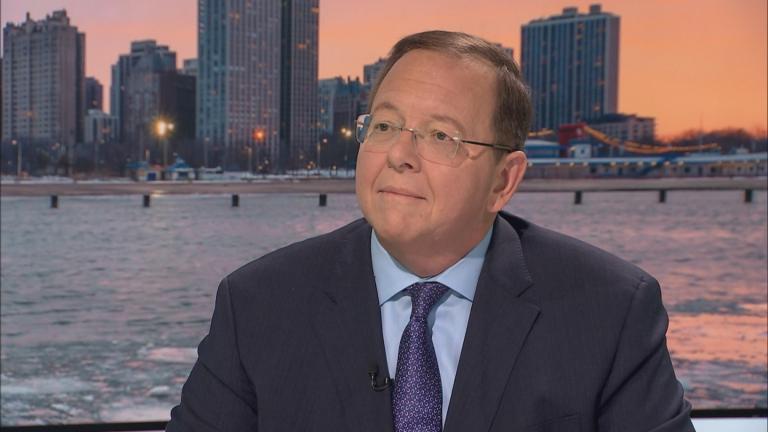
University of Chicago professor Robert Pape, founding director of the Chicago Project on Security and Threats and a specialist on political violence, warns “the Trump administration is sending Chicago and much of the country down a dark road.”
Pape fears any form of military intervention, even if ostensibly used to fight crime, is likely to inflame an already tense situation.
“I’ve lived in Chicago for 25 years,” Pape said. “I have never met anyone in Chicago who likes the crime. People in Chicago — and we know this from our surveys — people in Chicago do not like the idea of a military occupation and they don’t like the idea of a police state even more.”
In a recent survey of more than 1,100 Chicago residents, Pape said some 60% of those surveyed did not approve of the way Trump is handling immigration enforcement and deportations.
Furthermore, 28% said that they would attend protests even if they turned violent; 30% agreed that immigrants targeted by Trump are justified in using force to defend themselves; and 37% agreed that the use of force is justified to remove Trump from the presidency.
“This isn’t just a random phone dialing,” Pape said. “This (survey) is with NORC (National Opinion Research Center). That’s one of the most respected polling agencies on the planet, and a representative survey of the city of Chicago and its 2.7 million residents. This is not the picture of a city that is asking for military troops, this is the opposite.”
Pape worries that violence could erupt between demonstrators and ICE agents as well as the National Guard if they are in fact deployed in coming days. He warns of numerous potential flashpoints.
And if “Operation Midway Blitz” morphs from its stated focus on alleged migrant criminals to a broader operation against all undocumented migrants and a crackdown on violent crime, Pape fears the administration’s actions could provoke rather than quell violence.
“If you’re going to go into Austin to actually permanently reduce crime, you’re going to need to disarm gangs, disarm people,” Pape said. “This is going to take a lot of time and be very dangerous.”
He also worries that if the Trump administration ultimately aims to deport all undocumented migrants in the city “well, that’s 150,000 people,” Pape said.
“If you were to seriously talk about deporting 150,000 — 8% of the city — this would probably take a year,” said Pape. “This would probably involve tens of thousands of troops. And to be clear, troops cannot deport people, but they can support ICE agents in their efforts.”
Pape is also concerned that a decision by the U.S. Supreme Court on Monday that effectively gives court approval to racial profiling could inflame passions and spark conflict. The Supreme Court decision overturned a federal judge’s ruling that prevented federal agents in Los Angeles from stopping people solely on the basis of their ethnicity or because they were speaking Spanish as agents searched for undocumented migrants.
“That ruling was really quite stunning,” said Pape. “Because the ruling — 6 to 3 in the Supreme Court — is that ICE agents are now to essentially racial profile. So it is now the case that if you have the wrong skin, if you have the wrong accent, if you work in the wrong place, then with no other information whatsoever, you can be legally detained, so says the Supreme Court of the United States.”