Science & Nature
Prairie in a Pot: Chicago Plant Scientist Tackles Challenge of Native Gardening on an Urban Balcony
 Jeremie Fant, director of conservation at Chicago Botanic Garden, has spent 15 years experimenting with growing native plants in containers on his condo’s small balcony. (Courtesy of Jeremie Fant)
As director of conservation at Chicago Botanic Garden, Jeremie Fant oversees programs that preserve, restore and promote native landscapes.
So it would be fair to assume his home garden sports a spectacular display of Illinois wildflowers, right?
Well, kind of.
Fant’s “yard” is a 10-foot by 5-foot balcony off his third-floor Wicker Park condo, and his “garden” is a quartet of fiberglass pots.
But yes, the wildflowers are impressive, even more so considering these native perennials are persisting year-round, outdoors, in planters. That includes a serviceberry shrub which, before birds discovered it, produced enough fruit for Fant to make jam.
Over the past 15 years, Fant, who has a Ph.D. in plant genetics, estimates he’s tested some 200 prairie species in containers on his balcony.
“Which is crazy, I’m not recommending it,” he said. “But, as a nerd, I enjoy it. I’ve learned a lot about what succeeds and doesn’t.”
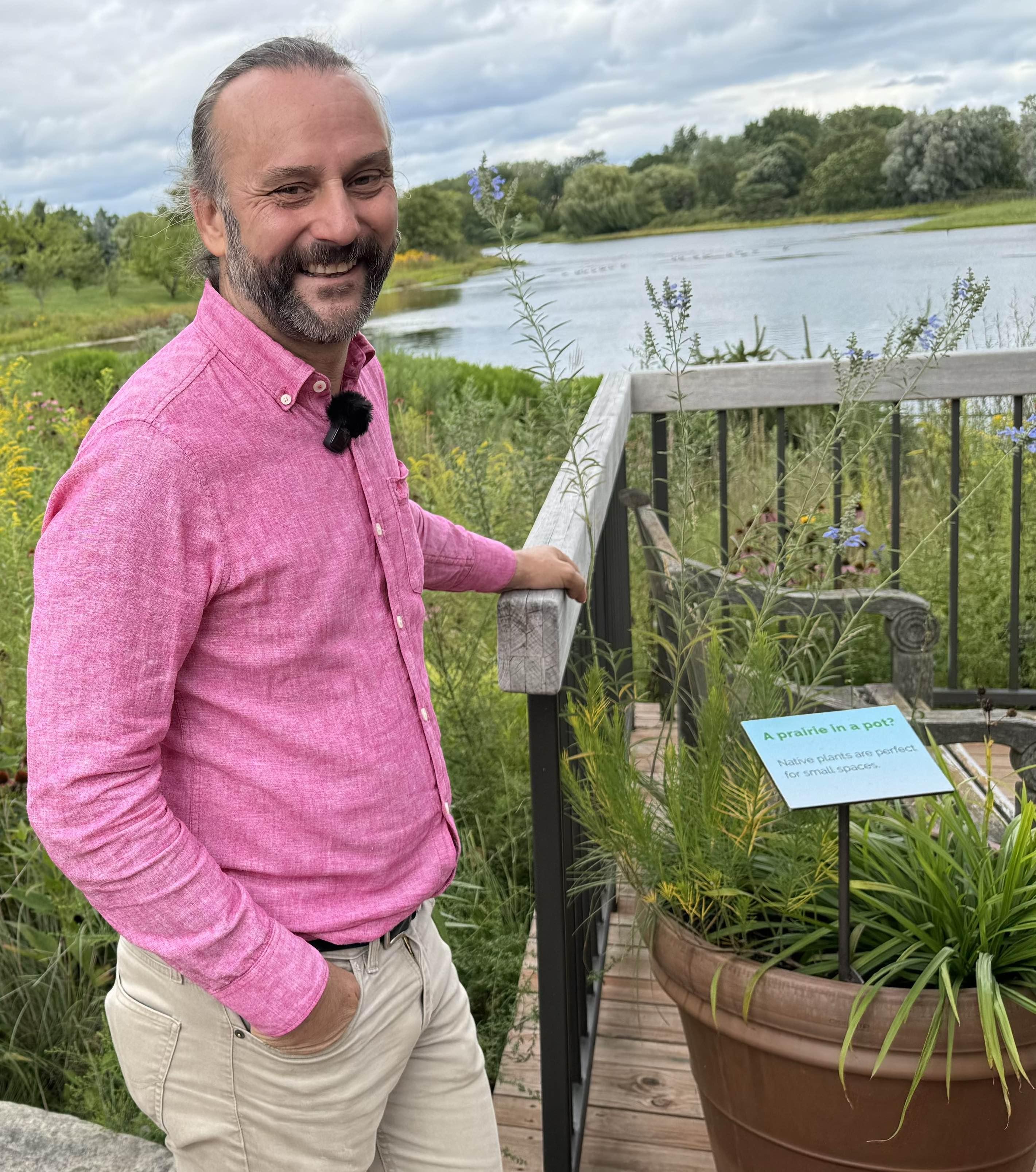 Jeremie Fant, seen in the Chicago Botanic Garden’s native garden, where “prairie in a pot” displays demonstrate how natives can be used in containers. (Patty Wetli / WTTW News)
Fant’s interest in native plants dates back to his childhood in Australia, a country where, much like in the United States, gardens were once heavily tilted toward European flora.
“Australia is a country that’s English-influenced. English gardens are very popular. Lawns are popular. But then Australians were like, ‘This is crazy. We’ve got the worst hot, dry summers and these (English) plants don’t love it,’” Fant recalled. “And so during my youth, there was a big movement to appreciate native plants.”
Fant fell in love with Australia’s “weird, eccentric, crazy” natives, with their rugged and harsh looks — North America’s rattlesnake master is a plant that reminds him of home — and as he moved around the globe, first to England and then the U.S., that enthusiasm grew to encompass the natives of his adopted lands.
“The word native changes depending on where you are,” he said. “The native is the one that suits the soil, suits the climate, and also benefits those insects and everything else that we love.”
So which ones suit a balcony?
Bucking conventional wisdom about both container gardening and gardening with natives, Fant set out to determine which plants would perform well in shallow pots and are also capable of weathering Chicago’s harsh winters without indoor shelter.
“I think the common dogma for a long time was ‘You’ve gotta put pots back inside.’ If you have a condo like me, and I don’t have a garage, there’s nowhere for me to put it. So my big thing is it’s got to survive the winter,” Fant said.
Native prairie plants’ deep root systems — ironically one of their biggest benefits — were another concern. How do you nurture such plants in a 12- or 18-inch pot?
Fant’s a-ha moment regarding container gardening came in 2009, when the Chicago Botanic Garden started installing a green roof with soil that was 8 inches deep at best.
“They were growing species on that roof that supposedly have roots that go 3, 4, 5 feet deep. And (the plants) were doing fine,” he said. “Some will persist in those environments, some won’t. But there are quite a few native plants that were more than capable of living on 8 inches of soil in hot, dry conditions.”
Translating the concept of a green roof to containers took a fair amount of trial and error. Fant discovered, for example, that taller species — think towering natives like ironweed or compass plant — would topple over in the wind at his balcony’s height. Now he chooses species that max out at 3 to 4 feet.
And Fant admits he’s guilty of adding degrees of difficulty that weren’t really necessary, like creating his own soil mixes to mimic different prairie habitats, including sand and gravel, in each of his pots.
“I think I overdid it, overthought it, tried too hard. I still had fun,” he said, “but truth be told, regular potting mix worked just fine.”
The reward has been a four-season outdoor oasis. In the spring, there’s phlox so bright it’s almost gaudy; spotted beebalm (Monarda punctata) hits its stride in summer; asters and goldenrod glow in fall; and sedges provides a pop of color in winter. Butterflies, bees, birds, wasps and pollinator flies are welcome visitors.
“I’ve seen it all,” Fant said. “I’m a plant nerd, my focus was plants, but the fringe benefit of insects has been incredible.”
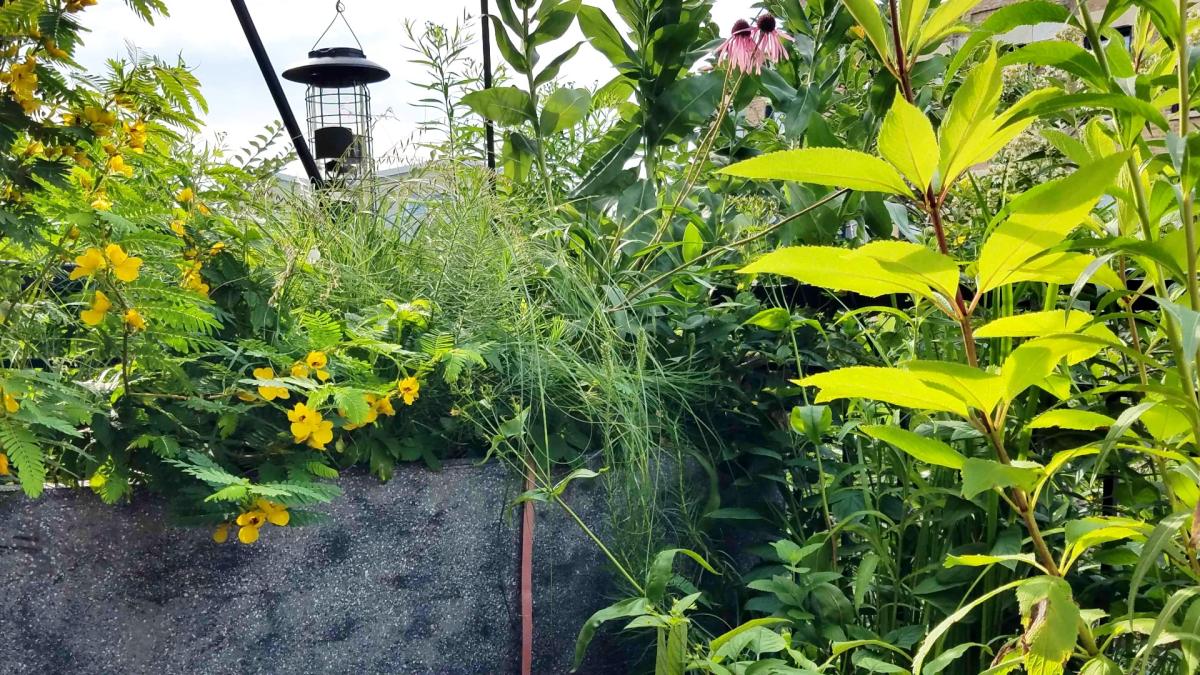
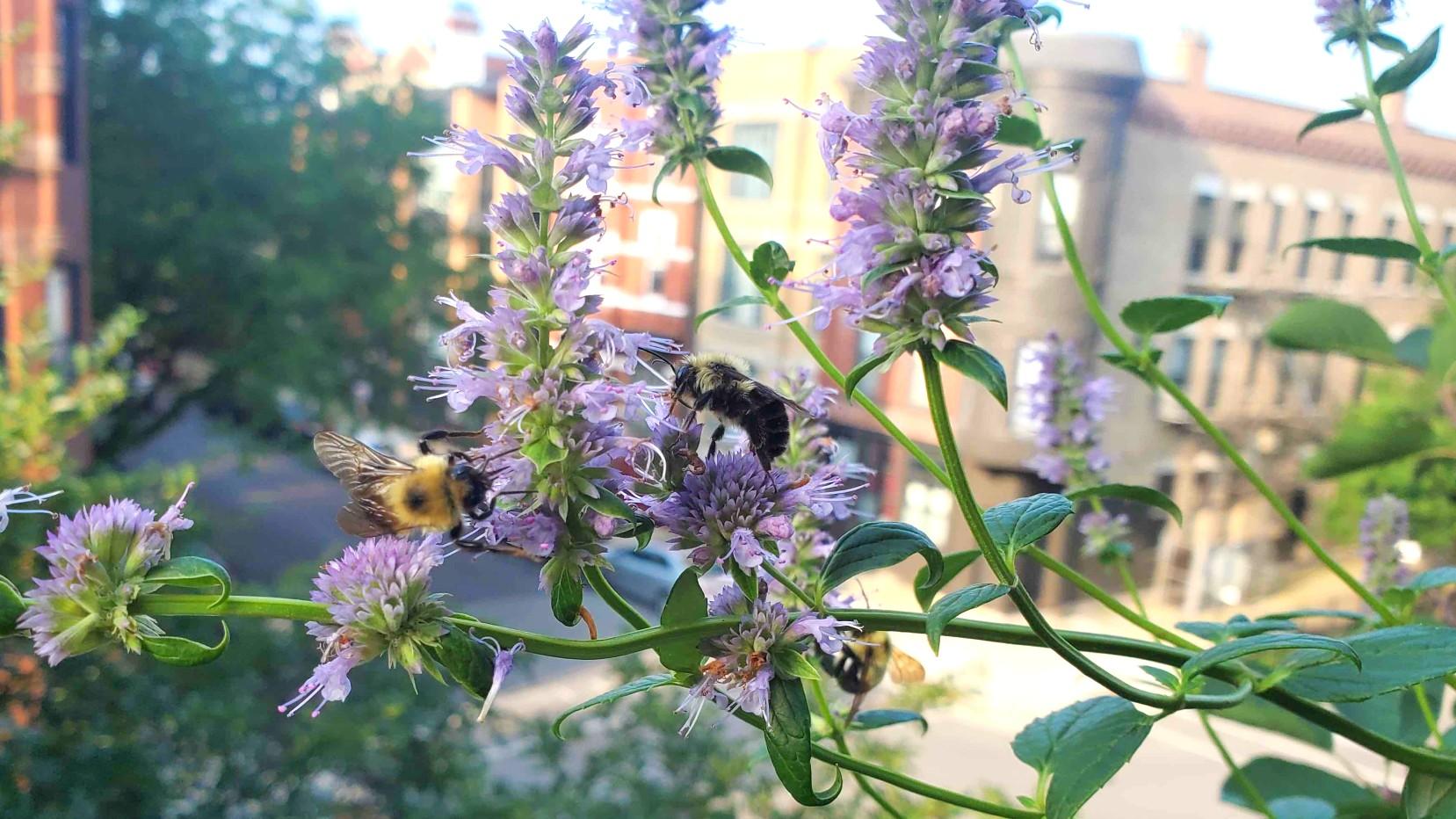 Native gardens in containers can create biodiversity and support a variety of pollinators even in dense urban areas. (Courtesy of Jeremie Fant)
While he still experiments with new plants every year, Fant has refined his process to the point where he meets with success more often than not, one caveat being that, as any gardener can attest, there’s often no rhyme or reason to whether a particular plant thrives or flops.
Now even the Botanic Garden has adopted some of his practices, placing a number of “prairie in a pot” containers within the larger, more naturalistic native plant garden display. It’s a recognition by the Botanic Garden, Fant said, that people are interested in using natives in their containers.
In an interesting twist, some of the potted natives were grown from 20-year-old seeds stored in the Botanic Garden’s seed bank, as part of a routine project to determine whether the seeds were still viable.
“We only need the germination data, but the plants exist now,” Fant explained. “So it was sort of a complete circle. We collected the seeds. Because we’re growing the plants, let’s test some of those plants in the pots.”
But it doesn’t take a degree in horticulture to attempt a prairie-in-a-pot at home.
For Chicago gardeners who, for lack of available green space, have felt left behind in the native gardening movement, Fant offers a rough blueprint to follow.
Fall is the perfect time to begin preparing for next year’s growing season, he said, if for no other reason than containers and other garden supplies are likely to be on sale.
Some nurseries sell bare root plants that could be placed in pots now and allowed to over-winter, he added, and the same goes for gardeners who want to try growing natives from seed.
“I don’t do seed just because I’m impatient, but you could put seed out now because seed needs to be cold before it germinates,” said Fant.
Additional tips, based on his years of experience:
The pot matters. Fant settled on fiberglass because of its ability to withstand cold without cracking. It’s also lighter weight than other durable materials such as concrete. He uses pieces of Styrofoam to insulate the sides of the pot and noted that wider pots provide more insulation than narrow.
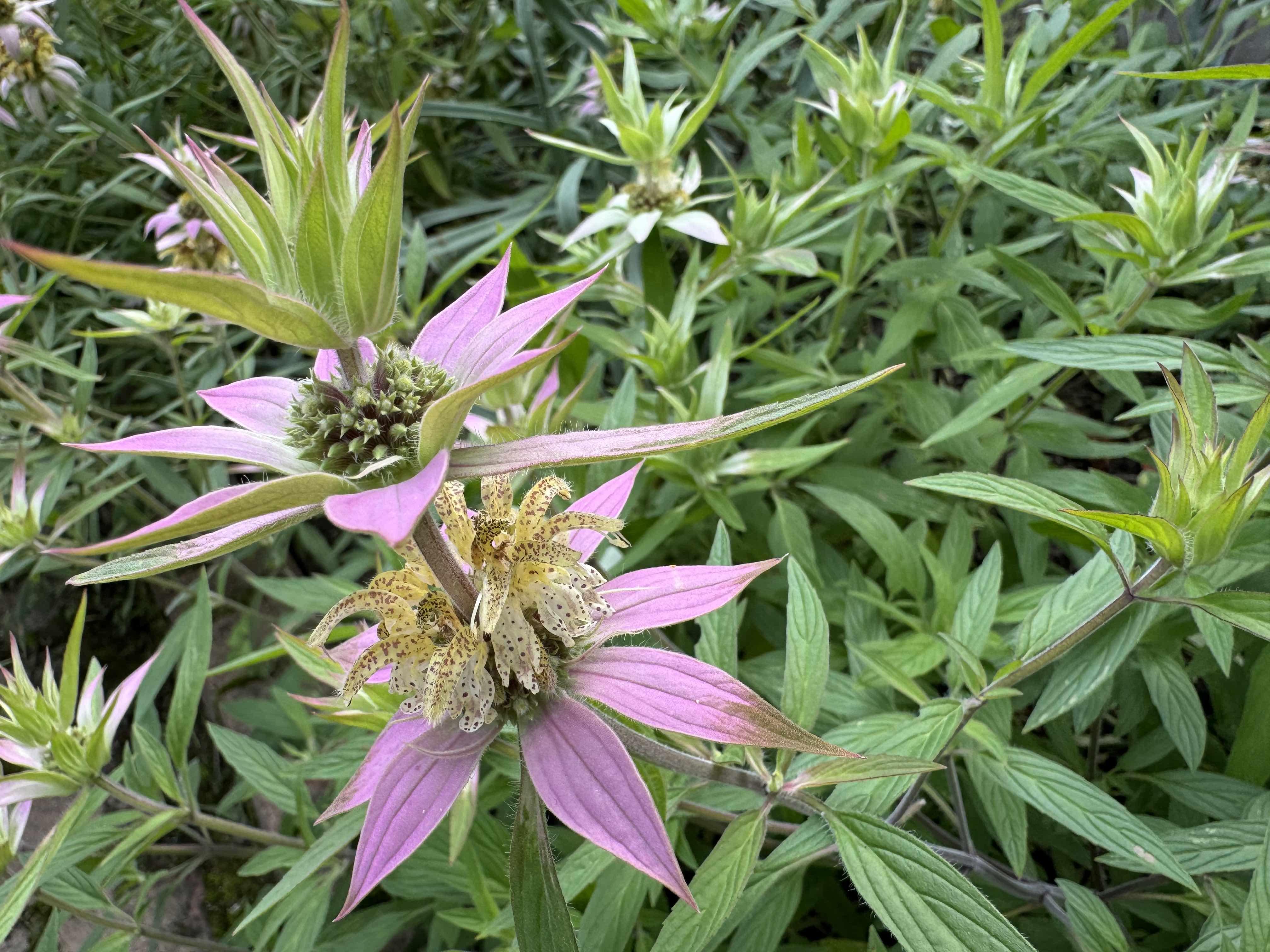 Spotted beebalm, also known as horsemint, has been a big winner in Jeremie Fant’s containers. (Patty Wetli / WTTW News)
Rock star plants. Alliums (the onion family) have been big winners for Fant. “The onions, they are tough as nails. They can do it all,” he said. In general, he’s found that plants with fibrous roots do better than those with tap roots, which tend to struggle more with the freeze-thaw cycle.
Sedges are another favorite. “Sedges don’t necessarily have a pretty flower, but they do provide good soil texture — they hold the soil together — and in the winter they stay green,” Fant said.
He’s blogged about some of his top performers but encourages people to experiment. “Play around,” he said.
Don’t forget to water. Fant acknowledged that one of native plants’ superpowers — their ability to survive on less water — is kind of negated by placing them in containers.
“You’ll lose a lot (of plants) if you forget to water, but they’re more forgiving if you select the right species,” he said.
He’s chosen natives found on drier gravel hills, specifically, adapted to less water. The strategy paid off when he was on holiday and houseguests left his pots high and dry for 10 days during a hot summer.
“I was shocked at how many things survived,” Fant said. “It didn’t look too good after the 10 days, but so many things came back. So, yeah, they’re robust.”
Contact Patty Wetli: [email protected]