Investigations
The Adams County Sheriff Has Been Cooperating With ICE. Does That Violate Illinois Law?
When it comes to Illinois laws aimed at protecting immigrants, Adams County Sheriff Tony Grootens has made his views clear.
“I have no intentions of turning away ICE agents or any of them, Homeland Security agents, any of them, that encounter illegal aliens in our community,” Grootens said in a July interview with TV station KHQA. “I know that we’ve had a few, and we put a few in jail and they’ve since been transported out of here by ICE.”
It appears the western Illinois sheriff has made good on his promise, according to documents obtained by WTTW News.
The Adams County Sheriff’s Office has transferred at least two men into U.S. Immigration and Customs Enforcement (ICE) custody, in apparent violation of the state’s TRUST Act and Way Forward Act, according to a lawyer who helped provide technical support for the legislation. Both men were later deported.
In a statement, Department of Homeland Security Assistant Secretary Tricia McLaughlin pointed to both men’s criminal charges — but in one case, the federal government dismissed its criminal complaint; in the other, he was never charged for the alleged crime that landed him in jail.
In addition, the Adams County Jail also has a contract with the U.S. Marshals Service that authorizes ICE to utilize the jail to detain people for $80 a day. Such contracts also appear to run afoul of state law.
The acts generally prohibit collaboration between Illinois law enforcement officers and federal immigration agencies.
“All of those things are violations,” Mark Fleming, associate director of federal litigation with the National Immigrant Justice Center, said of both the men handed off to ICE by Adams County and the jail contract.
WTTW News detailed these apparent violations to Illinois Attorney General Kwame Raoul’s office, which oversees compliance and enforcement of the state’s sanctuary laws. The office did not respond to repeated requests for comment.
In July, WTTW News sent Grooten’s remarks on KHQA to Raoul’s office for comment. A spokesperson replied that “nothing in the TRUST Act violates federal law. Local law enforcement in Illinois must follow the TRUST Act, just like any other Illinois law. Our office is aware of the comments made by the Adams County Sheriff. We have no further comment at this time.”
WTTW News also laid out the apparent violations to the Adams County Sheriff’s Office, which did not respond to repeated requests for comment.
The Jail Agreement
The intergovernmental agreement between Adams County and ICE is through a contract with the U.S. Marshals Service and Adams County Jail, effective last February: “this agreement is for the housing, safekeeping, subsistence and care of Federal prisoners.” ICE is marked under “other authorized agency user.”
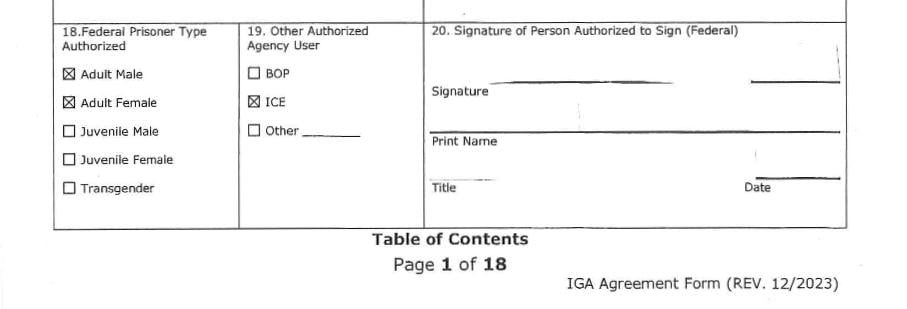 The intergovernmental agreement between Adams County Jail and the U.S. Marshals Service includes ICE has an authorized agency. Under the Illinois Trust Act, no law enforcement agency may enter into or renew any intergovernmental service agreement to house or detain individuals for federal civil immigration violations.
“No law enforcement agency, law enforcement official, or any unit of State or local government may enter into or renew any contract, intergovernmental service agreement, or any other agreement to house or detain individuals for federal civil immigration violations,” states the Illinois’ Way Forward Act.
“That is precisely one of the scenarios that the Illinois Way Forward Act sought to address,” Fleming said. “That authorization of ICE to use it is a clear violation.”
Fleming compared the situation to a 2021 lawsuit, in which McHenry and Kankakee counties sued to stop the implementation of the Way Forward Act and thereby protect their existing lucrative detention contracts with ICE. But a federal judge upheld the act, terminating the inclusion of ICE on their contracts.
Detainers and ICE Custody
Since the beginning of this year, Adams County has transferred at least two men into ICE custody — which also violates the TRUST Act, according to Fleming. Both men were deported, according to DHS.
In both instances, civil immigration detainers were issued. An immigration detainer is a request that a local law enforcement agency detain an individual to then transfer that person into federal immigration custody.
“A law enforcement agency or law enforcement official shall not detain or continue to detain any individual solely on the basis of any immigration detainer or civil immigration warrant or otherwise comply with an immigration detainer or civil immigration warrant,” the TRUST Act states.
“Unless presented with a federal criminal warrant, or otherwise required by federal law, a law enforcement agency or official may not … transfer any person into an immigration agent’s custody,” it continues.
One case involves Alejandro Palomo-Godines, a Mexican man. In September 2024, he was arrested in Sangamon County and charged with violating federal weapons laws. An immigration detainer was issued for him on June 16.
A June 18 filing shows that the federal government dismissed Palomo-Godines’ case. On June 21, he was transferred from Sangamon County to Adams County Jail in Quincy, held on an ICE detainer and was then “picked up by ICE.”
WTTW News has not been able to reach Palomo-Godines.
The other case involves Romaido Garcia-Santizo, a Mexican man who, according to ICE documents, had been removed on one prior occasion from the United States to Mexico in 2011. He said he worked at a dairy farm in nearby Missouri, the documents state. WTTW News has not been able to reach Garcia-Santizo.
An affidavit from an ICE deportation officer states that in March, he confirmed Garcia-Santizo reentered the U.S. after he was arrested for “aggravated assault use of a deadly weapon” by Quincy police. However, according to the Quincy Police Department, Garcia-Santizo was not charged.
The Quincy Police Department denied a WTTW News request under the Freedom of Information Act for his arrest report.
The ICE affidavit states that after Garcia-Santizo’s arrest, the ICE officer searched through a jail booking database, where he found that Garcia-Santizo was in Adams County Jail custody.
The officer then issued a civil immigration detainer for Garcia, according to the affidavit. Garcia-Santizo was taken into ICE Enforcement and Removal Options custody inside the booking area of the Adams County Jail; this transfer into ICE custody breaks the TRUST Act, Fleming said.
According to the affidavit, Garcia-Santizo was then transported to the St. Louis ICE office before being placed into ICE custody at the Ste. Genevieve County Jail in Missouri. At some point, he was taken back to Adams County Jail during his trial on re-entry charges, according to a court filing. In June, he pleaded guilty to one count of re-entry of a removed alien and was remanded to the custody of the U.S. Marshals Service, filings state.
When asked about Adams County’s apparent violation of the TRUST Act, DHS’ McLaughlin said in a statement that the department condemns “any sanctuary city or jurisdiction for breaking federal immigration law by refusing to enforce our laws.”
In that interview with KHQA, Grootens reasoned his defiance of these sanctuary laws by stating, “If state law conflicts with federal law, federal law trumps state law. Being a sanctuary state, they’re going to seek refuge, protection from the state. But not here.”
But Fleming said it’s not a decision about choosing sides between state and federal law enforcement. What the TRUST Act and Way Forward Act do is withdraw the state and its resources from being expended on immigration enforcement, which is a federal responsibility, he said.
“I am shocked by the county sheriff’s misunderstanding of the law,” Fleming said.
He said the U.S. Supreme Court has made this clear, pointing to the 1997 decision Printz v. United States, where the court ruled that state legislatures are not subject to federal direction.
“Counties are just a subdivision of the state, the state can decide on behalf of the counties and behalf of all municipalities in the state as to what sort of cooperation or participation they may have in enforcing a federal regulatory program, like immigration enforcement, in the state,” Fleming said.
For his part, Gov. JB Pritzker is firm in his belief that state law is not in violation of federal law.
“But let me be clear: We expect the federal government to follow the law, too,” Pritzker said at a June congressional hearing on sanctuary laws. “We will not participate in abuses of power. We will not violate court orders. We will not ignore the Constitution. We will not defy the Supreme Court.”
If local law enforcement breaks these sanctuary statutes, the Attorney General’s Office has “fairly broad power to investigate,” Fleming said.
The attorney general could bring civil action against a sheriff in state court to try to get them into compliance through additional reporting requirements or training. If they remain in blatant violation, Fleming said, it could lead to contempt proceedings against an official.
Contact Blair Paddock: @blairpaddock.bsky.social | [email protected]