Politics
CPD Data Shows Steep Drop in Shootings, Homicides in Neighborhoods Where ShotSpotter Was Removed: Analysis
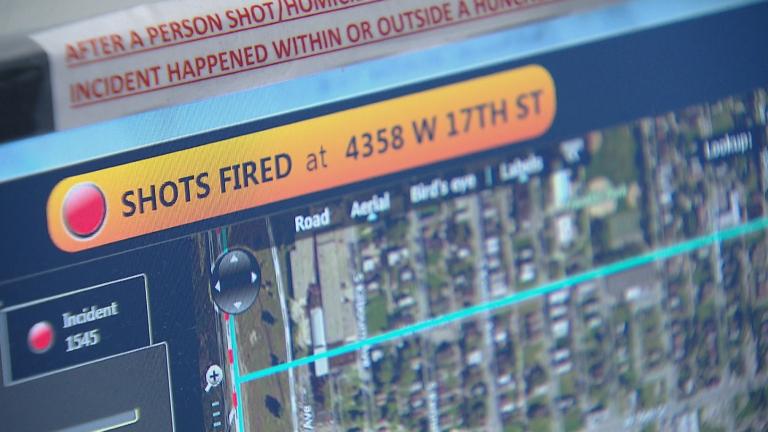
When Mayor Brandon Johnson scrapped the city’s controversial gunshot detection system, he defied critics who warned that without ShotSpotter, police officers would be unable to stop a wave of gun violence.
But nearly a year after officials turned off the microphones that sent an alert to police officers every time the system picked up suspected gunfire, a new analysis of Chicago crime data shows a steep drop in violent crime and homicides in the 12 South and West side neighborhoods that had ShotSpotter sensors until September 2024.
Police beats that had ShotSpotter sensors saw an approximately 17.8% decrease in violent crime and a 37.5% decrease in homicides during the first six months of 2025, as compared with the first six months of 2024, according to the analysis of Chicago crime data by Rob Vargas, a sociology professor at the University of Chicago who leads the UChicago Justice Project.
Citywide, incidents of violent crime dropped 17.7%, while the number of homicides dropped 30% during the same period, as compared with the same period in 2024, according to Chicago police data. The number of shootings was also down 30%, according to police data.
“Crime increases and crime decreases have become crazy politicized,” Vargas told WTTW News. “I wanted to put everyone’s hypothesis to the test.”
The analysis by the UChicago Project, which studies the politics of policing, is the first academic study to examine the impact the decommissioning of ShotSpotter on crime rates in Chicago. The system was not in use on Chicago’s North Side or downtown.
“This debate stirred up a lot of fear,” Vargas said. “Oftentimes, the politics of fear drives these decisions, and in the case of ShotSpotter, the fear was real, but unfounded.”
Twice in four months, the Chicago City Council rebuked Johnson and demanded that he reverse his decision to scrap the system, which he said leads to the overpolicing of neighborhoods home to a majority of Black and Latino Chicagoans.
The City Council attempted to give Chicago Police Supt. Larry Snelling the power to bypass the mayor’s office and directly ink a contract with SoundThinking, the firm that operates ShotSpotter. Snelling supported the use of the system, but did not openly defy the mayor, who appointed him and has the power to fire him.
The debate pinned Johnson between two major parts of his political base. Some progressive Chicagoans urged him to scrap the system, while some Black Chicagoans pressed city officials to do everything possible to reduce persistent levels of violence.
Johnson repeatedly said there is “clear evidence (ShotSpotter) is unreliable and overly susceptible to human error.” He blamed the system for the death of 13-year-old Adam Toledo, who was shot and killed by a Chicago police officer responding to an alert from the system in March 2021.
Johnson accused SoundThinking of exploiting Chicagoans’ fears of gun violence in an attempt to increase its revenue.
There was no evidence that ShotSpotter lived up to promises that it would reduce gun violence, Johnson said, calling it no more than a “walkie talkie on a pole.”
“City leaders deserve credit for pulling the plug on ineffective technology,” Vargas said.
Vargas said he decided to examine the impact of ShotSpotter’s removal after CWBChicago, a news organization that reports extensively on crime in Chicago, began keeping a running tally of the number of “people being found shot in areas previously served by ShotSpotter where the technology, had it not been dismantled, could have played a critical, helpful role.”
Johnson “stubbornly refused to reconsider his decision to dismantle the system even though the vast majority of aldermen, many citizens, victims’ advocates and his handpicked police superintendent asked for it to remain in place,” according to CWB Chicago.
That tally — dubbed “Brandon’s Bodies” — listed 54 people as of Wednesday, and includes those “found shot without corresponding 911 calls of shots fired and people being found shot in areas where 911 callers provided inaccurate or overly broad locations of gunfire,” according to CWB Chicago.
That is not a valid way of determining the impact of the removal of the ShotSpotter system, Vargas said.
However, CWB Chicago Managing Partner Tim Hecke told WTTW News via an email that while Vargas examined ShotSpotter’s value as a crime reduction tool, the “Brandon’s Bodies” tally was designed to measure the system’s “potential value in saving lives and speeding emergency response when shootings go unreported.”
ShotSpotter was never used to dispatch paramedics.
Under pressure from the City Council, Johnson’s administration agreed to consider proposals from firms to use technology to “ensure quick response by law enforcement authorities in emergency situations.”
City officials required gunshot detection systems to cover the entire city of Chicago and be able to report “incidents” to police with positional data within 60 seconds, with 95% accuracy, to help the city “improve detection of violent crime, expedite response times, improve the likelihood of obtaining forensic evidence and speed up medical response and first aid for victims.”
Eight firms submitted proposals for that contract, including SoundThinking, the Chicago Sun-Times reported in April.
A spokesperson for SoundThinking declined to comment on the drop in violent crime and homicide in parts of Chicago its system once operated in, citing its participation in the process that could lead to a new city contract.
Johnson declined Tuesday to tell reporters whether the drop in crime across the city after ShotSpotter was scrapped will prompt him to drop efforts to set up a new gunshot detection system in Chicago.
“If someone presents something to the city of Chicago that drives us towards building the most affordable big city, I’ll explore it, but at least there’s proof and evidence that in many of the areas in which technology used to exist, removing that technology did not prevent us from lowering crime in those areas,” Johnson said. “It has to work. That’s the bottom line.”
Johnson and Snelling have cited a number of reasons for the drop in crime and violence, including the expansion of violence prevention programs designed to stop shootings, carjackings, assaults or robberies before they happen by addressing what supporters say causes people to commit the vast majority of crimes in the first place: trauma, abuse and poverty.
One program, funded by both the state and city as well as philanthropic organizations, trains community members as to work as peacekeepers to prevent violence.
Police beats where peacekeepers are active saw a decrease in violent crime of 20.46%, beating the citywide average, according to Vargas’ analysis.
Snelling and Johnson have also touted efforts to concentrate resources in the most violent parts of Chicago, known as “hotspots.”
By identifying which police beats saw the highest number of investigatory stops — often referred to as stop-and-frisks — Vargas identified hotspots for crime and violence in Chicago and determined those beats saw a decrease in violent crime of 17.8%, in line with the citywide average, according to the analysis.
Contact Heather Cherone: @HeatherCherone | (773) 569-1863 | [email protected]
WTTW News coverage of policing and police reform is supported by The Joyce Foundation.