Crime & Law
Police Board President’s Pleas Fail to Break Stalemate Over Serious Police Discipline Cases
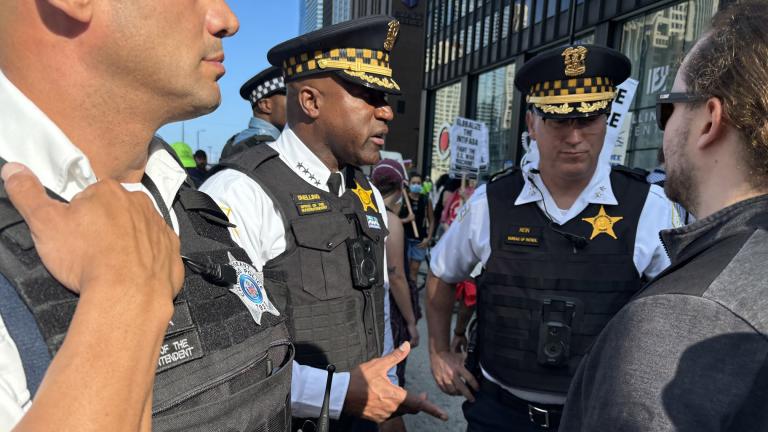
 (WTTW News/Michael Izquierdo)
Chicago Police Board President Kyle Cooper used the last two meetings of the board he presides over to plead with Chicago police officers facing allegations of serious misconduct: allow the Police Board to determine whether they should be terminated or suspended even as a protracted legal battle plays out.
“The members of the board are not ideologically driven and do not prejudge cases,” Cooper said June 18 and again on July 17, pledging to protect officers’ rights and ensure they get a fair hearing as quickly as possible. “Rather, we approach our role as neutral decision-makers — like baseball umpires — tasked with calling balls and strikes based solely on the evidence presented and the applicable law in each case.”
But there is no sign those pleas will break a legal stalemate that has lasted more than 16 months, keeping the system Chicago officials used for 60 years to hold officers accused of the most egregious misconduct in a deep freeze.
John Catanzara Jr., the president of Chicago’s largest police union, the Fraternal Order of Police, Lodge 7, said he will “not negotiate collective bargaining rights” with Cooper, or the head of any other city agency.
“It’s shameful that this administration and its puppets continue to fight a just interest arbitration process and award,” Catanzara said in an email to WTTW News, referring to the decision by an arbitrator during the most recent round of contract negotiations that would allow officers to elect to have serious discipline cases resolved in private by an independent arbitrator, selected with the approval of union leaders and city officials.
Mayor Brandon Johnson has said that decision would reduce public trust in the police department, and vowed to fight it.
“We have plenty of issues with the police board,” Catanzara said. “Many of them … repeat issues. Until those are fixed, it makes ZERO sense.”
The deadlock will continue until an Illinois appeals court determines whether officers facing termination or a 365-day suspension have the right to ask an arbitrator — and not the Police Board — to decide their fate and whether those proceedings should have to take place in public. That ruling could come at any time, since oral arguments took place more than a month ago.
But that decision is likely to be appealed to the Illinois Supreme Court, meaning the impasse could continue indefinitely, keeping 25 cases in limbo — including three that seek to terminate officers accused of killing Chicagoans without justification, including the officer that shot and killed 13-year-old Adam Toledo in 2021.
Chicago taxpayers have already paid a combined $13.75 million to resolve lawsuits filed by the families of the victims in the other two cases – even as both of those officers remain on the force, each earning nearly $112,000 annually, records show.
In 2024, the Police Board resolved just three cases after full evidentiary hearings after nearly two dozen officers followed the advice of their union leaders and opted to have an arbitrator decide their fate. By comparison, the Police Board held 14 full hearings in 2023, records show.
Since 2021, the Police Board ordered the officer terminated in approximately one-third of all cases, ordered a lesser penalty in another third of cases and found the officer not guilty of all charges in the rest, records show.
“These outcomes reflect a board that takes seriously its responsibility to impartially assess each case on its own merits and ensure due process is afforded,” Cooper said.
In the first and only case it heard this year, the Police Board declined to fire an officer who tested positive for cannabis in August 2021 as CPD Supt. Larry Snelling requested, ruling instead that the proper punishment was a 90-day suspension.
Two other officers facing termination for testing positive for cannabis declined to allow the Police Board to determine their punishment, choosing instead to wait for the legal process to be resolved.
If Cook County Judge Michael Mullen’s March 2024 ruling allowing an arbitrator to resolve serious cases of misconduct in a public session is upheld, city officials will have to set up an entirely new system to handle the most serious police misconduct cases.
Mullen also ruled that the city can stop paying officers facing serious discipline. The police union has also appealed that ruling.
Once the legal fight is over, it will likely take months for the Police Board to work through its now massive backlog.
25 Police Misconduct Cases in Limbo
The most high-profile case pending before the Police Board could result in the termination of Officer Eric Stillman, accused of violating department policy by shooting and killing 13-year-old Adam Toledo after a brief foot chase in March 2021.
The Civilian Office of Police Accountability, the agency charged with investigating police misconduct known as COPA, determined that Stillman should be fired, finding that he violated the department’s use of force policy by shooting the unarmed 13-year-old and violated his training on foot pursuits.
Former Chicago Police Supt. David Brown objected to that conclusion, instead recommending that Stillman be suspended for five days for failing to activate his body-worn camera when required.
That disagreement meant it was up to a randomly chosen member of the Chicago Police Board to determine whether Brown met “his burden of overcoming” then-COPA Chief Administrator Andrea Kersten’s recommendation.
Former Chicago Police Board President Ghian Foreman was randomly chosen to decide whether to uphold the superintendent’s decision or send the matter to the full board.
In October 2022, Foreman determined that Brown had not met his burden to overturn Kersten’s recommendation that Stillman be fired, sending the matter to the full Police Board for a full evidentiary hearing and public vote.
The Police Board was set to begin considering whether to terminate Stillman when the legal dispute erupted, suspending his case in the limbo where it remains.
Chicago taxpayers have already paid more than $1.7 million to fight a wrongful death lawsuit filed by the Toledo family, according to documents obtained by WTTW News through a Freedom of Information Act request.
A trial date has not been set for the Toledo lawsuit. Stillman has asked that his disciplinary case be decided by an arbitrator.
Also facing termination is Chicago Police Officer Alberto Covarrubias, who shot and killed Michael Craig in October 2021 after Craig called 911 for help while being threatened by his wife, who had a knife.
When Covarrubias arrived at Craig’s home, he was holding his Taser and his gun. As he entered, Covarrubias simultaneously fired his gun, killing Craig, according to the lawsuit filed by Craig’s family.
In December 2023, the Chicago City Council agreed to pay $8.75 million to resolve that lawsuit, one of the largest settlements in a case that did not involve a wrongful conviction in recent years.
Covarrubias has asked that his disciplinary case be decided by an arbitrator.
The Police Board also considered firing Covarrubias in 2019.
In 2018, former Chicago Police Supt. Eddie Johnson recommended Covarrubias be fired for threatening an officer while he was being detained after a drunken altercation with a woman and refused a direct order to take a breathalyzer test. That incident took place in 2016.
In August 2019, the Chicago Police Board found Covarrubias committed eight rule violations but declined to follow Johnson’s recommendation that he be terminated. Instead, Covarrubias was suspended until he could present evidence that he was fit for duty.
The Police Board unanimously reinstated Covarrubias as a police officer in November 2019 after he completed treatment for alcohol addiction, according to police board records.
Covarrubias remains a Chicago police officer, earning $111,800 annually, according to the city’s employee database.
Also facing termination is Officer Adolfo Bolanos, who shot and killed 17-year-old Michael Elam Jr. in February 2019. Elam was shot by Bolanos three times: twice in the back and once in the back of his head.
COPA recommended Bolanos be fired for shooting Elam, failing to turn on his body camera, failing to immediately notify dispatchers of the shooting and failing to immediately request medical attention for Elam.
Brown disagreed with that recommendation, recommending Bolanos be suspended for 10 days. That sent the matter to the Chicago Police Board.
Foreman determined Brown did not meet his burden to overturn COPA’s recommendations. Bolanos has asked that his disciplinary case be decided by an arbitrator.
In November 2022, the Chicago City Council agreed to pay $5 million to resolve the lawsuit filed by Elam’s family.
Bolanos remains a Chicago police officer, earning $111,800 annually, according to the city’s employee database.
In addition to those cases, five other officers face lengthy suspensions or terminations for using excessive force against members of the public, police board records show.
Another five officers face termination after being accused of committing domestic violence, police board records show.
Three other officers are facing charges of violating department rules by failing to get vaccinated against COVID-19, police board records show.
WTTW News coverage of policing and police reform is supported by The Joyce Foundation.
Contact Heather Cherone: @HeatherCherone | (773) 569-1863 | [email protected]